
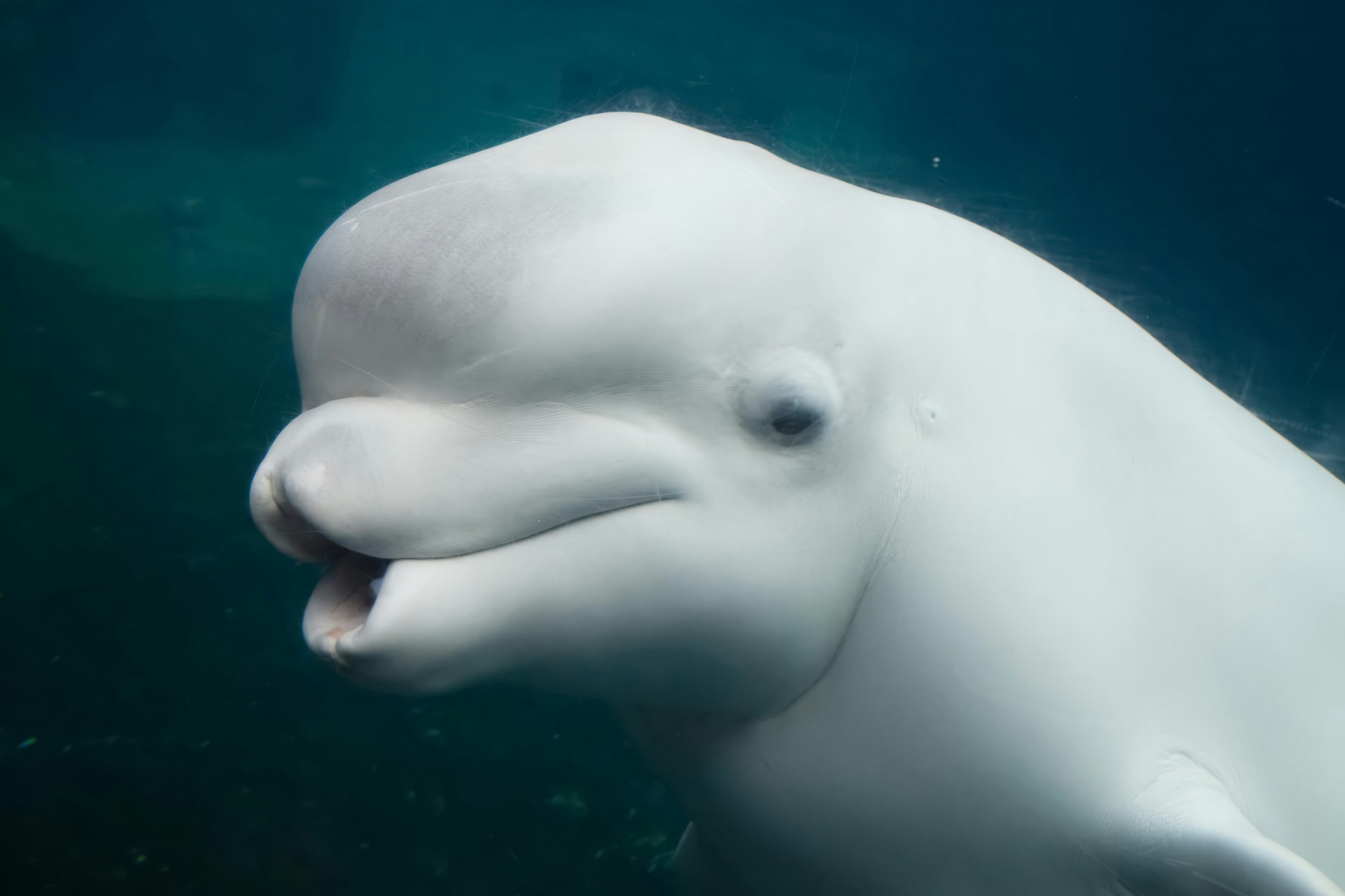
More than twenty years ago, a beluga whale looked at herself in a mirror at the New York Aquarium — and realized that the mark behind her right ear was not normal. Researchers have only now published these results. Natasha, now 42 and still alive in Connecticut, has entered the very exclusive circle of animals capable of self-recognition.
What you will learn
- How the mirror test works and why it is regarded as a measure of self-awareness
- What Natasha did in front of her reflection that her daughter Maris failed to replicate
- Why these twenty-year-old results were published only now — and what they imply for beluga protection
The mirror test: a mark on the chin and a big question
If you have ever discreetly wiped a mark from your face upon catching a glimpse of your reflection, you have demonstrated something remarkable: you know that this reflection is you.
Scientists call this self-recognition. And they use it as an indicator of a form of consciousness similar to our own.
The protocol is simple: a non-toxic mark is applied to a part of the animal’s body that it cannot directly see. If, facing the mirror, the animal orients this area toward its reflection and attempts to interact with it, it has understood that the image belongs to itself.
Chimps, dolphins, elephants, magpies — and even a small tropical fish known as the cleaner wrasse — appear on this exclusive list. Belugas may have just joined them.
Glass turned into mirrors, whales watching themselves
At the New York Aquarium, Diana Reiss and her team temporarily transformed the tank glass into reflective panels. The belugas could see themselves. The researchers could observe without being seen.
Four females took part in the experiments: Kathy, Marina, Natasha — captured in the wild — and Maris, Natasha’s daughter, born at the aquarium in 1994.
The first phase focused on spontaneous behaviors in front of the reflection: nodding, neck-stretching, and most notably a curious behavior — blowing a bubble through the blowhole, then biting it while watching the mirror, as if observing its own action in real time.
Natasha and Maris stood out clearly from the other two. They seemed to use the mirror as a tool to observe themselves.
The mother succeeds, the daughter fails
The second phase was decisive. The caretakers applied a temporary mark on body regions that belugas could not see without a reflection.
Natasha oriented the marked area — behind her right ear — toward the mirror, while displaying a suite of self-directed behaviors. She had grasped that something on her own body deserved attention.
Maris, by contrast, did not reach this step. She exhibited self-directed behaviors in front of the mirror, a sign of possible self-awareness, but never oriented the marked area toward her reflection.
The mother was self-aware. The daughter, not quite — or not yet.
Twenty years later, a beluga still alive
These experiments took place more than twenty years ago. The researchers hoped to conduct follow-up studies with other belugas before publishing. That did not happen.
They eventually digitized their original video recordings to analyze the behaviors, and published their results in PLOS One in 2025.
Maris died in 2015 at the age of 21. Natasha, meanwhile, is still alive. Now about 42, she resides at Mystic Aquarium in Connecticut — one of the oldest belugas in captivity.
The beluga that looked at herself in a mirror twenty years ago and understood what she was seeing is still around.
