
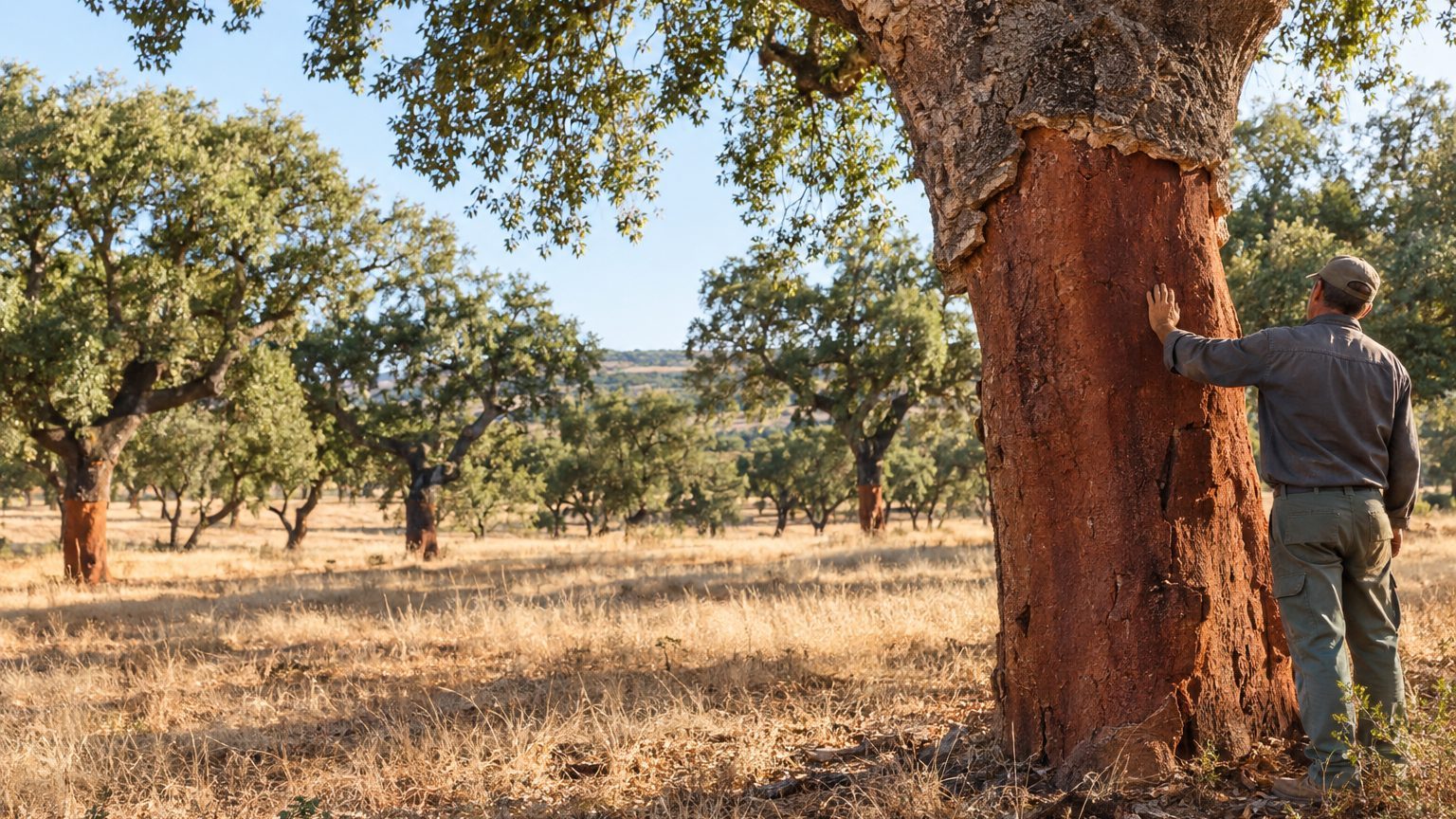
After harvest, a single digit is painted on the tree: the last year of extraction. It appears on the brick-red trunk of a cork oak in Alentejo, and it might be from this very tree that the cork stopper you’ll open this weekend comes. A “6” signifies 2026, and no one will come to scratch this tree again before 2035.
- A single digit, from 0 to 9, is painted on the trunk after each harvest.
- A cork oak can be debarked only after a nine-year interval.
- Portugal produces about 50% of the world’s cork.
- A tree can be harvested up to 15 times over a life of around 200 years.
An axe, a summer, a number painted in white
The harvest takes place every year from late May to August, and much of it is still done by hand. The debarkers strike the bark with a hatchet, making a long vertical cut followed by horizontal slices, then peel away the cork sheets. They are left at the base of the tree and gathered the next day. Once the bark is removed, the trunk reveals a deep red color that darkens with the years.
The crews then paint a single digit, from 0 to 9, which corresponds to the last year’s final number. A Port wine producer in the Douro valley marked his trees with a 0 in 2020, with the next harvest planned for 2029.
A tree marked with a 6 this year will be revisited with the ax in 2035.
The digit stays legible throughout the cycle, because the bark grows from the inside out. Estate managers can thus spot, at a glance, among the fields, the trees ready for the next season.
No fully mechanized alternative matches the precision of the gesture, and the know-how is handed down from one generation to the next.
43 years before the first cork for bottling
A cork oak is first harvested when it reaches maturity, around 25 years old. This initial cork, called “virgin cork,” is too rough to seal a bottle of wine. The second harvest, nine years later, yields a cork more uniform, but the cork for bottling that most people recognize comes from the third harvest. The calculation is simple: 25 + 9 + 9 equals 43 years.
A tree that provides cork for bottling this year therefore germinated no later than 1983. Researchers are meanwhile working to accelerate the first harvest, to select the best plants and to increase productivity without disturbing the ecosystem. For now, the forest keeps its rhythm, and the cork reader must adapt to it.
The tree stays standing, Portugal dominates
Debarking most trees kills them, because the act tears away the cambium, which makes new conductive tissues, and the phloem that carries sugars. Cork can be removed without harming the cambial layer. The tree thus continues to live, and a single oak can produce cork for over 150 years.
With a life expectancy of about 200 years, a cork oak can be harvested up to 15 times. In the montados of Alentejo, where oaks mingle with meadows, grain fields and grazing areas, the forests follow annual and rotating harvest cycles. Each summer, a portion of the trees are debarked, and the rest wait their turn.
Portugal produces roughly 50% of the world’s cork.
The industry that results from this operates on an scale that’s hard to imagine: the Amorim group makes more than 5.5 billion corks per year. That’s more than 80 corks for every person in France, even babies. And each one started as a bark plaque peeled off with a hatchet somewhere beneath a numbered tree.
Portuguese regulations would forbid debarking a tree less than nine years apart and would require inscribing the year with indelible ink, according to public texts consulted. These rules aim to give the bark time to regenerate fully between harvests.
The digit changes with each cycle, since nine years do not complete a full turn of the dial. A tree marked 6 in 2026 will bear a 5 in 2035, then a 4 in 2044. The one that received its 0 in 2020 will be debarked again in 2029, and the digit painted on it then will be a 9.
Sources: winewithseth.com | epic.travel
