
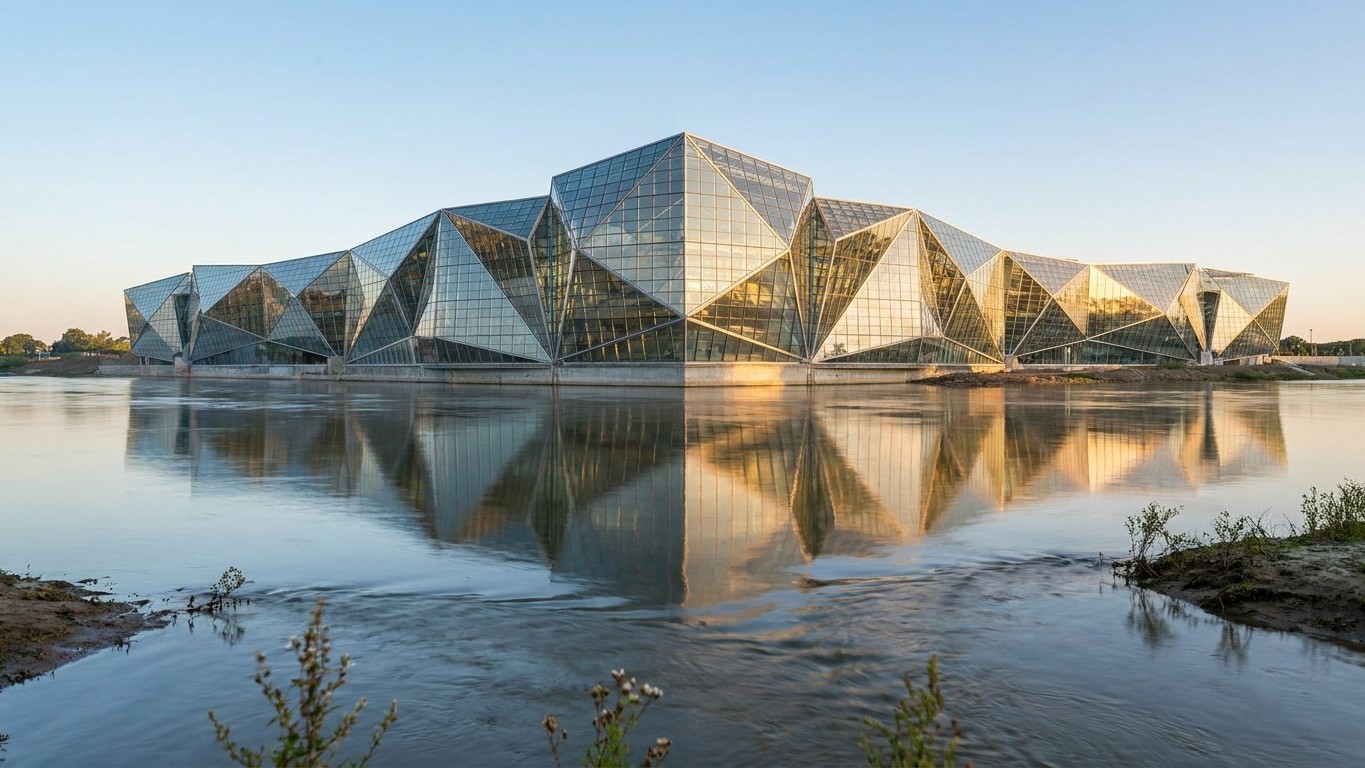
A glass-and-steel vessel 190 meters long, moored at the southern tip of Lyon’s Presqu’île, where the Rhône meets the Saône. The Confluences Museum was supposed to cost €61 million. It ended up swallowing far more, becoming one of the most cited symbols of budget drift in large French cultural projects.
Key takeaways
- A museum whose initial budget was multiplied by more than five in less than 15 years
- Successive redesigns and a change of contractor transformed a project into an endless soap opera
- A paradox: despite the controversy, the building attracts more visitors than expected and shows a healthy financial outlook
A project approved in 2000, a budget that exploded by 2003
Everything begins in July 2000.
The amount did not hold for long. By 2003, the bill rose to more than €91 million. In 2006, it surpassed €150 million. Two years later, it nearly reached €180 million. Then, in 2011, a thunderclap: the overall envelope was raised to €239 million. The General Council attempted to justify the inexplicable by citing “the termination of the Bec contract, the supplementary remuneration of the project manager, another amendment regarding insurance, and unforeseen additional works.” A dodge that poorly masks the reality: at the time of the change of contractor, the bill climbed by almost €80 million, even though Michel Mercier had promised that it would not need to be re-evaluated.
The crystal cloud that derailed the project
The building itself germinated the project’s difficulties. Designed by the Viennese firm Coop Himmelb(l)au, it adopts a deconstructivist architecture that was unprecedented in France: a complex metal structure, nicknamed the “Cloud,” grafted onto a crystal base with multi-faceted façades. This technical feat, unlike any other French edifice, required successive design revisions during construction, each structural adjustment bringing its share of extra costs and delays.
The mid-project change of company, with the termination of the contract linking the department to its initial builder, completed turning an already tight schedule into an endless soap opera. The construction site was long mocked for its slowness, having undergone several stoppages since its 2000 launch, as Lyon Mag notes. Fourteen years separate the decision to build, taken in 2000, from the building’s inauguration in December 2014. A delay that raises questions, given that comparable museums, such as Centre Pompidou-Metz, opened in a fraction of that time.
What the regional chamber of accounts says
It took until 2024 for an official report to settle the accounts of the past. The Auvergne-Rhône-Alpes Regional Chamber of Accounts, in a report published in October 2024, confirms that the Rhône General Council committed €314 million to the museum’s construction before handing over the keys to Lyon’s newly formed Metropolis in 2015. This amount includes the scenography, the surroundings, and landscaping, and places the overshoot well beyond the first reassessment in 2011.
The report does not stop at this accounting finding. It highlights a persistent anomaly: the Metropolis of Lyon remains, to this day, the sole funder of the establishment, a situation that makes the museum an institution with no effective cooperation with the city of Lyon and other local authorities, nor with the State, which should participate given its regional and national influence. The financial judges recommend involving the State and the Region in the governance of the institution. Notably, this same report dispels the idea of a perpetual financial abyss: focusing on the museum, which attracts more than 630,000 visitors per year, the financial judges praised a “healthy financial situation.”
A popular success that contradicts the critics
Here lies the paradox of the Confluences Museum. While the construction site was mocked, attendance belies the gloomiest forecasts. Since its opening in December 2014, the institution has surpassed 7,100,000 visitors, of whom 64% come from the Auvergne-Rhône-Alpes region. In 2025, it welcomed 699,387 visitors, averaging 2,192 entries per day, compared with 708,965 in 2024. Two years that rank among the best since opening.
The growth of international visitors accompanies this momentum. The share of foreign visitors continues to rise, from 15% in 2024 to 17% in 2025, with a predominance of neighboring nationalities: Italy, Germany, Switzerland, and Spain. A sign that the Lyonnais “Cloud” has finally established itself well beyond the budget controversy that marked its birth. The museum has thus become, with its three million objects, the largest museum in France located outside the capital.
One ironic note remains hard to erase: when the museum’s director hoped in 2014 to reach 500,000 visitors per year to help bury the cost polemics, no one imagined that this figure would be surpassed by nearly 200,000 entries a decade later, even as the Metropolis of Lyon reduced the museum’s annual subsidy by one million euros in 2024.
Sources: lyonpoche.com | tribunedelyon.fr | lyoncapitale.fr
