
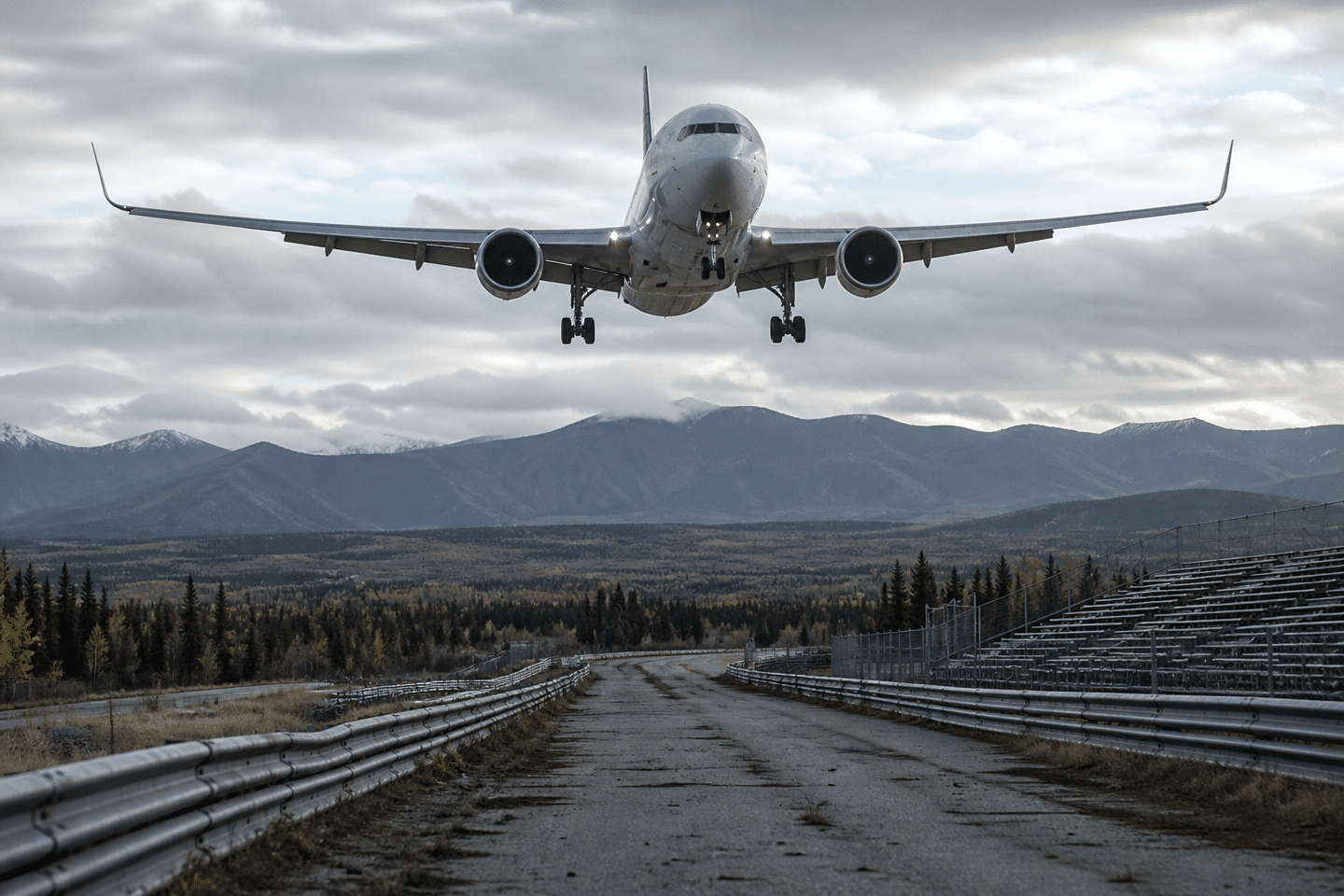
Could a Boeing 767 fly with no fuel at all? At an altitude of 12,500 meters above Manitoba, the question is far from theoretical. The two engines shut down one after the other. Aboard, 69 people. On the ground, a former military airfield repurposed into a race track. The story may seem unlikely, but it is very real.
- A conversion error between pounds and kilograms left the Boeing 767 with only half the fuel required to reach Edmonton.
- At 41,000 feet, both engines shut down, forcing the pilots to glide without power for seventeen minutes, thanks to the captain’s gliding experience.
- The aircraft landed with no serious injuries on the former Gimli military base, converted into a race track, where a family day was taking place that day.
- A metric conversion error at the root of the disaster
- When a Boeing 767 becomes a 132-tonne glider
- Gimli, the former military base transformed into a rescue strip
A metric conversion error at the root of the disaster
It all begins with a seemingly minor technical detail. Before takeoff from Montreal, the crew notices that the aircraft’s fuel gauge is out of service. It is impossible to rely on the on-board computer to know the amount of kerosene aboard. The maintenance team must then calculate the load by hand, as it was done before the digital era.
That is where the trap closes. Canada had just shifted to the metric system, but Air Canada’s older Boeings still operated in imperial units. For this newly delivered 767, just released in March 1983, calculations had to be done in kilograms. A conversion factor was misapplied: 1.77 pounds per liter instead of the expected 0.8 kilograms per liter.
The consequence is dizzying. After the Ottawa layover, the tanks contain only 9,144 kilograms of kerosene, while the pilots believe they have 20,400. The crew thus received barely half the fuel required to reach Edmonton, without anyone aboard realizing it until it was too late.
When a Boeing 767 becomes a 132-tonne glider
At 41,000 feet, alarms go off. First one engine shuts down, then the second a few minutes later. Captain Bob Pearson and co-pilot Maurice Quintal find themselves at the controls of a long-range airliner weighing more than 130 tonnes that no longer produces any thrust. With no engine power, there is no normal electricity, no powered hydraulics, and instruments reduced to the bare minimum.
A commercial airliner is not designed to glide, but physics leaves no choice. Without thrust, the aircraft continually loses altitude, much like a kite whose string has been released. Fortunately, Bob Pearson spent his spare time practicing sailplane flying, an experience that would prove decisive in the minutes that followed.
As the approach to the runway nears, the aircraft comes in too fast and too high to land normally. Pearson then performs a wing slip, a maneuver borrowed from sailplane flying that makes the aircraft drift sideways to increase drag. This technique allows rapid loss of speed and altitude, without any engine power.
Gimli, the former military base transformed into a rescue strip
The choice of landing ground is almost a matter of chance. Maurice Quintal recalls a former Royal Canadian Air Force aerodrome at Gimli that he had frequented during his military service. What the crew does not know is that one of the two runways had been turned into a car circuit and was hosting, that day, a family day organized by a Winnipeg club.
After seventeen minutes of silent gliding, the 767 finally touches down. Spectators and race drivers must quickly clear the runway as the aircraft brakes on the asphalt, its nose slightly drooping because the nose gear had not fully deployed. None of the 69 occupants is seriously injured, a ending that few would have dared predict just minutes earlier.
The place had already flirted with auto racing in the past. In June 1975, Gimli Circuit saw Gilles Villeneuve score his very first Formula Atlantic victory, driving his March 75B. Eight years later, it was a fuel-free airliner that wrote another page in the history of this improbable circuit.
The aircraft, quickly nicknamed the Gimli Glider, was repaired and put back into service. It would fly for another quarter of a century, until 2008, before being stored in California’s Mojave Desert and eventually dismantled. Put up for auction in 2013 with an estimated value around three million Canadian dollars, it found a buyer only for 425,000 dollars, and the lot remained unsold. A relatively quiet ending for an aircraft that proved that a simple unit error could turn a passenger jet into a glider, and extraordinary calm into a real bulwark against catastrophe.
