
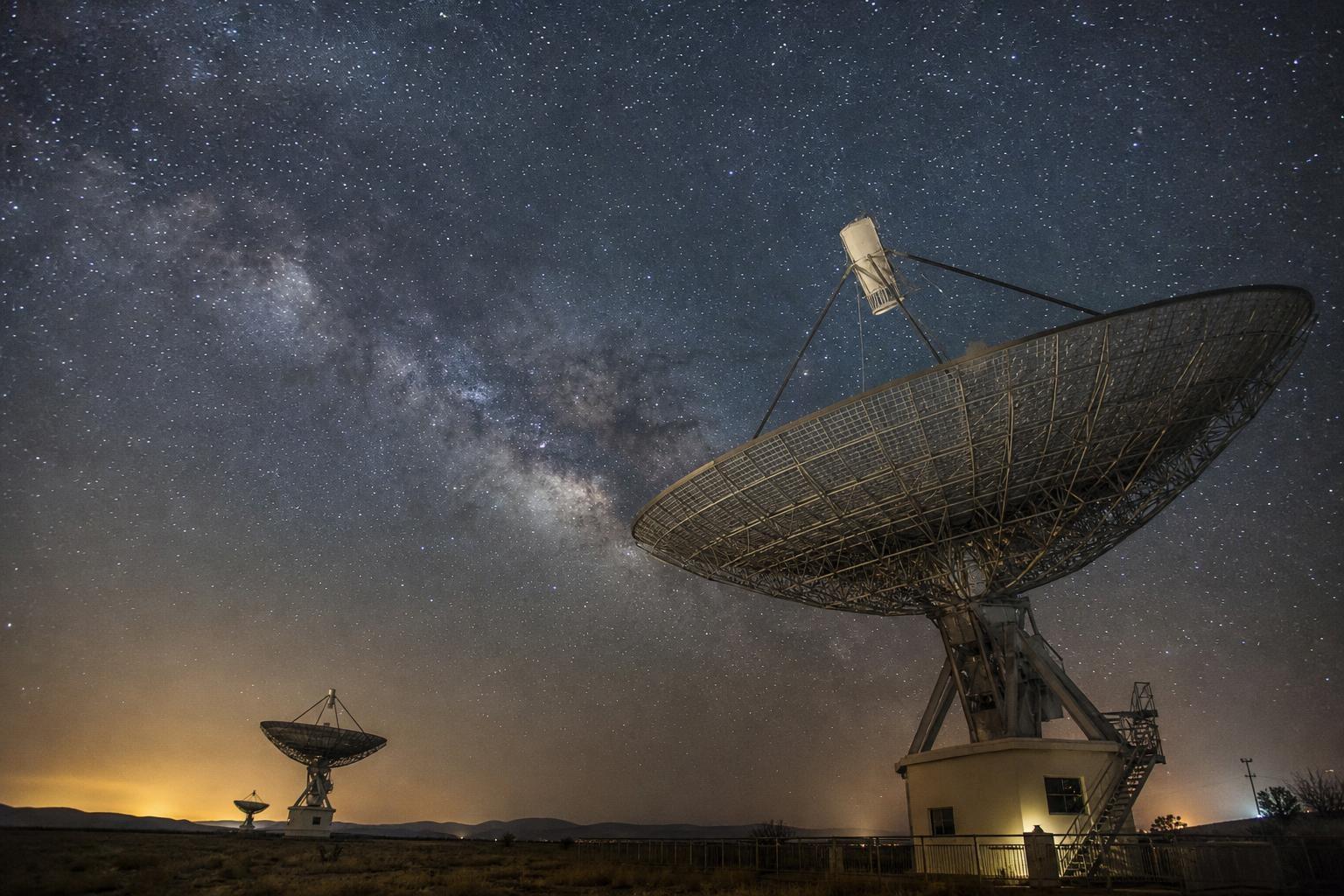
The night sky just blinked, and a radio telescope caught it. A faint, persistent signal keeps arriving with unnerving punctuality—every 18 minutes—like a metronome someone left ticking in the cosmos. Astronomers ran the numbers, scrubbed the noise, and stared at the screen. The pulse stayed true.
No one is ready to call it a discovery of something alien, but the mystery is thick enough to taste. “We checked every usual suspect,” one researcher said, “and the pattern keeps refusing to fit.” It’s steady, stubborn, and strange.
The 18-minute heartbeat
Most cosmic clocks spin faster. Pulsars flick like sewing-machine needles, slicing microseconds into bright blips. This one lingers, taking long, patient breaths, as if time itself were stretching its legs. Eighteen minutes, pause, repeat, without drift.
That kind of interval is awkward for known compact objects. It’s too slow for classic neutron stars, too disciplined for messy magnetic storms. And yet the pulses arrive with discipline, like a lighthouse through quiet fog.
A puzzle for astrophysics
Theories piled up, but each one snagged. An ultra-long-period magnetar could, in principle, cough at low frequencies, but the timing feels almost too clean. A white-dwarf pulsar might do it, but those are vanishingly rare.
Then there’s the provocative option nobody wants to lead with: engineered signaling. Scientists hate jumping to aliens, because nature is devious and endlessly inventive. Still, the open question remains, and the room stays quiet when it’s asked.
How the signal was found
The detection came from a low-frequency array, spread like metal wildflowers across red earth. Night after night, the software combed static, flagging patterns that refuse to smear. This one rose above the hiss, unafraid.
Engineers walled off human-made interference, cross-checking time, direction, and polarization clues. Aircraft, satellites, and downlink bleed were culled by careful filters. What remained pointed skyward, beyond commercial traffic, into genuine deep-space quiet.
What makes it different
The pulse is highly polarized, which screams magnetism, not mundane machinery. Its dispersion measure hints at distance, electrons draping the path like gauze on a long, cold road. Far, but not impossibly far.
Brightness waxes and wanes, yet the beat stays loyal. The spectrum favors low frequencies, sand-bottom tones that seep through the ionosphere. You can almost hear the bass, if you could listen with miles instead of ears.
Shortlist of suspects
- An ultra-long-period magnetar, rotating lazily with twisted magnetic fields
- A white-dwarf pulsar, a rare clock built from exhausted stellar embers
- A precessing neutron star, wobbling like a slightly unbalanced top
- An unknown class of transient, an object physics has not yet named
Voices from the control room
“We’re not chasing fantasy,” says a weary but smiling observer. “We’re chasing the data, and the data keep pointing to a clock in the dark.” The team shares screens, coffee, and skeptical joy.
Another scientist shrugs and grins: “If it’s a new kind of star, wonderful. If it’s a new kind of noise, we’ll still learn something. But if it’s neither, then buckle your seatbelt.”
Next steps and sharper eyes
Follow-up campaigns are already spinning. Telescopes at higher frequencies are listening, while X-ray and optical scopes scan the neighborhood for a counterpart that flares. Coordination across hemispheres tightens the net.
Very Long Baseline Interferometry could nail the position to a pinprick, letting theory finally grip rock instead of vapor. If the pulses scatter differently across bands, the culprit narrows its own profile.
Why this matters
Every odd signal redefines the possible. Decades ago, pulsars were dismissed as “scruff” on the tape, then crowned as celestial clocks. Fast radio bursts burst in, got weirder, then became a thriving field. This could be that moment again.
A slow, repeating radio pulse might rewrite pieces of stellar evolution, or magnetic physics, or emission geometry. Or it might introduce us to an object that sits between known boxes, smiling at our tidy labels.
The human part of the story
Someone had to trust the anomaly, to not shrug at a neat coincidence and file it away. Curiosity does that—it taps your shoulder, then insists you keep watch. “Keep watching,” the screen whispered. They did.
Perhaps this is a new member of the galactic choir, a baritone that takes its time and nails the note. Perhaps it’s a puzzle piece from a box we never opened. For now, the clock keeps ticking—and we keep listening.
