
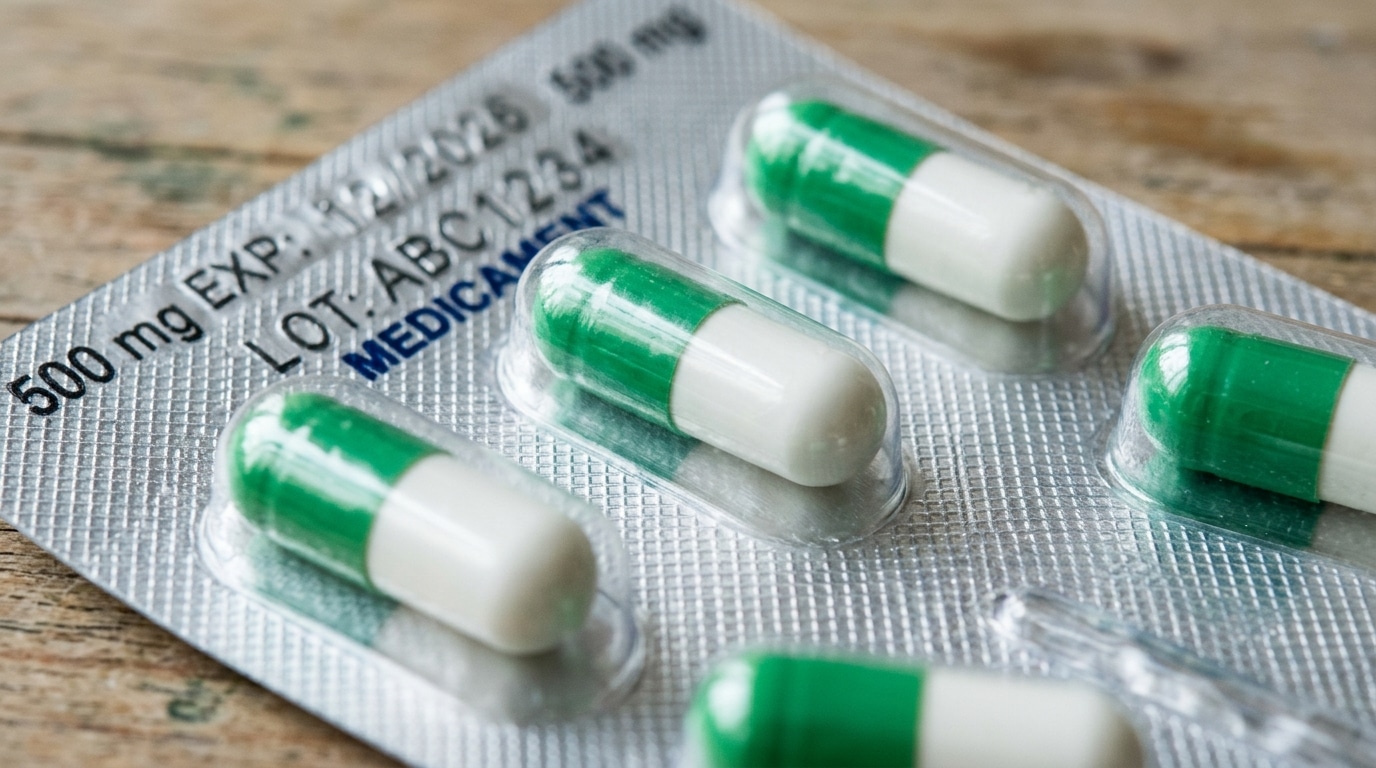
Many French people believe they have permanently banished titanium dioxide from their daily lives since its prohibition in candies, pastries, and other confections. A fairly widespread misconception, and yet understandable given how the messaging around this ban could have suggested a total eradication. For this white colorant, known under the code E171, it has in fact disappeared from only one shelf: that of food. In medicine cabinets, it continues to maintain a perfectly legal, discreet existence, quietly slipped into the coating of thousands of medications. This reasonably justifies asking: how can a substance deemed sufficiently problematic to be banned from food still coat our most ordinary tablets?
- Titanium dioxide (E171), banned in food since 2022, remains allowed in over 4,000 medicines due to lack of validated alternatives, according to the European Medicines Agency.
- The Avicenn association took the European Court to challenge this continuation in October 2025, citing more than 30 scientific studies pointing to inflammatory and immune risks and a possible carcinogenic classification since 2007.
- To limit exposure, it is advised to check the packaging insert, favor effervescent or oral liquid forms, consult your pharmacist, and never stop a treatment on your own initiative.
- A colorant banned from the plate yet still present in medicine
- What scientific studies reveal about ingested nanoparticles
- How to identify and avoid titanium dioxide in your treatments
A colorant banned in food but still present in medicine
The premise is striking. Titanium dioxide has been banned in foodstuffs in France since January 2020, an interdiction extended to the entire European Union since August 2022. Concretely, since August 8, 2022, it has been impossible to produce or import any food containing this white colorant into the EU. Yet this same colorant remains fully authorized in another domain just as intimate: the medicines we swallow every day. According to 60 Millions de Consommateurs, the pigment would still be present in more than 4,000 medicines, and not the least ones. It is used notably to make the shells of capsules and to coat tablets, including standard varieties of ibuprofen, paracetamol, and cetirizine. In other words, over-the-counter analgesics that sit in almost every family medicine cabinet. This regulatory disparity naturally fosters a certain confusion among patients, who struggle to understand why a molecule deemed undesirable in a biscuit would suddenly be acceptable in a pill.
The explanation actually lies in a balance between precaution and continuity of care. The use of titanium dioxide in medicines remains allowed as long as safe replacement solutions have not been found, the stated aim being to prevent drug shortages that would harm public health. The European Commission had thus given three years to drug manufacturers, starting in 2022, to propose credible alternatives, which would then be evaluated by the European Medicines Agency. Problem: an analysis by that same agency, published in April 2024, concluded that there were to date no viable alternative to replace titanium dioxide in the affected treatments. As a result, on August 4, 2025, the European Commission published a working document affirming the continued use of it in medicines. A decision that, one can imagine, did not exactly reassure consumer-protection groups.
What the studies reveal about ingested nanoparticles
If the debate has become so heated, it is not a mere regulatory whim. Studies conducted in animals and in cell cultures point to real risks associated with ingesting titanium dioxide nanoparticles: immune, inflammatory, and metabolic disorders are regularly mentioned in the scientific literature. As a reminder, as early as 2007, the International Agency for Research on Cancer classified titanium dioxide as possibly carcinogenic to humans, a classification that is by no means trivial and bears significant weight in the equation. In response to these signals, the Avicenn association does not intend to sit idly by. It has compiled more than 30 recent scientific articles which, in its view, were not taken into account by either the European Commission or the European Medicines Agency during the renewal of the authorization. A meticulous undertaking that led to concrete action: the association filed a case with the European Court in October 2025 to challenge the conditions under which the continued use of E171 was decided, with the support of similar associations in other European countries. This legal process could stretch over several months, or longer, while the court weighs the solidity of the documentary base that justified this prolongation. Until a possible verdict, a common-sense rule applies: it is strongly discouraged to interrupt a treatment on your own, even in the face of legitimate concerns raised by these revelations.
How to identify and avoid titanium dioxide in your treatments
Good news amid this regulatory ambiguity: there are concrete ways to check whether a medicine contains titanium dioxide, and sometimes even to avoid it altogether. The first reflex to adopt: whenever medically possible, prefer effervescent forms, powders, or oral solutions, which generally do not contain TiO2. Creams, on the other hand, may contain it, but the risk is deemed lower since they are not ingested. For standard tablets and capsules, several avenues allow you to investigate on your own. Consulting the insert remains the most accessible starting point, looking for mentions of titanium dioxide or E171 in the list of excipients. The pharmacist also remains a valuable interlocutor, able to quickly inform about the composition of a treatment. For the curious, the QR code on the box can also direct you to additional information, just as the public medicines database, which allows searching for a product by its International Nonproprietary Name before consulting its Summary of Product Characteristics. One detail to note: titanium dioxide is not considered a notable excipient, so it does not automatically appear on the packaging, except in rare cases, as with Titanoreïne cream where it is clearly listed among the ingredients. For those wishing to find a TiO2-free alternative, it is better to search by International Nonproprietary Name rather than by brand name, a somewhat laborious approach but often more effective. Here are the main precautions to reduce exposure to titanium dioxide:
- Prefer, when possible, effervescent forms, powders, or oral solutions
- Carefully read the list of excipients in the insert
- Ask your pharmacist for advice before changing treatment
- Scan the QR code on the box or consult the public medicines database
- Search for an alternative by International Nonproprietary Name rather than by brand name
As long as the legal case brought by Avicenn has not reached a conclusion, prudence remains wise, without giving in to panic. Abruptly stopping a treatment out of fear of titanium dioxide could cause more harm than the suspected risk itself. Staying informed, discussing with your pharmacist, and favoring, whenever health permits, TiO2-free alternatives remains probably the most balanced approach while science and the courts provide clearer answers.
