
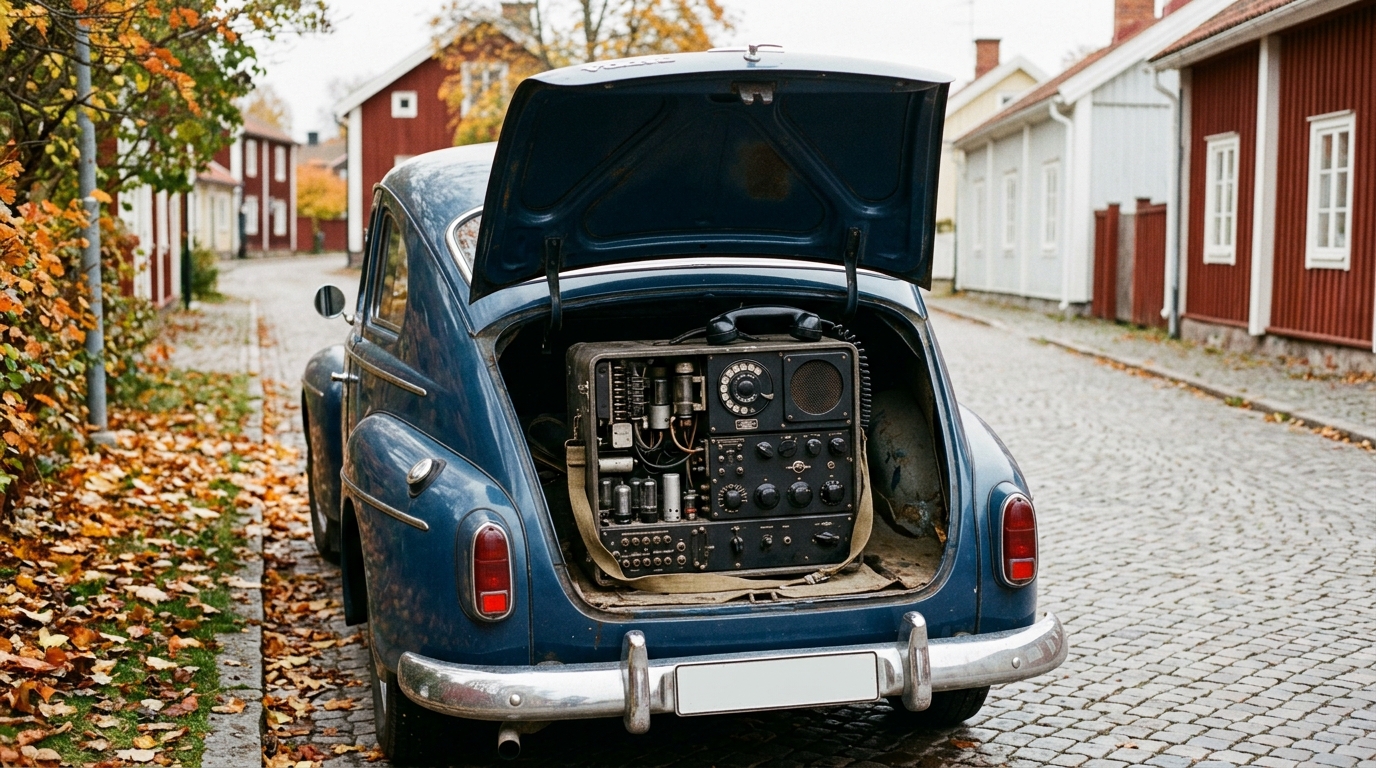
What if the first “real” mobile phone wasn’t a touchscreen smartphone, but a 40-kilogram suitcase tucked away in a car trunk? In Sweden, as early as 1956, this object truly existed. Its failure wasn’t due to its weight or its size, but to a reason far more subtle.
- The MTA by Ericsson, launched in 1956 in Sweden, weighed 40 kg and was stored in car trunks with a handset connected to the dashboard.
- The system was limited to 100 vehicles per base station and to 1,000 lines nationwide because of five-digit numbers starting with 95.
- Reserved for a few hundred wealthy subscribers such as lawyers and doctors, the MTA operated until 1962 before being replaced by the MTB, which remained in service until 1983.
- A car trunk transformed into a telephone exchange
- The real culprit isn’t the kilos but the network
- Six years of service for a handful of privileged people
- What the MTA left to today’s smartphones
Today it’s hard to imagine a phone that won’t fit in a pocket. Yet, in the autumn of the postwar boom, the very idea of making a call from your car bordered on science fiction made real. This crazy bet was daringly pursued first by the Swedes, with a device as massive as it was ingenious. Here is a story that remains little known, shedding new light on our current smartphones.
A Car Trunk Transformed into a Telephone Exchange
We are in Stockholm, where Ericsson is about to bring to market an object that will leave a lasting mark on the history of telecommunications: the MTA, for Mobile Telephone System A. This system, initially designed by an engineer named Lauhrén, bore his name before being renamed in a more modest fashion. Technically, the device weighed roughly 40 kilograms and carried the imposing footprint of a large briefcase. Impossible, therefore, to slip it into a jacket pocket: it had to be literally installed in the car’s trunk, with a handset linked to the dashboard to enable the driver to place calls.
The manufacture of this technological behemoth relied on a fairly precise division of labor. Ericsson supplied the telephone exchange, while two other companies, Svenska Radioaktiebolaget (SRA) and Marconi, produced both the onboard phones and the base stations responsible for capturing the signal. A true craftwork for the era, which testifies to an impressive technological ambition given the resources available in the 1950s.
The Real Culprit Isn’t the Kilos but the Network
One might reasonably think that a device so heavy and bulky was doomed to fail. Wrong. The real problem with the MTA lay not in its weight but in the structural limits of its network. Each base station could technically handle only 100 vehicles per covered area, a cap deemed reasonable at the time for a single radio cell, but which would soon prove far too restrictive.
This technical constraint was matched by an equally stifling administrative limit: subscribers received five-digit numbers that always started with 95, which mechanically capped the total number of subscriptions at 1,000 lines for the entire country. In other words, a drop in the ocean compared with the real needs of a vast and sparsely populated Swedish territory. So the system wasn’t doomed by its onboard mechanics, but by its inability to expand and cover the entire national territory efficiently.
Six Years of Service for a Handful of Privileged People
The MTA was never a mass-market product, far from it. Its installation cost, added to the price of the equipment itself, could reach almost the price of the car in which it was installed. A colossal investment that naturally reserved this innovation for a very limited clientele: only a few hundred subscribers, mainly lawyers and doctors, professions for whom staying reachable while on the move represented a decisive professional advantage.
The service operated from 1956 to 1962, six years during which this handful of privileged users could savor, ahead of everyone else, the still-unprecedented pleasure of making telephone calls from their car. According to Televerket archives, the historic Swedish operator, the MTA was then replaced by a second-generation system named MTB, which remained in service until 1983. This transition confirms, if there was any doubt, that abandoning the MTA was indeed tied to the deployment of a more capable relay infrastructure, not to any issue of weight or bulk of the device.
What the MTA Left to Today’s Smartphones
It would be tempting to reduce the MTA to a mere curiosity of Swedish engineers a little too ahead of their time. Yet, this device laid the conceptual foundations for everything that followed. The very idea of a mobile telephone, a term that officially appeared at its commercial launch, would traverse decades to become the universal vocabulary we still use today.
More fundamentally, the MTA highlighted a truth that remains valid for our smartphones today: it isn’t merely the miniaturization of hardware that determines a technology’s success, but the capacity of the network to absorb demand. Each generation of mobile telephony, from 2G to 5G, has thus had to solve the same problem that Ericsson’s engineers faced in 1956: how to multiply simultaneous connections without saturating the infrastructures. In this sense, this 40-kilogram Swedish suitcase was not a failure, but the first stone of an edifice that would, a few decades later, transform the entire world.
From this Swedish anecdote emerges a universal lesson: major technological revolutions are not judged solely by their weight or immediate footprint, but by the capacity of the surrounding infrastructures to keep pace with human ambitions. Reflecting on that phone stored in a car trunk helps us better appreciate the journey to today’s touchscreens tucked into our pockets. And one can legitimately wonder what invisible constraints still limit technologies we believe to be fully mature today.
