
A millisecond-long flash from the deep cosmos has rewritten what astronomers thought was possible. In a span briefer than a camera shutter, a single burst of radio light unleashed as much energy as our star emits in roughly three decades. Even more staggering, the source lies some eight billion light-years away, meaning the signal set out when the universe was less than half its current age.
It was one of those blink-and-you-miss-it moments, yet it carried a payload of power that strains the imagination. “A millisecond that could light a galaxy,” as one researcher quipped, is not hyperbole—it’s a reminder that the universe keeps secrets on scales both tiny and titanic.
What is a fast radio burst?
Fast radio bursts—FRBs—are ultrashort, ultrabright pulses of radio waves. They last mere milliseconds yet appear, at their peak, as luminous as entire galaxies in radio light. Most are one-off events, though a minority repeat, hinting at a complex zoo of underlying sources and mechanisms.
Because they are so brief, FRBs must come from compact, extreme engines—neutron stars, magnetars, or black holes wringing energy from magnetic fields and superheated plasmas. The physics pushes toward exotic conditions: densities near nuclear matter, magnetic fields a trillion times Earth’s, and particles accelerated to relativistic speeds.
How astronomers pinned it down
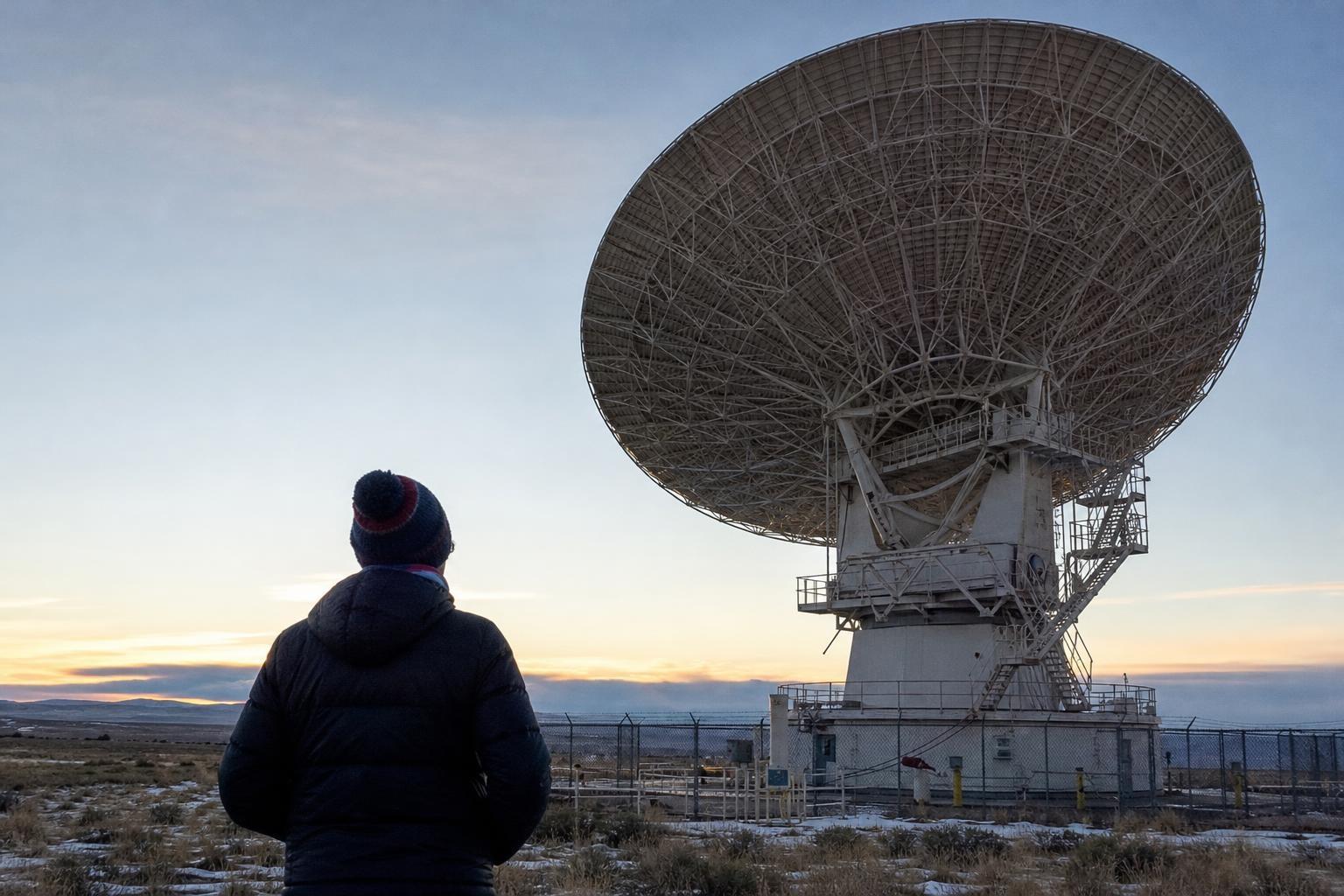
Catching a burst this distant is a triumph of rapid-response astronomy. Wide-field radio arrays continuously scan the sky, flagging milliseconds-long anomalies in real time. Software triangulates the origin across multiple antennas, converting timing differences into a precise position.
Once localized, optical telescopes measure the host galaxy’s redshift, converting cosmic stretching of light into a distance and a look-back time. It’s a delicate relay: radio to optical, milliseconds to months, and algorithms to human eyes. “You can’t aim a telescope at a flash that’s gone,” one team member said, “so you aim at the home it came from.”
Why the energy stat is so astonishing
Saying “as much energy as the Sun in 30 years” anchors an otherwise abstract number. That estimate refers to the burst’s isotropic-equivalent energy—what it would be if emitted equally in all directions. In reality, it’s likely beamed, which reduces the true energy budget but raises the instantaneous brightness to unfathomable levels.
The implied brightness temperature is so extreme that only coherent emission—charges moving in lockstep—can do the job. Think of a cosmic laser, but in radio and shaped by magnetic geometry rather than mirrors and crystals. For a heartbeat of time, the source outshines almost anything else in the universe.
A ruler for the intergalactic web
Every FRB carries a built-in yardstick: dispersion measure, the integrated tally of free electrons along the line of sight. Lower radio frequencies are slowed more than higher ones, stretching the pulse into a characteristic sweep. That sweep encodes how much tenuous plasma the signal has crossed.
At billions of light-years, the dispersion is dominated by the intergalactic medium, the wispy gas threading the cosmic web. Bursts this far let astronomers test how much ordinary—baryonic—matter lurks between galaxies, long “missing” in traditional censuses. “Space between galaxies is not empty,” as one scientist put it. “It’s a reservoir of charged particles we can finally weigh.”
What could make a blast like this?
The shortlist of culprits is short, but none are tame:
- Young, hypermagnetized neutron stars—so-called magnetars—unleashing magnetic reconnection or crustal quakes.
- Compact binaries where a neutron star meets a black hole, triggering magnetospheric shocks.
- Relativistic jets from a newborn magnetar in a superluminous supernova or a gamma-ray burst afterglow.
- Plasma lensing that amplifies an otherwise strong but less extreme burst via interstellar caustics.
A Milky Way magnetar produced an FRB-like flash in 2020, proving such stars can generate fast radio fireworks. But the staggering energy at this distance may require exceptionally young, highly magnetized engines, efficient beaming, or both.
Peering into the host galaxy
Localizing the burst to a specific galaxy—likely a modest, star-forming system—tightens the physical picture. If the environment is rich in young massive stars, it naturally seeds the birth of neutron stars and magnetars. Dust and gas content also shapes how the radio pulse is scattered and rotated, offering clues to magnetic fields on galactic scales.
Each well-localized FRB adds a point to the cosmic map, linking a measured distance to dispersion and environmental fingerprints. Stack enough points and you get an empirical relation that turns FRBs into precision tools for weighing the universe.
What’s next
More sky coverage, more detections, and sharper localizations are the way forward. New arrays will multiply catch rates, while real-time alerts will summon optical, X-ray, and gamma-ray follow-ups within seconds. If any multiwavelength “afterglow” shows up, it could pinpoint the underlying engine with surgical clarity.
“We’re learning to treat these bursts not as anomalies, but as astronomical instruments,” one researcher said. With each millisecond flash, we sample the universe’s invisible matter, probe extreme physics, and watch compact objects do impossible-seeming things—from half a universe away.
