
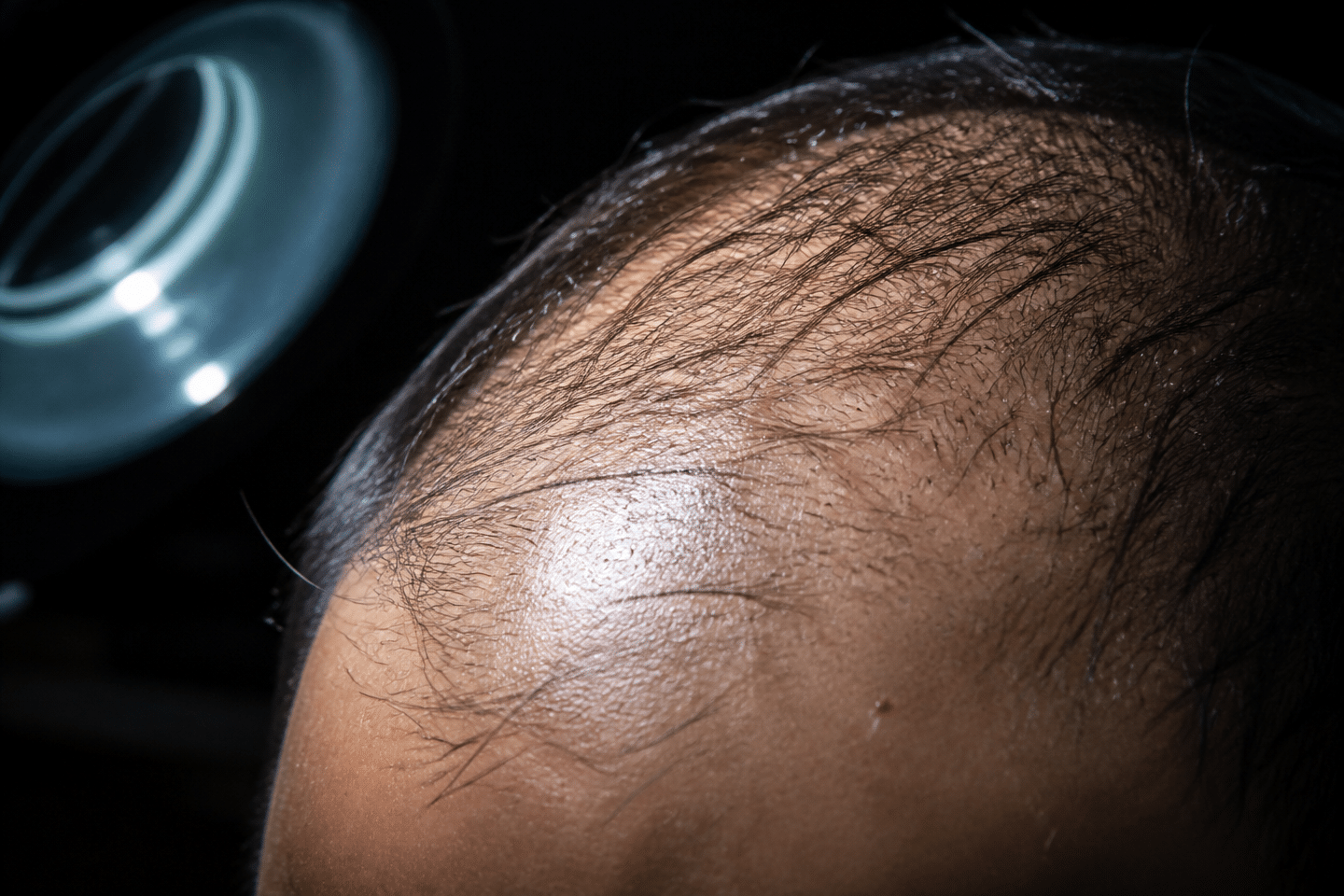
Hair follicles dormant for years, not dead, merely on hold, have started producing visible hair again in just six months, without surgery or hormonal blockers. A phase 3 clinical trial has documented this phenomenon with precise figures, and the results seriously challenge what was previously thought possible against baldness.
- VDPHL01, an extended-release oral minoxidil tablet developed by Veradermics, achieved an average gain of 36.4 terminal hairs per cm² with twice-daily dosing versus 6.6 with placebo after six months.
- 68.7% of patients on twice-daily dosing reported being improved or very improved, with no serious adverse or cardiac effects reported, but hypertrichosis occurred in 9% of them.
- The drug is not yet approved or marketed; Veradermics plans to file with the FDA in early 2027, with results expected for women in the first half of that same year.
- Hair follicles dormant for years, not dead, merely on hold
- The VDPHL01 molecule targets cells no one dared to wake up
- October figures reveal the true scale of regrowth
Hair follicles dormant for years, not dead, merely on hold
Androgenetic alopecia, the type that affects most men as they age, can become a permanent loss of hair. It is a progressive narrowing. Hair follicles miniaturize, producing hairs that become thinner and shorter until they vanish from view to the naked eye.
For a long time, this miniaturization was seen as a point of no return. Once the follicle was reduced to its barest form, little remained to be saved. Existing treatments mainly aimed to slow shedding, not reverse the process.
Yet beneath the surface of the scalp, these miniaturized follicles retain residual activity. They are not extinguished; they are in a state of pause. This nuance—between cellular death and simple pause—has occupied dermatology laboratories for years.
Veradermics’ recent results fit precisely within this logic. Its drug candidate, named VDPHL01, seeks to leverage this residual activity rather than replace it artificially, as a graft would.
The VDPHL01 molecule targets cells that no one dared to wake up
The clinical results disclosed in October 2026 fed a compelling interpretation: a molecule capable of directly reactivating dormant stem cells at the heart of hair follicles, these biological reserves meant to stay in reserve once baldness takes hold. The idea is fascinating, as it upends the usual talk about the irreversibility of hair loss.
In practice, the mechanism documented by Veradermics is a bit different, even if the visible outcome closely resembles a cellular awakening. VDPHL01 is not gene therapy nor a stem-cell injection. It is an oral extended-release formulation of minoxidil taken as a tablet.
Unlike finasteride, this molecule does not act on DHT, the hormone responsible for follicular miniaturization. Instead, it behaves as a booster of local blood flow, better irrigating the follicles and prolonging their active growth phase—the phase during which hair actively grows.
It is this enhanced perfusion, maintained over time through the extended-release of the active ingredient, that would allow miniaturized follicles to again produce terminal hairs—the visible, pigmented hairs—rather than mere fuzz. The exact mechanism still requires clarification through further research, but the follicular blood-flow hypothesis remains the strongest lead at this stage.
This approach did not emerge from nowhere. As early as April 2026, the initial results of Study 302, conducted on 519 men, had already boosted Veradermics’ action by 37.3% in a single session. A strong signal for a biotechnology company still relatively unknown to the general public.
October figures reveal the true scale of regrowth
The phase 3 trial, named Study 304, enrolled 536 men with mild to moderate androgenetic alopecia. The protocol was classic and rigorous: randomized, double-blind, placebo-controlled. Two dosages were tested: 8.5 mg once daily, and the same tablet taken twice daily.
The numbers, measured after six months of treatment, are unequivocal. Twice-daily dosing yielded an average gain of 36.4 terminal hairs per cm², versus 28.6 for once-daily, and only 6.6 in the placebo group. Veradermics presents this as the highest gain ever reported in a placebo-controlled trial for baldness.
Beyond microscopic hair counts, patient feedback confirms the trend. On the AAIRS evaluation scale, 68.7% of men on twice-daily dosing report being improved or very improved, compared with 55.7% on once-daily, and only 15% on placebo. The study also met all its primary endpoints, as well as seventeen secondary endpoints.
On tolerability, the profile remains broadly reassuring. Hypertrichosis, that is, excessive hair growth in non-targeted areas, was observed in 2.2% of once-daily patients and 9% of twice-daily patients. Veradermics notes that no serious treatment-related adverse event, nor any concerning cardiac event, was reported during the trial.
These results remain preliminary and have not been directly compared with finasteride or with the classic forms of minoxidil applied as a lotion. Additional data from Study 302, Part B, as well as from Study 306, are still expected before any regulatory filing.
- Gain of 36.4 hairs per cm² with twice-daily dosing, versus 6.6 with placebo
- 68.7% of patients improved or very improved with twice-daily dosing
- Hypertrichosis in 9% of patients with twice-daily dosing
- No concerning cardiac effects reported at this stage
For women, a Phase 2 trial named Study 207 has already reported average gains of 22.7 and 23.3 hairs per cm² at six months. Results from Study 306, specifically dedicated to female patients, are expected in the first half of 2027, a timeline that will show whether this molecule meets its promises beyond the male population alone.
VDPHL01 is not yet approved or marketed. Veradermics plans to file its dossier with the FDA in early 2027. Until then, these results remain those of an experimental drug—promising indeed, but still subject to time and the expert committees that will decide its clinical future.
