
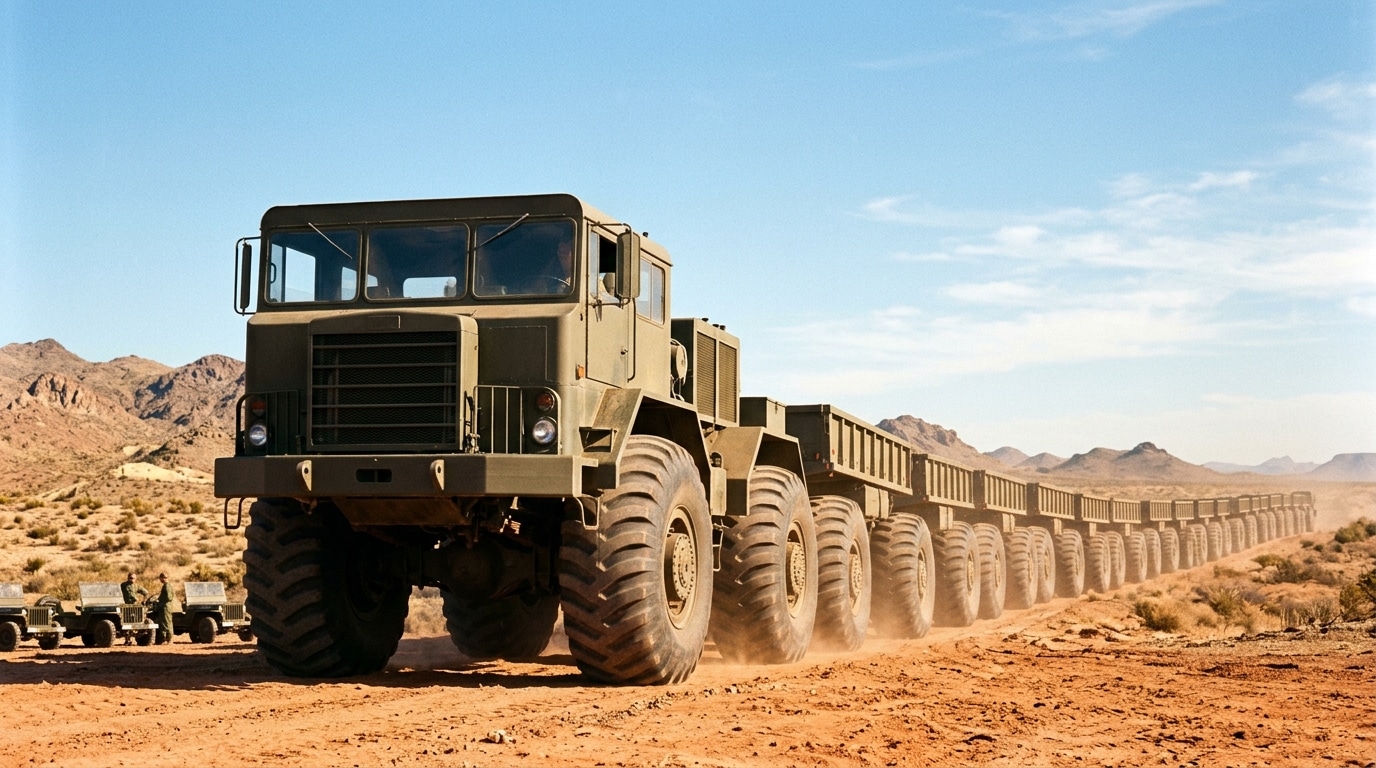
In 1962, the U.S. Army tested in the Arizona desert a 170-meter-long truck, equipped with 54 drive wheels and capable of carrying 150 tonnes of freight. Yet this aluminium giant never served a single day in operation: its mission had already disappeared before it rolled.
- The TC-497 Overland Train, built by LeTourneau, measured 170 meters, weighed 135 tonnes and could transport 150 tonnes thanks to its 54 drive wheels.
- The tests conducted at the Yuma Proving Ground in 1962 were technically successful, but the program was abandoned in the face of the rise of heavy helicopters such as the CH-54 Tarhe.
- The vehicle’s cockpit survived and is today on display at the Yuma Proving Ground, in Arizona.
- A 54-wheeled monster designed to confront the Arctic Circle
- When the heavy helicopter rendered this terrestrial behemoth obsolete
- Why this mechanical giant sleeps today in the Arizona desert
A 54-Wheeled Monster Designed to Confront the Arctic Circle
Imagine a train, but without tracks. That’s roughly what engineer LeTourneau envisioned with his TC-497 Overland Train, an assembly of thirteen articulated units stretching 572 feet, about 170 meters. To put it into perspective, it is longer than a Nimitz-class aircraft carrier resting on tires.
The machine weighed 135 tonnes and could haul 150 tonnes more, from light armored vehicles to containers of construction equipment. Six service members were enough to crew it from a single control cabin, somewhat like steering a liner from its wheelhouse.
Its welded aluminum body and its 54 drive wheels made it, according to the U.S. Army itself, the longest wheeled vehicle ever built. A record that was not merely a technical stunt but a direct answer to a very real problem.
That problem dated back to World War II. In regions lacking roads and rail lines, notably Arctic areas, the U.S. Army had hit a logistical wall. The TC-497 was meant to fill this gap, by crossing terrains where no infrastructure existed.
When the Heavy Helicopter Made This Terrestrial Colossus Obsolete
Here’s the twist: the TC-497 performed perfectly during the tests at the Yuma Proving Ground. No major mechanical failure, no technical setback to point to. The vehicle did exactly what it had been designed to do.
The catch is that while LeTourneau was refining his land train, the U.S. Army was pursuing a completely different path: rotary-wing aviation. And that path was about to change everything. According to the Army AL&T magazine, it wasn’t a failure of the Army, nor of the vehicle, nor of the manufacturer that sealed the program’s fate, but rather the concurrent development of heavy helicopters.
The culprit had a name: the CH-54 Tarhe by Sikorsky, whose civilian version, the S-64 Skycrane, had its first flight in 1962, the same year as the TC-497 tests. Calendar irony: the tool that would make the truck obsolete took off while the latter was still rolling in the sand.
Military logic eventually cut the knot fairly quickly. Why roll a 170-meter behemoth over rough terrain, when a helicopter can fly over any obstacle and drop its payload exactly where it’s needed? Faster, cheaper to deploy, the Skycrane accomplished the same mission without the need for any passable road.
Why This Mechanical Giant Sleeps Today in the Arizona Desert
Before drawing a definitive line under the project, the Army had even considered in 1961 an even bolder option: nuclear propulsion. The idea was to turn this giant into a mobile, all-terrain resupply point, able to operate indefinitely without refueling. A concept that never progressed beyond the study stage.
The fate of the TC-497 is also shrouded in a bit of documentary ambiguity. The U.S. Army mentions a sale for scrap in 1968, while another specialized source places an auction in 1971. No major mainstream media has looked into this detail, which explains this unresolved discrepancy to this day.
What is certain, however, is that the cockpit escaped destruction. It enjoyed a second, rather unexpected life, serving as a roadside advertisement for a Yuma RV dealer, before returning to the military testing site in the late 1990s.
Today, the cockpit sits on static display in the Howard cantonment area of the Yuma Proving Ground, in Arizona. A unique relic, reminding us that a project can be technically successful and yet completely sidelined by the parallel evolution of another technology.
The story of the TC-497 ultimately illustrates a fairly common phenomenon in the history of military engineering: the best technical solution doesn’t always win. Sometimes, it’s simply another innovation, developed concurrently in a neighboring corridor, that changes the rules of the game before the first project has had its chance.
