
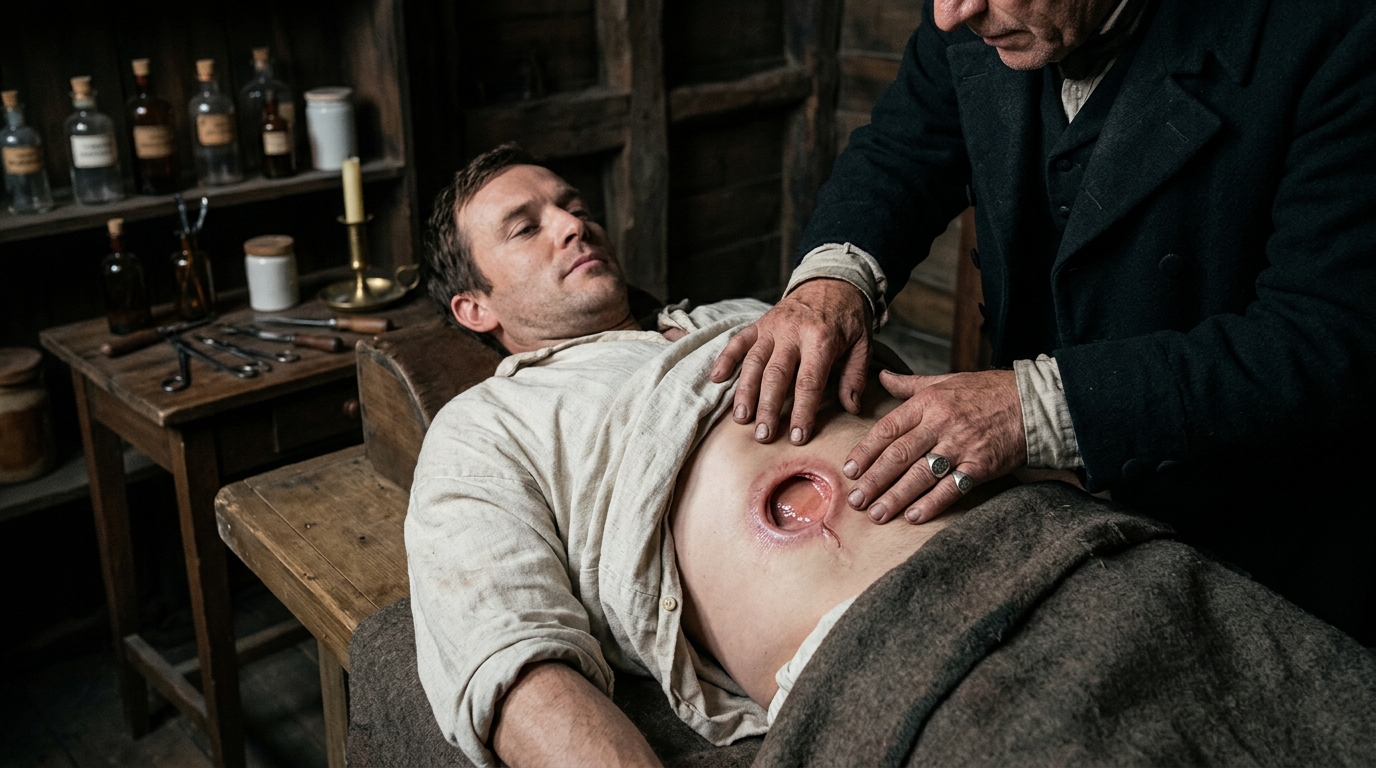
A musket shot fired from less than a meter away, a gaping wound in the abdomen, and yet a man survives. In 1822, Alexis St-Martin should have died on Mackinac Island. His wound never fully closed, leaving a permanent opening to his stomach. An American army surgeon would turn this tragedy into one of the most influential studies in the history of medicine.
- On June 6, 1822, Alexis St-Martin survives a gunshot to the stomach that leaves a gastric fistula that never fully closes.
- The surgeon William Beaumont uses this opening to conduct more than 250 digestion experiments between 1825 and 1833.
- These studies demonstrate that digestion is a chemical reaction rather than a mere mechanical process, earning Beaumont the title of father of gastric physiology.
- An accidental gunshot that should never have left a survivor
- An impossible-to-close wound becomes a window into the human body
- A decade of experiments that transformed the understanding of digestion
An accidental gunshot that should never have left a survivor
Alexis St-Martin was a Canadian traveler employed by the American Fur Company. He worked on Mackinac Island, a remote trading post at the heart of the Great Lakes. On June 6, 1822, a hunting rifle discharged at extremely close range, less than a meter, in the abdominal region.
The damage was substantial. The lead slug ripped through the abdominal muscles, perforated part of a lung, and struck the stomach itself. In the medical context of the early nineteenth century, such an injury usually meant certain death, due to the inability to stop bleeding and infection.
William Beaumont, an American army surgeon posted nearby, was summoned urgently. He treated the wound with makeshift means, not imagining that this patient would remain linked to his name for more than a decade. Against all odds, St-Martin survived, but his body bore an indelible mark of the accident.
An injury that could not be closed becomes a window into the human body
Despite the care provided, the wound never fully healed. It left behind a fistula, that is, an abnormal conduit permanently connecting the interior of the stomach with the outside of the body. Practically, lift a fold of skin and you could watch the organ in action.
For Beaumont, this anomaly represented an unprecedented scientific opportunity. Wounded by a gunshot in 1822, Alexis St-Martin had preserved a gastric fistula that allowed the surgeon William Beaumont to study digestion directly, without the need for surgery or any invasive technique. In the spring of 1825, the idea truly took shape in the physician’s mind.
A contract was drawn up between the two men, binding St-Martin to participate in the surgeon’s experiments. The Becker Medical Library, at Washington University in St. Louis, today emphasizes the ethically questionable nature of this relationship. At the time, notions of informed consent did not exist in their current form.
Ten years of experiments that transformed the understanding of digestion
From May 1825 onward, Beaumont devised a protocol of striking simplicity. He tied various foods to a silk thread, which he introduced directly through the fistula’s opening. He then retrieved them at regular intervals to observe, step by step, the speed and manner in which each item was transformed.
The experiments unfolded in four major series, spread between 1825 and 1833, at different locations: Mackinac, Niagara, Crawford, then Plattsburgh and Washington. St-Martin’s trips back to Canada periodically interrupted the work, forcing Beaumont to wait several years before resuming his observations.
In total, Becker Library records more than 250 experiments conducted on this singular patient. Beaumont discovered that plants digest more slowly than meat, and that milk coagulates very early in the digestive process. These observations also confirmed William Prout’s theory of hydrochloric acid in gastric juice.
This meticulous work established a fundamental point for physiology: digestion is not merely a mechanical grinding process, but a complex chemical reaction. The experiments concluded on November 1, 1833, and Beaumont published all of his conclusions—51 in total—in a 280-page volume released the following month in Plattsburgh, printed in a thousand copies.
Alexis St-Martin died on June 24, 1880 in Saint-Thomas, Quebec, nearly fifty-eight years after the accident that altered his life. William Beaumont, for his part, died as early as 1853 in Saint-Louis, without ever fully grasping the magnitude of his scientific legacy. The National Library of Medicine today preserves the records of his work and honours him as the father of gastric physiology, a title that succinctly captures the significance of this improbable yet decisive collaboration between a life-marked patient and a surgeon determined to understand what his era still did not know about the human body.
