
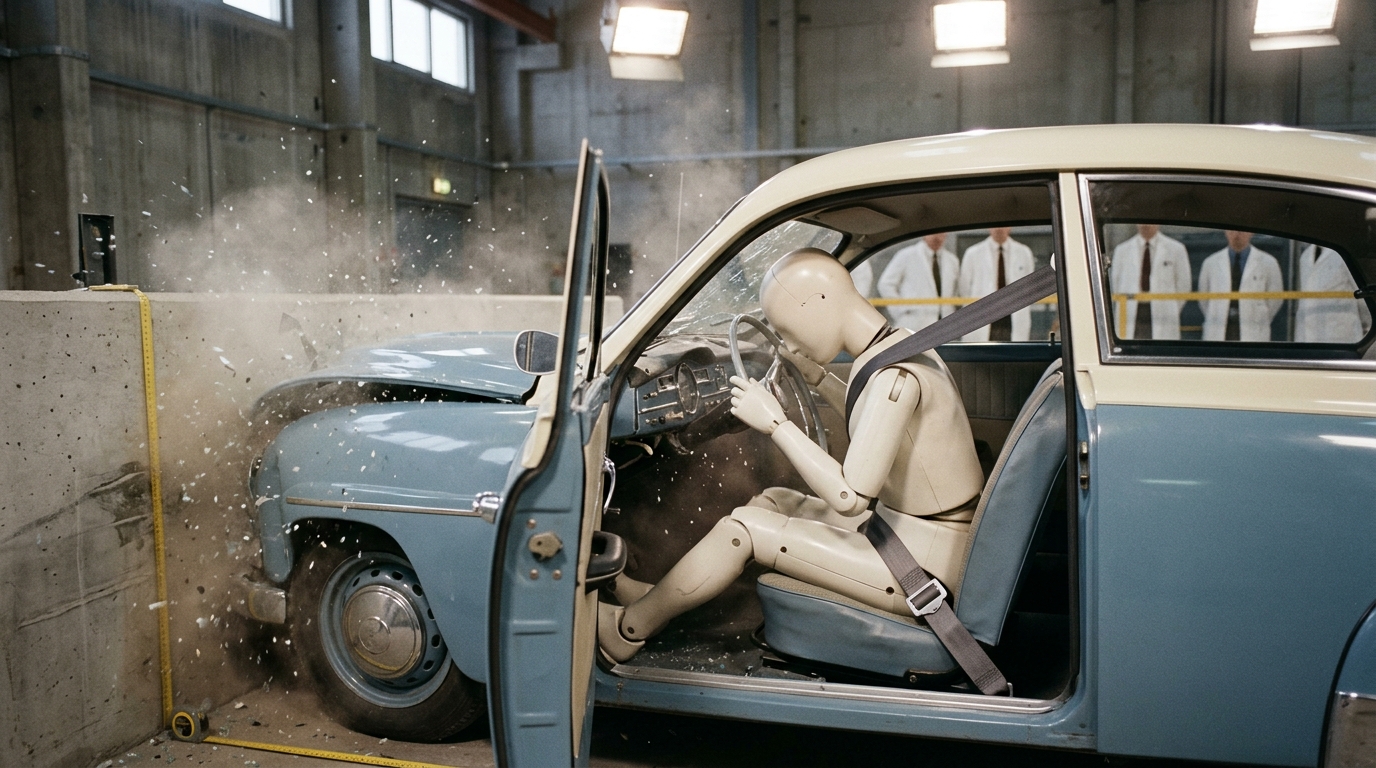
People often assume that an inventor as pivotal as the creator of the seat belt made his fortune from his patent. The opposite occurred. In 1959, Volvo engineer Nils Bohlin developed the three-point belt, and the Swedish manufacturer chose to make it freely available to the entire automotive industry, a decision that would save more than a million lives.
- The engineer Nils Bohlin developed the three-point seat belt at Volvo in 1959, after working on ejector seats at Saab.
- Volvo decided to make the patent freely accessible to the entire automotive industry, without demanding royalties.
- The manufacturer estimates that this invention has saved more than a million lives since its creation.
- 1959: The invention that would change the history of the automobile
- The unexpected choice by Volvo: relinquishing a fortune to save lives
- A million lives saved: the invaluable legacy of a patent offered to the world
1959: The invention that would change the history of the automobile
Before the three-point seat belt arrived, the few restraint devices in use typically consisted of a simple horizontal strap laid across the abdomen. In a frontal impact, this type of belt could cause serious internal injuries rather than protect the occupant. Automotive safety thus remained a largely unfinished project.
This is where Nils Bohlin enters the scene. This Swedish engineer first cut his teeth at the aircraft manufacturer Saab, where since 1955 he worked on the design of ejector seats. A demanding field, where even a small miscalculation could cost a life, and which taught him to think of safety as a system rather than a mere accessory.
In 1958, Bohlin joined Volvo as a safety engineer. He quickly developed a V-shaped system, anchored at three distinct points, that distributes crash forces across the chest and pelvis rather than concentrating them on the abdomen alone. A patent application was filed in Sweden the previous year, and the device was installed in volume in its very first car, a Volvo PV544 delivered to a Swedish dealer in 1959. The American patent would be officially granted in 1962.
Volvo’s Unexpected Choice: Forgoing a Fortune to Save Lives
A patent this strategic could have brought Volvo substantial sums. All carmakers around the world would eventually need a license to equip their vehicles with this system, which quickly became a benchmark. The financial calculus seemed straightforward.
Yet Volvo’s management made a radically different decision: to make the patent freely accessible to the entire automotive industry, without charging any royalties. The idea was simple, but heavy with consequences: an innovation capable of saving lives should not belong to any single entity.
This philosophy is something Volvo illustrated a few years later as well. In 1967, the brand presented to the United States a report based on the analysis of 28,000 accidents that occurred in Sweden over one year. The numbers speak for themselves: the three-point belt reduced injuries by 50 to 60 percent depending on the scenarios. That was enough to convince the skeptics and to accelerate its adoption well beyond Swedish borders.
A Million Lives Saved: The Invaluable Legacy of a Patent Offered to the World
Today it’s hard to measure precisely the impact of such a decision, but Volvo dared to attempt it. By cross-referencing its own data with external studies, the automaker estimates that more than a million people owe their lives to this three-point belt. A staggering figure for a device that has become almost banal, so integral to our daily lives.
The story does not end in 1959. Volvo continues to evolve this technology, proving that Bohlin’s invention is not a static object. The brand unveiled a so-called multi-adaptive belt, which will equip its future electric model EX60 from 2026. Its principle: extend the tension-limiting range from three to eleven profiles, adjusted according to the occupant’s size, weight, and position. Time magazine even ranked this innovation among its best inventions of the year, in a list that nonetheless contains several hundreds.
But the fight remains current, including in France. The final ONISR results for 2025 report 3,515 people killed on the roads, in metropolitan France and overseas, up 2.4% from the previous year. In the overseas territories, road safety notes a chilling detail: the seat belt was not fastened in half, or even three-quarters, of the deceased drivers. Sixty-five years after its invention, the simplest gesture remains too often neglected.
From the workshop of a Swedish engineer to the intelligent sensors of today’s vehicles, the three-point belt remains undoubtedly one of the quietest, yet most decisive, inventions in automotive history. A useful reminder the next time we slide into the driver’s seat without really thinking about it.
