
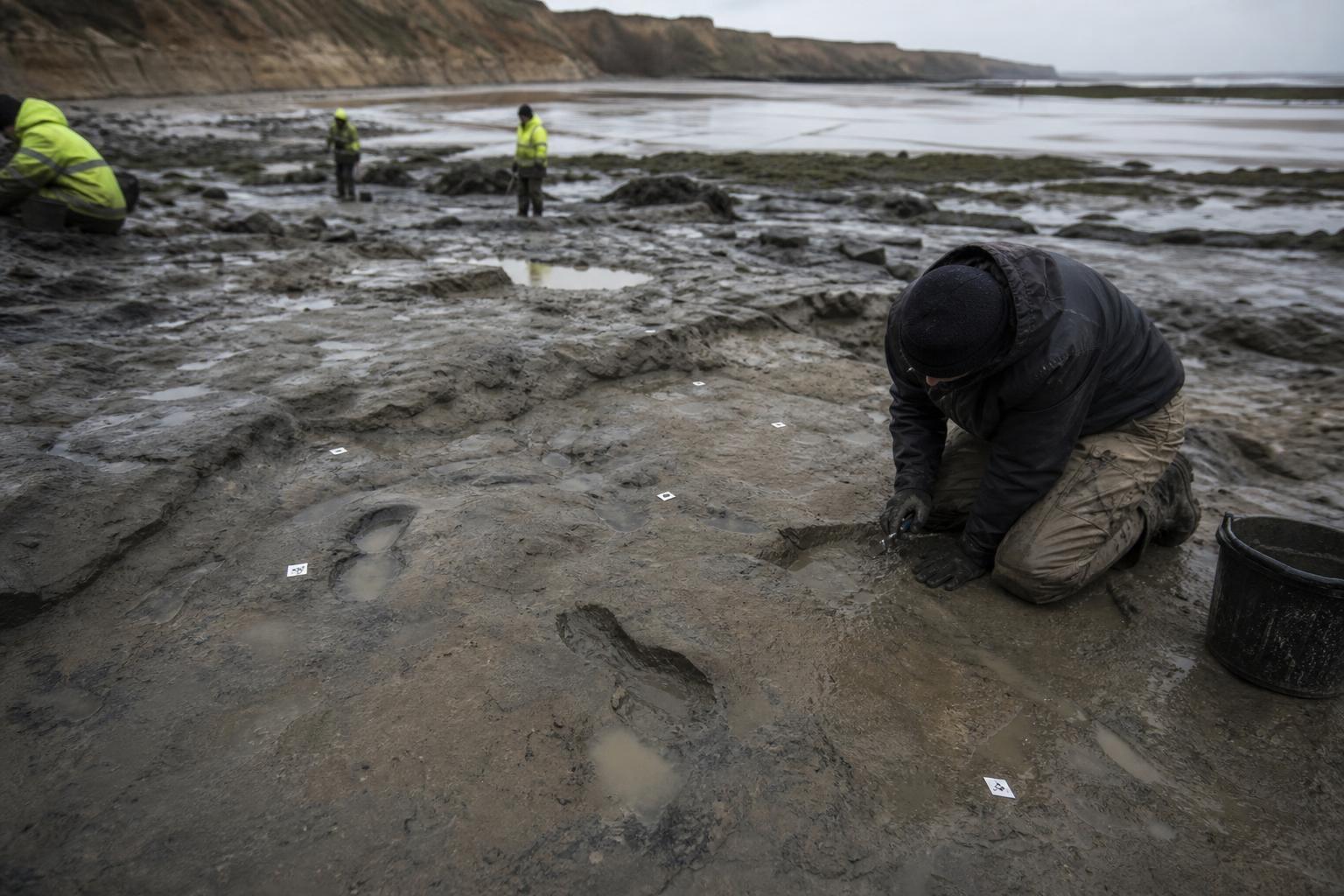
The surf pulled back and revealed a story no one expected: a scatter of human steps pressed into ancient mud, a moment from a world colder, wilder, and thought to be empty of people. On a Norfolk shore, a family moved across a silty estuary, leaving a trackway that rewrites where and when our ancestors dared to live. By the yardstick of old assumptions, they “weren’t meant to be there.” And yet the prints say, with quiet certainty, they were.
The day the past stepped out of the surf
In the winter churn of a rough sea, storms stripped away layers of sand near Happisburgh and revealed dozens of footprints. At low tide, their edges caught the light—heels, arches, and splayed toes, crisp enough to map like cartography in clay. “For a few hours, the beach turned into a page from a lost diary,” one observer later remarked.
Researchers moved fast—photographing, scanning, and measuring before the tide erased what it had just given. The prints, the oldest known outside Africa, captured motion and presence rather than shards of bone or chipped stone. Instead of fragments of things, here was the rhythm of bodies crossing a wet, living landscape.
How old is a step?
Dating footprints is part detective work, part patient geology. The impressions lay within the Cromer Forest-bed Formation—river and estuary deposits that bracket the Middle Pleistocene. Using stratigraphy, fossils, and luminescence signals, the layers resolved to roughly 850,000 years. That number lands squarely in a time when Britain wasn’t an island, sea levels were lower, and a broad land bridge—later called Doggerland—connected this coast to the continental plain.
“Each print is a clock tick,” a team member said, “if you read the sediment as its calendar.” The mud, built grain by grain, kept a fleeting moment safe for nearly a million winters.
Who walked here?
Some prints are small, others broad, a few long enough to imply a tall adult. From stride length and foot size, scientists inferred at least five individuals—likely a mixed group of adults and children. The largest track hints at a person around 1.7 meters tall, while the smallest steps trace a youngster not much above a parent’s hip.
The likely authors were early humans akin to Homo antecessor or a closely related population, people who carried simple tools, sharp eyes, and an adaptable diet. Their path angles toward shallow water, perhaps in search of shellfish, stranded fish, or the soft roots that thrive in tidal mudflats. “You can almost hear the squelch,” someone said, “and the quick giggle of a child testing the depth.”
They weren’t supposed to be this far north
By the logic of older textbooks, people this early lacked the technology or the warm-season window to endure Britain’s high latitude. Short days, sharp frosts, and thin pickings on winter heaths seemed like deal-breakers. The tracks argue otherwise.
These travelers found a strategy:
- Follow estuaries where freshwater, salt marsh, and forest edges overlap in dense, year-round resources.
Estuaries gather fish, birds, mammals, and edible plants in tight zones. Driftwood brings fuel to open shores. Wide views limit predator surprise. With a cooperative group, even a cold coast becomes habitable.
Doggerland under their feet
Picture not a lonely island, but an endless undulating plain stretching to what is now the Netherlands, Germany, and Denmark. Rivers braided through marsh and meadow; herds moved with the seasons; humans tracked both. The family that crossed this mud may have lived days or weeks nearby, or simply followed a river’s edge north and then back again as climates swung between cooler and milder spells.
Their world was not uniformly hostile—it was patchy. In those patches, ingenuity beats latitude. The prints freeze an instant in that ongoing dance of movement and choice.
What a footprint can say that a bone can’t
Bones tell of bodies; tools tell of hands. Footprints tell of behavior—pace, direction, and togetherness. These steps are not a lone hunter’s; they belong to a group, including the young. That single fact tilts the story from mere survival to social life.
“Nothing in archaeology feels as present as a track,” someone once said. “It’s a touch across time—their weight still on our ground.” You can trace a parent pausing, a child skipping, a turn toward shallower water, and the decision to keep going.
A race against the tide
Most of the prints are now gone, reworked by waves into featureless sand. Their afterlife survives as 3D models, a thousand digital facets holding the scalloped heel of a long-dead walker. Coastal erosion destroys, but it also reveals—a harsh bargain that demands fast teams, ready cameras, and nimble methods.
What remains is not just a data point, but a recalibrated map of human courage and reach. On a gray beach under a quickening tide, early people did what our species does best: read a landscape, make a plan, and step into the unknown together.
