
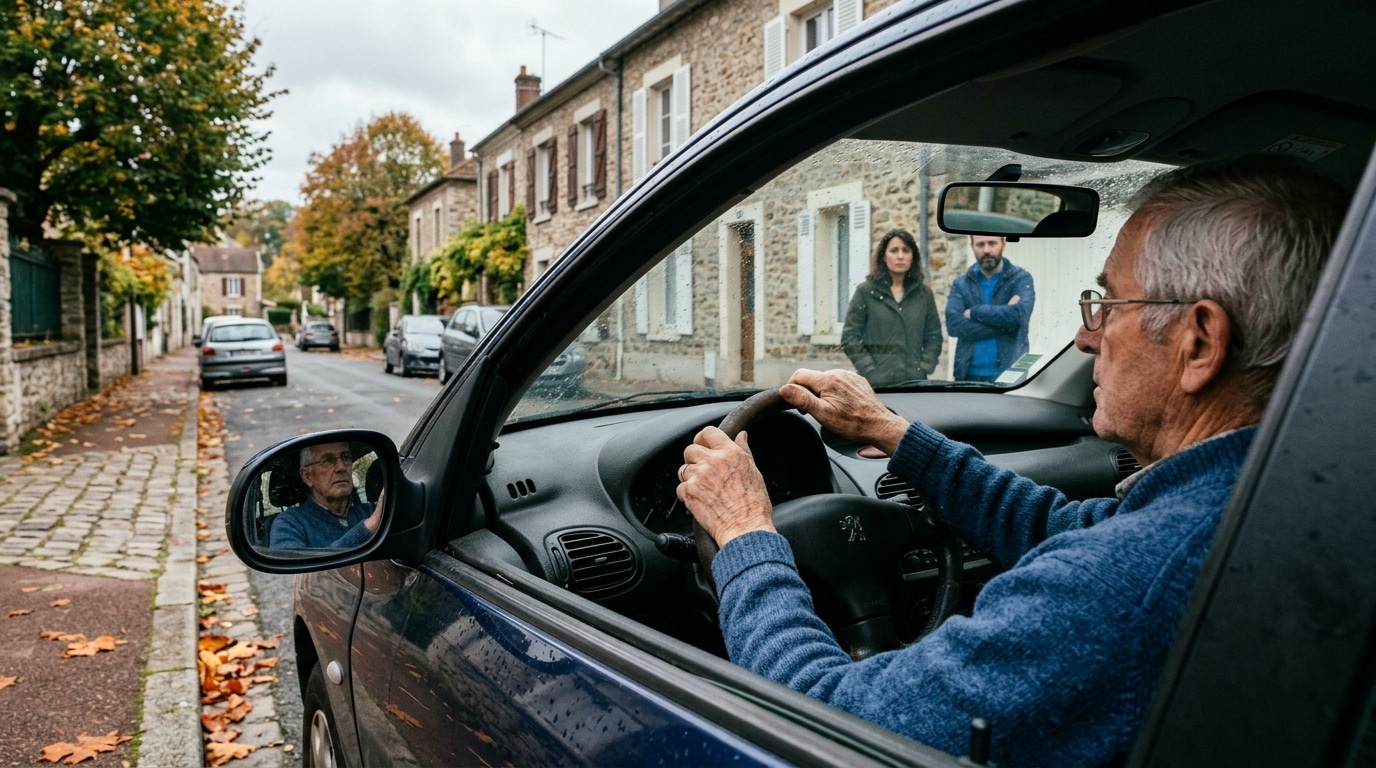
No scrapes in fifty years behind the wheel, not a single ticket, a file as clean as a brand-new windshield. On paper, nothing was wrong. And yet, around the family table, something had changed: glances exchanged between the children, silences a bit too long after each trip, sentences left hanging. These signals weren’t clearly voiced. They had been there for months, ignored or swept aside with a wave of the hand. For how could one accept that a flawless driving record might still hide a real danger? The answer lies in a few very precise signs, often minimized, sometimes even invisible to the person concerned.
- A driving record with no accidents does not guarantee intact fitness for driving, as it may simply reflect more cautious or evasive driving.
- Certain signs should raise alarms: vision problems, frequent forgetfulness, disorientation in familiar places, repeated near-m accidents, or non-compliance with traffic rules.
- Article R. 221-14 of the Highway Code allows relatives or law enforcement to alert the prefect about a person whose health state could be incompatible with driving.
- The absence of accident does not guarantee safe driving
- The physical and cognitive signals that should alert
- When the entourage expresses concern, listen and seek medical advice
The absence of accident does not guarantee safe driving
It is tempting to reassure oneself by thinking that a driver with no record has no reason to worry. Yet statistics have their limits: a perfect track record may simply reflect driving that has become more cautious, slower, and avoidant, rather than an unchanged aptitude. Moreover, road-safety figures remind us that people over 65 form the adult group least represented among those deemed responsible for fatal crashes, accounting for 16.9% of drivers judged responsible for fatal crashes in 2017, the lowest ratio among adult drivers. This nuance challenges the common belief that age automatically equates to danger behind the wheel. In France, moreover, no age-based medical examination is mandatory for the B license, whether you are 70, 80, or even 90 years old: the B category remains valid for life, but the license must be renewed every 15 years, and age alone can never justify a withdrawal. A medically determined unfitness can lead to a restriction or a suspension. But this legal framework, however reassuring, should not obscure the essential point: a good file does not reveal the real state of a person at any given moment. It is precisely this gray area between legality and prudence that the issue of aging at the wheel comes to challenge.
The physical and cognitive signals that should alert
Some signs, taken in isolation, may seem trivial. When put together, they paint a picture that becomes hard to ignore. Vision troubles, frequent forgetfulness, drowsiness behind the wheel, chronic pain or the use of sedative medications should lead to slowing down, or even stopping driving, and seeking medical advice without delay. Other, more subtle indicators deserve as much attention:
- Regularly misses exits from highways or intersections that are known
- Feels disoriented in familiar places, as if the neighborhood were no longer quite the same
- Experiences unusual anxiety at the thought of getting behind the wheel
- Has had several near-accidents in a short period
- Often ignores or regularly breaks well-known traffic rules
These manifestations do not necessarily signal a serious pathology, but they deserve to be taken seriously, because they often reflect a progressive decline in reflexes, attention, or the processing of information, all essential abilities to anticipate danger on the road. It is precisely this dimension that the new European directive aims to anticipate: adopted by the European Parliament, it ends the principle of a lifelong license in the Union and sets a maximum validity period of fifteen years for cars and motorcycles. Member states may, for drivers aged 65 and over, reduce this period in order to multiply medical visits or refresher courses, each country remaining free to choose the type of control—classic medical examination or self-assessment. In France, the National Council for Road Safety has in fact decided in favor of an online declarative self-questionnaire rather than a systematic medical visit, with redirection to an approved physician in case of doubt. Its president, Yves Goasdoué, nonetheless nuances the position, noting that for a 70-year-old, self-evaluating every fifteen years does not make much sense.
When the entourage expresses concern, listen and consult
In many families, it is precisely the entourage who detects the change first, sometimes well before the person concerned. A child suddenly proposing to take the wheel, a grandchild avoiding lengthy journeys as a passenger, conversations that circle around the topic without addressing it directly: these worries deserve to be heard rather than dismissed as mere prudence. The law provides a precise mechanism for these delicate situations. Article R. 221-14 of the Highway Code allows the prefect to order a driver to undergo a medical fitness examination if it believes the person’s health state may be incompatible with driving, a signal that can be raised by relatives as well as by law enforcement. This mechanism recalls an essential point: asking for medical advice is not a sanction, but a way to safeguard both the person and other road users. Rather than waiting for an incident to react, it is better to treat these family alerts as valuable indicators, often more nuanced than any points on a license.
Stopping driving, or simply adapting the way one drives, does not mean renouncing one’s freedom of movement. Carpooling with neighbors, on-demand transport, local mobility aids, or simple trips redesigned with loved ones: today there are many ways to stay mobile without stubbornly hanging on to the wheel. The aim is not to assign blame but to open dialogue in time, before the road acts for everyone.
