
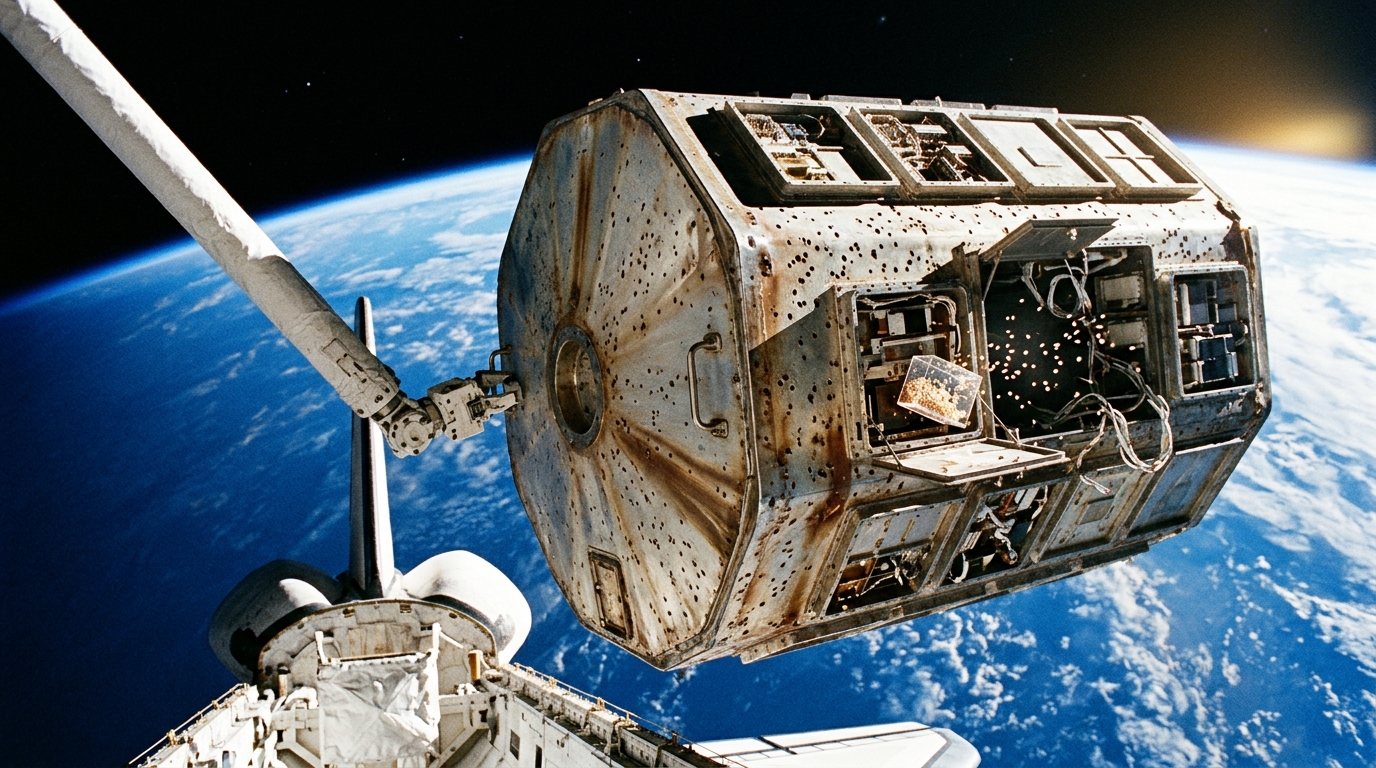
A satellite was supposed to stay in orbit for ten months. It stayed for nearly six years. Not because of a failure or an administrative oversight, but because the shuttle intended to retrieve it exploded mid-flight. On board were 12.5 million tomato seeds, waiting, too, to return to Earth.
- The LDEF satellite remained in orbit for 69 months instead of 10 due to shuttle program delays and the 1986 Challenger explosion that halted American manned flights
- The 12.5 million seeds were distributed in 132,000 kits to 3.3 million students, showing a germination rate of 73.8% versus 70.3% for the Earth-based control seeds
- An alarmist internal memo mentioning a risk of toxic fruits circulated in 1990, but NASA and Park Seed Co. confirmed there was no radioactive anomaly or real danger
- A satellite forgotten by everyone except the laws of orbital mechanics
- 12.5 million seeds held hostage by the Challenger shuttle
- Millions of student gardeners facing a tomato forbidden from tasting
A satellite forgotten by everyone except the laws of orbital mechanics
In April 1984, the space shuttle Challenger released into low Earth orbit a strange object named LDEF, for Long Duration Exposure Facility. Picture a twelve-faced cylinder, weighing nearly 9,700 kilograms, bristling with 57 different scientific experiments. Its cruising altitude hovered around 477 kilometers, on an almost circular orbit inclined 28.4 degrees relative to the equator.
The mission of LDEF was simple on paper: expose materials and living organisms to the extreme conditions of space, then bring them back to study the effects of vacuum, radiation, and thermal fluctuations. Ten months, at most a year, was the original timetable—a straightforward scientific round trip.
Except that space never quite follows engineers’ schedules. Retrieval, initially planned for March 1985, slid first to 1986. Then the story took a sharp turn, and LDEF found itself left to drift, slowly but inexorably descending toward Earth’s atmosphere.
12.5 million seeds held hostage by the Challenger shuttle
What kept LDEF in orbit for 69 months wasn’t a technical failure or a lapse in attention: it was first the shuttle program’s delays, then the January 1986 Challenger disaster. The catastrophe froze the entire American crewed flight program for years, and retrieving the satellite was simply dropped from the schedule, indefinitely postponed for lack of a shuttle available to fetch it.
Meanwhile, LDEF continued its quiet patrol around the Earth. It would eventually complete 32,422 full revolutions—a staggering figure for an object that had been intended to make only a few hundred laps. Its altitude kept dropping, eaten away by the residual drag of the upper atmosphere.
The urgency became real in 1990. That year coincided with a solar maximum, and the Sun’s increased activity heated and expanded the atmosphere, accelerating the decay of objects in low orbit. NASA’s calculations were blunt: by mid-January, LDEF would be too low to recover and would likely re-enter the atmosphere before early March. A launch was even canceled due to weather on January 8, with Columbia standing by for the final shot. The shuttle launched the very next day and, with careful timing, managed to grab the satellite before it was lost. Among the valuable cargo were five aluminum containers containing 12.5 million Rutgers tomato seeds, carried under the SEEDS project—a collaboration between NASA Headquarters, Langley Research Center, and the seed company George W. Park Seed.
Millions of student gardeners facing a tomato forbidden from tasting
Back on Earth, these seeds were not simply tucked away in a laboratory behind triple locks. About 132,000 SEEDS kits were distributed to nearly 3.3 million students in schools across every American state and in about thirty foreign countries. Each kit contained two seed lots: those that had journeyed into space and a control batch kept safely in a climate-controlled Earth warehouse for the same duration.
The preliminary results of this large-scale experiment, conducted with millions of small pots of soil, were surprisingly restrained. The germination rate reached 73.8% for the space seeds, compared with 70.3% for the Earth seeds, and the average germination time was almost identical—8.0 days for space seeds versus 8.3 days for Earth seeds. The final tally confirmed the initial impression: students reported only a few noticeable differences between the two rows of sprouts.
This is where the famous twist of the tale comes into play. In April 1990, the Los Angeles Times disclosed the existence of a two-page internal memo, drafted by a NASA contractor based in Oklahoma. The document spoke, I quote, of a remote possibility that radiation-induced mutations could cause plants to produce toxic fruits. In other words: some teachers and students were implicitly told not to eat their space tomatoes.
NASA did not delay in responding publicly to quell the furor. William H. Kinard, the program’s chief scientist for LDEF, asserted that there was no validity to the idea of danger for students. Jim Alston, research director at Park Seed Co. in South Carolina, likewise confirmed that radiation counters detected nothing abnormal when the seeds returned to Earth. The alarm memo, which nonetheless targeted 120,000 kits distributed to 58,000 teachers, remained a single, quickly debunked note but has persisted in later retellings of the mission as a cautionary aside.
The LDEF adventure neatly captures the unpredictable nature of space exploration, even in the most educational of missions. A satellite stranded in orbit by a tragic accident, millions of children turned unknowingly into apprentice botanists, and a health scare with no real basis that nearly overshadowed scientifically reassuring results: the seeds exposed to space grew just as well, if not a little better, than their terrestrial twins.
