
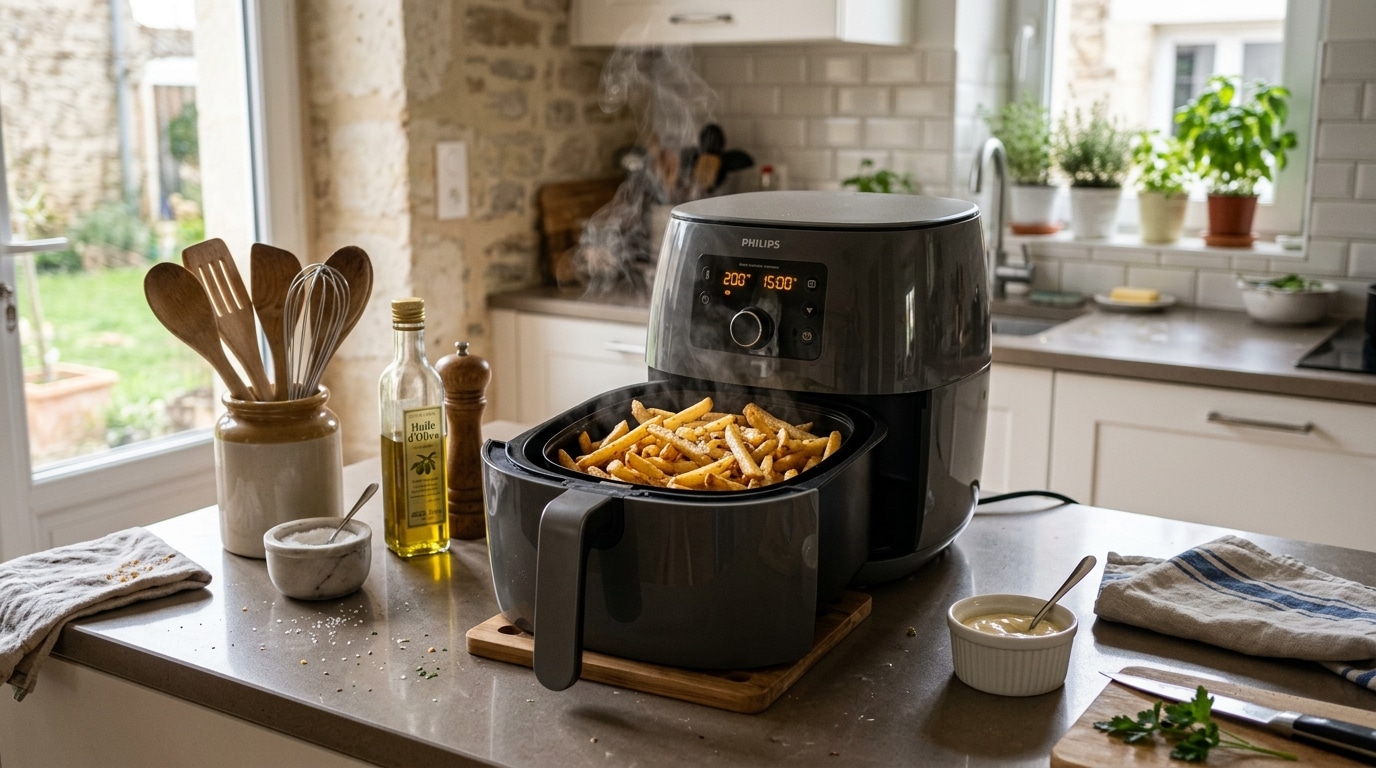
What if the panic surrounding airfryers was just a misunderstanding? On social networks, the darling appliance of modern kitchens is regularly singled out: its non-stick coating would be laden with forever chemicals, the infamous PFAS that worry more and more. Faced with this persistent rumor, a consumer association decided not to settle for guesses and to look into what really lies beneath the surface of six of the best-selling devices. The lab verdict is sure to surprise, and it deserves attention, without dismissing all the questions that still linger.
- UFC-Que Choisir tested six airfryers and did not detect PFOA, PFOS, or PFHxS, substances banned for their toxicity
- PTFE (Teflon) was found in the coatings, but no harmful effects have been demonstrated at the usual cooking temperatures of airfryers
- Kitchen utensils like airfryers remain exempt from the 2025 law banning certain PFAS, unlike cosmetics and clothing
- What the analysis of the six tested airfryers reveals
- PFOA, PFOS, PTFE: molecules with very different health risk profiles
- What to remember for cooking with your airfryer with peace of mind
What the analysis of the six tested airfryers reveals
To get to the bottom of things, UFC-Que Choisir had six airfryer models subjected to laboratory testing. A market-representative panel: two Ninja models, one Philips, one Tefal, one Princess, and one Inventum sat on the analysis table. The objective was simple: to track the presence of PFAS in the non-stick coatings that line baskets and racks. The result: A QueChoisir.fr study shows that these six airfryers do not contain PFAS banned for their toxicity. Neither PFOA, PFOS, nor PFHxS were detected in the tested coatings, three substances at the heart of concerns voiced in recent months. A reassuring development for those who have invested in this device, now a staple of everyday meals.
PFOA, PFOS, PTFE: molecules with very different health risk profiles
It is tempting to put all PFAS in the same bucket, but this family of molecules comprises substances with very different profiles. PFOA, long used in the manufacture of non-stick coatings, is classified as a human carcinogen by the International Agency for Research on Cancer. Its danger prompted its ban on production, export, and import in Europe, a measure that, at least on the fundamental level, is reassuring. Yet, it is precisely not the one that the analyses found in the six airfryers. What laboratories did detect, however, are fluoropolymers like PTFE, the star component of Teflon. And here lies the nuance: to release particles, you would need to reach about 260 degrees Celsius, a threshold these devices simply do not reach during ordinary cooking. It is a bit like confusing a mild sleeping pill with a powerful sedative—both belong to the same category, but their impact on the body is not the same.
What to remember for cooking with your airfryer with peace of mind
Before decisively tucking the airfryer away as a precaution, it’s worth putting things into perspective. The results of this analysis stand in stark contrast to those of a prior study conducted in January 2024 by the same association on eight models of non-stick cookware, where traces of PFAS were detected, including in a ceramic range marketed as PFAS-free. A reminder that marketing promises sometimes deserve closer verification. On regulation, the February 27, 2025 law bans the manufacture, import, export, and marketing of cosmetics, ski-waxes, clothing, and shoes containing PFAS starting January 1, 2026. Cookware, pans, pots, and airfryer baskets are, for the moment, exempt from this ban and remain permitted for sale. This legal ambiguity also fuels concrete actions: in October 2026, the associations Générations Futures, Notre Affaire à Tous, and ClientEarth formally notified a French cookware manufacturer regarding the use of PTFE in its coatings. To cook with a clear mind while these questions are clarified, a simple gesture is enough:
- Favor wooden or silicone utensils over metal, to avoid scratching the walls and racks and to limit any risk of leaching
Beyond the immediate health question, an underlying issue remains, one of environment. Fluoropolymers like PTFE are extremely stable and persistent in nature, which raises questions about their upstream production and their end-of-life management for devices. Reassuring for everyday cooking, thus, but not yet fully resolved environmentally. The airfryer can continue to sit on the countertop without immediate concern, while keeping a watchful eye on forthcoming regulatory developments.
