
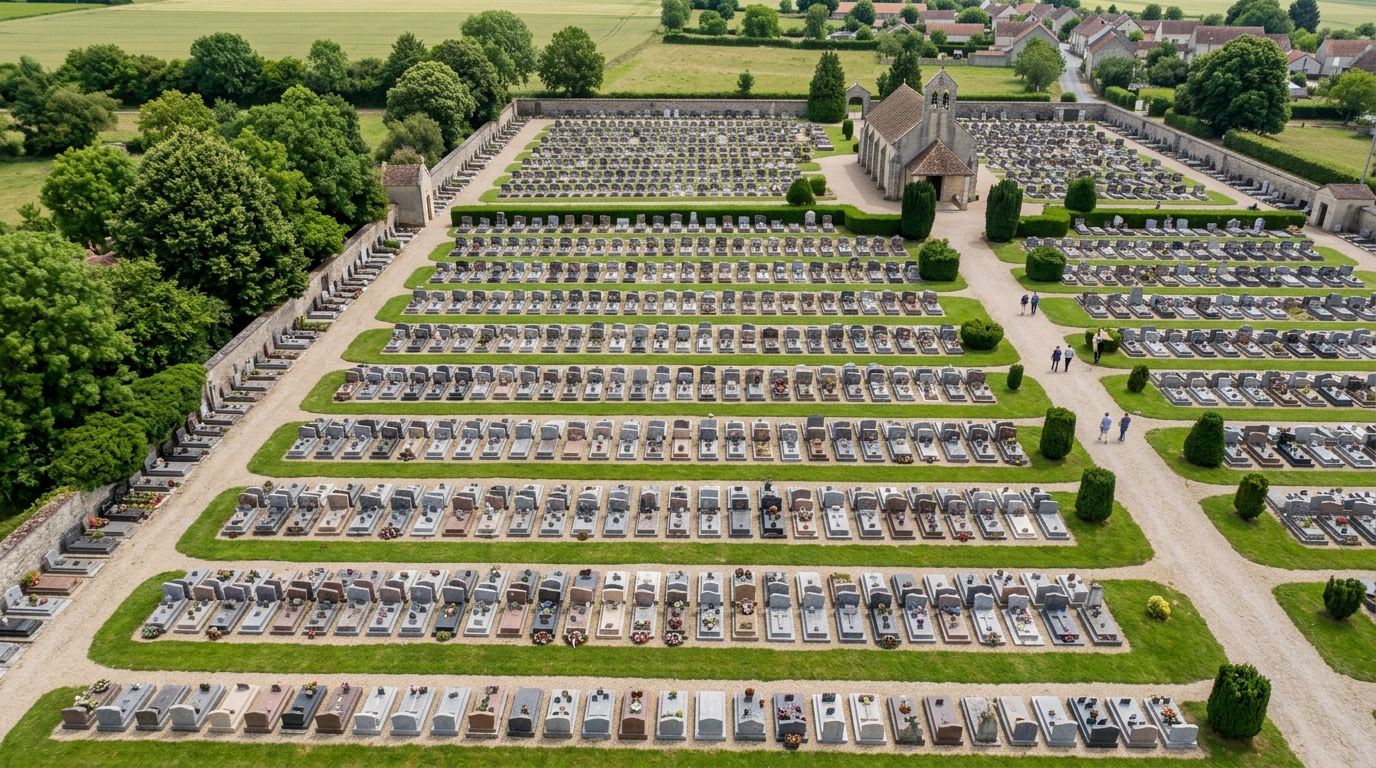
A small bucket, gloves and a lot of good will: this is what millions of French people are about to pull out to tidy the graves of their loved ones before All Saints’ Day. A tender gesture, almost ritual, performed every year without asking many questions. Yet, behind this autumnal spring-cleaning lies a reality that many still ignore: pulling weeds in a cemetery plot with the wrong product can today constitute an offense. Yes, you read that correctly. This seemingly innocuous act, handed down from generation to generation, is governed by a precise law passed years ago, yet still largely unknown to the general public. So, what exactly does this text say, and above all, how can we continue to honor the memory of the departed without breaking the regulations?
- Since the order of January 15, 2021, which took effect on July 1, 2022, synthetic pesticides are banned in cemeteries, including for weed control on graves.
- This ban, continuing the Labbé law, aims to protect soils, groundwater, and the biodiversity present in these green spaces.
- To maintain a plot legally, it is advised to weed by hand, use boiling water, mineral mulch or ground-covering plants.
- What the law changes in French cemeteries
- Why synthetic pesticides are now banned on graves
- Weeding by hand or with boiling water: the permitted methods
- A practice still largely ignored by families before All Saints’ Day
- The risks involved and alternative solutions to maintain graves
What the law changes in French cemeteries
In recent years, cemeteries have not escaped the broad environmental reform that has gradually banned synthetic pesticides from public spaces. An order dated January 15, 2021 extended this ban to cemeteries, with an effective date set for July 1, 2022. Practically, this means that municipalities, but also individuals, are no longer allowed to use chemical weed killers on walkways, lawns, and, of course, the tomb plots themselves. A major shift for a place where people used to think, “as long as it’s clean, no one looks at how.” Now, we must look, and above all, change our habits.
Why synthetic pesticides are now banned on graves
This ban does not arise out of nowhere. It follows the continuation of the Labbé law, which gradually removed chemical pesticides from gardens, parks, and roadways to protect biodiversity and limit soil and groundwater pollution. Cemeteries—often vast green spaces in the heart of towns or villages—do not escape this logic. The problem is that these products don’t just kill weeds between tombstones: they seep into soils, run off into watercourses, and threaten insects, including pollinators that did nothing to deserve it. A cemetery remains a living space, crossed by birds, hedgehogs, and a whole discreet fauna that should be safeguarded, even if the atmosphere of the place does not invite thoughts of biodiversity.
Weeding by hand or with boiling water: the permitted methods
Don’t panic; it remains quite possible to maintain a grave without turning your action into a crime. The simplest method is manual weeding: a hoe, a weed knife, or simply hands protected by gloves allow you to remove unwanted plants without any risk to the environment. Boiling water is another widely used alternative, highly effective against weeds that settle between gravel or paving stones. It’s enough to pour the water directly at the root to burn the plant without leaving behind toxic residues. Some municipalities even offer diluted white vinegar as an auxiliary solution, though its use should be moderated to avoid excessive soil acidification.
A practice still largely ignored by families before All Saints’ Day
The catch is that this regulation remains too poorly communicated to the general public. As All Saints’ Day approaches, the period when cemetery visits surge, many people instinctively pull out the chemical weed killer purchased years earlier, stored in the shed, convinced they are properly “cleaning” the family plot. Many discover the ban when confronted by a notice at the cemetery entrance, or worse, after being challenged by a municipal officer. Ignorance of the law does not excuse non-compliance, but it goes a long way toward explaining why this habit persists, far more stubborn than the weeds themselves.
The risks involved and the alternative solutions for maintaining graves
Using a synthetic pesticide in a cemetery exposes you to penalties, just as any violation of phytosanitary regulations. Beyond the legal aspect, there is also an environmental coherence issue: a cemetery treated chemically directly contributes to soil and water pollution, well beyond the few square meters of the plot in question. Fortunately, solutions exist and require surprisingly little extra effort. Here are simple practices to adopt to maintain a grave without breaking the law:
- weed regularly by hand to prevent roots from taking hold for good
- apply boiling water to gravely or paved areas
- prefer a mineral mulch that naturally limits weed regrowth
- choose ground-cover plants that occupy space and smother unwanted growth
- seek guidance from the town hall about local cemetery-specific guidelines
Maintaining a grave without chemical products takes a bit more time and elbow grease, but it is also an opportunity to rethink this moment of remembrance in a different way. A simple gesture, ultimately more respectful of the memory of the deceased and the environment that surrounds them.
