
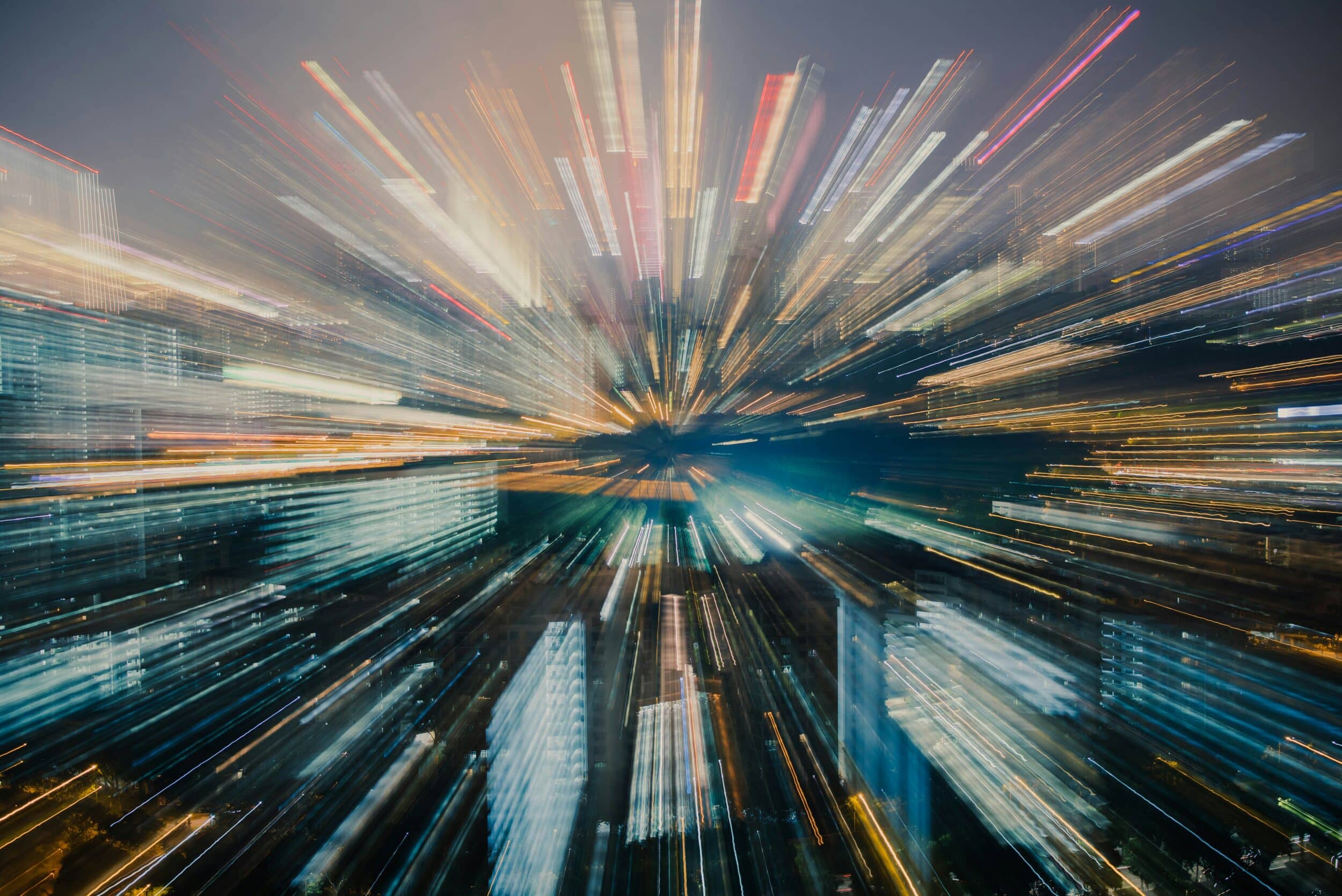
Light travels at 299,792 kilometers per second — the absolute speed limit of the universe. But what would happen if that speed dropped drastically? Scientists have slowed it to 61 km/h in a lab. MIT has built a video game to simulate the effects. And the answer to this physics question is far more dizzying than one might imagine.
What you will learn
- Why slowing the speed of light would not merely slow light — but would destabilize the entire universe
- What redshift, time dilation, and Lorentz transformation mean concretely for an observer
- How a MIT video game lets you experience relativistic effects of nearly stationary light in real time
61 km/h: Light Put in Its Place
Under normal conditions, light travels 299,792 kilometers in one second. That is the constant c — the fundamental conversion factor that links space to time, energy to mass, in every equation of modern physics.
But in the lab, researchers managed to bring it down to 61 kilometers per hour — slower than a car on a highway — by transmitting photons through ultra-cold sodium atoms held a few billionths of a degree above absolute zero.
The feat is real. The theoretical consequences of such a reduction on the scale of the universe, however, would be catastrophic.
E = mc²: why everything would collapse
Slowing light in a medium like water or a Bose-Einstein condensate is one thing. Truly reducing the constant c would be another matter — a manipulation of the very foundations of physical reality.
The most famous equation in physics, E = mc², says that the energy of an object equals its mass multiplied by the square of the speed of light. If c were to drop substantially, the energy available in the universe would collapse in tandem. The nuclear reactions that power stars would fade away. Matter itself would become different.
Changing c does not slow light — it rewrites the universe from the ground up.
Overtaking light in its own slowed-down universe
But let’s put aside these catastrophic considerations and play along with the simulation.
In a universe where light is as slow as a jogger, something odd would become possible: it would be possible to surpass it. And that is when Einstein’s special relativity enters with all of its quirks.
The phenomenon is known as time dilation: the closer an object travels to the speed of light, the more its own time slows relative to an outside observer. If the light speed were reduced to a few tens of kilometers per hour, a simple jog would become a relativistic undertaking. You’d get home with hardly a sweat, while your friend on the couch would have aged by several years.
Redshift, blueshift: the universe changes color
In this same slowed-down universe, something else would become visible to the naked eye: the Doppler shift of light.
You’ve heard the ambulance’s sonic effect — the siren climbs as it approaches, drops as it moves away, because waves compress or stretch. Light does exactly the same thing. An approaching object appears bluer; a receding object appears redder.
This is how Edwin Hubble discovered the expansion of the universe in 1929 — by noticing that distant galaxies appear slightly redder than they ought to. In a slow-light universe, this effect would be visible without a telescope, with the naked eye, in the street.
The MIT game: experiencing relativity in real time
In 2012, MIT created a video game to make all this tangible: A Slower Speed of Light.
The principle is simple: the player moves through a 3D space, collecting orbs that progressively reduce the speed of light. As the constant c approaches the player’s speed, relativistic effects accumulate in real time — redshift and blueshift, a spotlight effect that intensifies brightness in the direction of motion, distortion of space by the Lorentz transformation, and that uncanny phenomenon that lets you see objects as they were in the past.
The physics are rendered with mathematical precision. And the result is, according to the MIT creators themselves, quite destabilizing.
The game is freely available on most operating systems — for anyone who wants to experience the end of the universe from their desk.
