
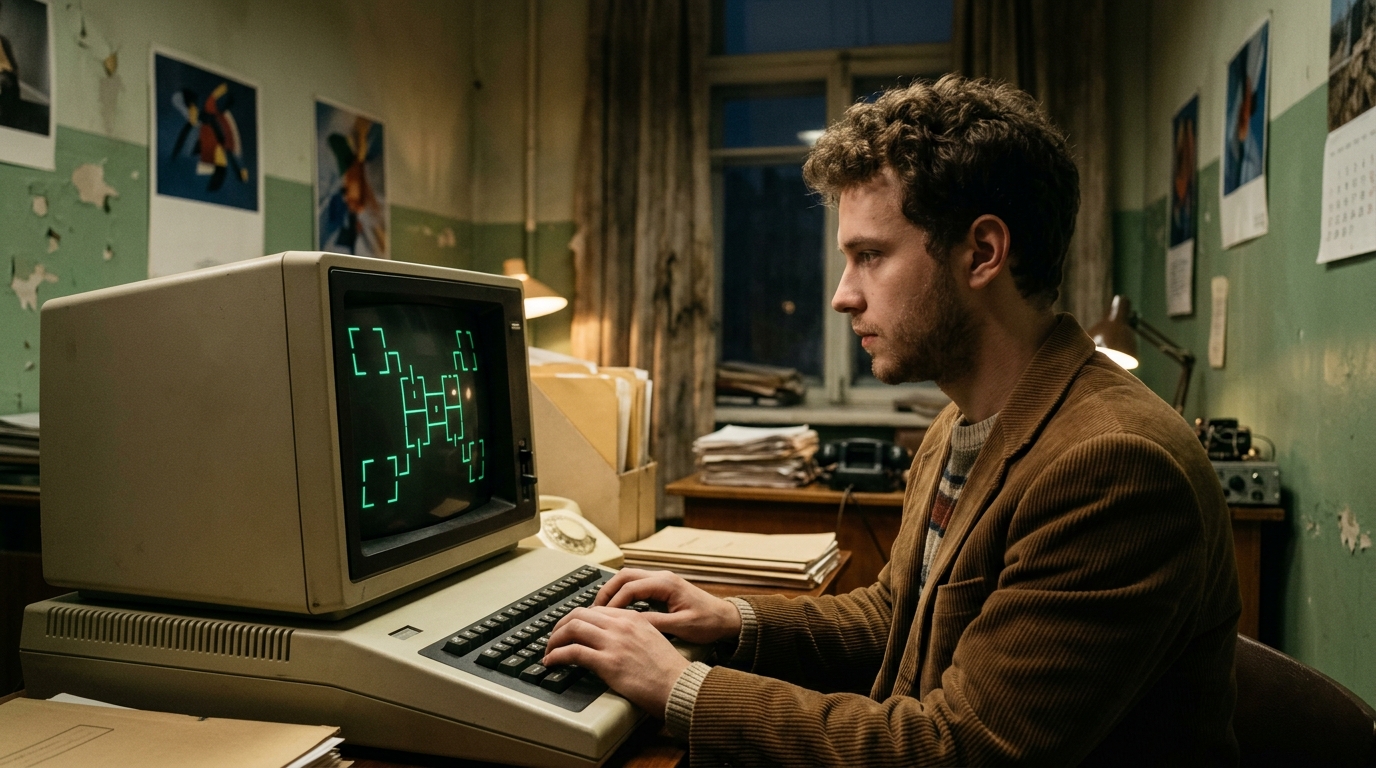
A game you’ve probably played on your phone or your console was coded without a single image, using only brackets and spaces on a text screen. Its creator did not earn a penny for twelve years. The story of Tetris deserves attention, as it reveals much about the USSR of its time.
- Alexei Pajitnov coded Tetris in June 1984 on an Elektronika 60 without a graphical interface, representing pieces and terrain with brackets and spaces.
- Having ceded the rights to his research center, Tetris became the property of the Soviet state, exploited worldwide by the Elorg agency.
- Pajitnov did not receive any income until 1996, the year he founded The Tetris Company with Henk Rogers to regain license management.
- Brackets on a monochrome screen: the unlikely birth of Tetris
- When the Soviet state appropriated the game from its own employee
- Twelve years of financial exile: Pajitnov deprived of the fruits of his worldwide success
Brackets on a monochrome screen: the unlikely birth of Tetris
It all begins at the Dorodnitsyn Computing Center, affiliated with the Soviet Academy of Sciences, in Moscow. It is there that Alexei Pajitnov works as a researcher, unaware that he will create one of the most famous video games in history. The prototype comes to life during his spare time, somewhat like a personal project pursued on the fringes of his official research.
To code his idea, Pajitnov uses the Pascal language and works on an Elektronika 60, a Soviet clone of the American PDP-11, running RT-11. A crucial technical detail to remember: this machine has no graphical interface. No pixels, no colors, nothing of what we now associate with a video game.
Pajitnov therefore had to demonstrate creativity. He models the playing field and the pieces with simple spaces and brackets, relying on a purely alphanumeric screen. The machine, in his own words, had “64 KB of memory with an alphanumeric display.” One can say that we are very far from today’s computing capabilities, even those of a small pocket calculator.
The first prototype is dated June 1984, still within the same Moscow computing center. To simplify the concept, Pajitnov abandons pentominoes, those figures made up of five squares, in favor of tetrominoes, which have only four. This choice reduces the number of possible shapes from twelve to seven, making the game smoother and, above all, much more addictive.
When the Soviet state appropriated the game from its own employee
Coded by Alexei Pajitnov at the Computing Center of the Academy of Sciences in Moscow, Tetris belonged to the Soviet state via Elorg, and its author did not receive royalties until 1996. This sentence alone encapsulates the administrative absurdity into which the game’s creator found himself.
Pajitnov recalls signing a document transferring Tetris’ rights to the computing center for a period of ten years. A seemingly banal gesture at the time, but laden with consequences. In a contemporaneous interview, he explained bluntly that “the Tetris contract happened without me.”
The reason lies in a fundamental principle of the Soviet system: the Academy of Sciences, as a public institution, was not allowed to engage directly in commercial activities. Since Tetris had been written by an employee of that institution, the game legally belonged to the state.
In practice, all global exploitation rights were entrusted to the state agency Elorg. It was Elorg that negotiated contracts with Western companies wishing to distribute Tetris; it was Elorg that collected the revenues, while the man who originated the concept remained entirely outside the economic equation.
Twelve years of financial exile: Pajitnov deprived of the fruits of his worldwide success
While Tetris conquered Western living rooms and then portable consoles, Pajitnov watched the phenomenon from Moscow, without receiving any financial benefit. He himself has stated that he did not receive any income related to his game until 1996, twelve full years after its creation.
Twelve years is a long time. It was the period needed for the creator of a cult game to finally regain control of his work, in a geopolitical context undergoing rapid change with the collapse of the USSR and the gradual opening to a market economy.
The situation finally changed in 1996, the year Pajitnov founded The Tetris Company alongside Henk Rogers, the man who had helped bring the game to international attention a few years earlier. This company was created specifically to manage licensing rights worldwide, allowing the creator to receive a rightful share of the revenues generated by his invention.
This turning point marked a decisive shift. Pajitnov moved from the status of a mere Soviet official deprived of his creation to that of a partnered entrepreneur, finally able to capitalize on what had become one of the best-selling games in history.
The story of Tetris wonderfully illustrates how political and economic contexts can shape, or even divert, the fate of an invention. A simple arrangement of brackets on a monochrome screen, born in a Moscow office, crossed the Iron Curtain to become a global phenomenon, while its inventor waited patiently to finally reap what he had sown.
