
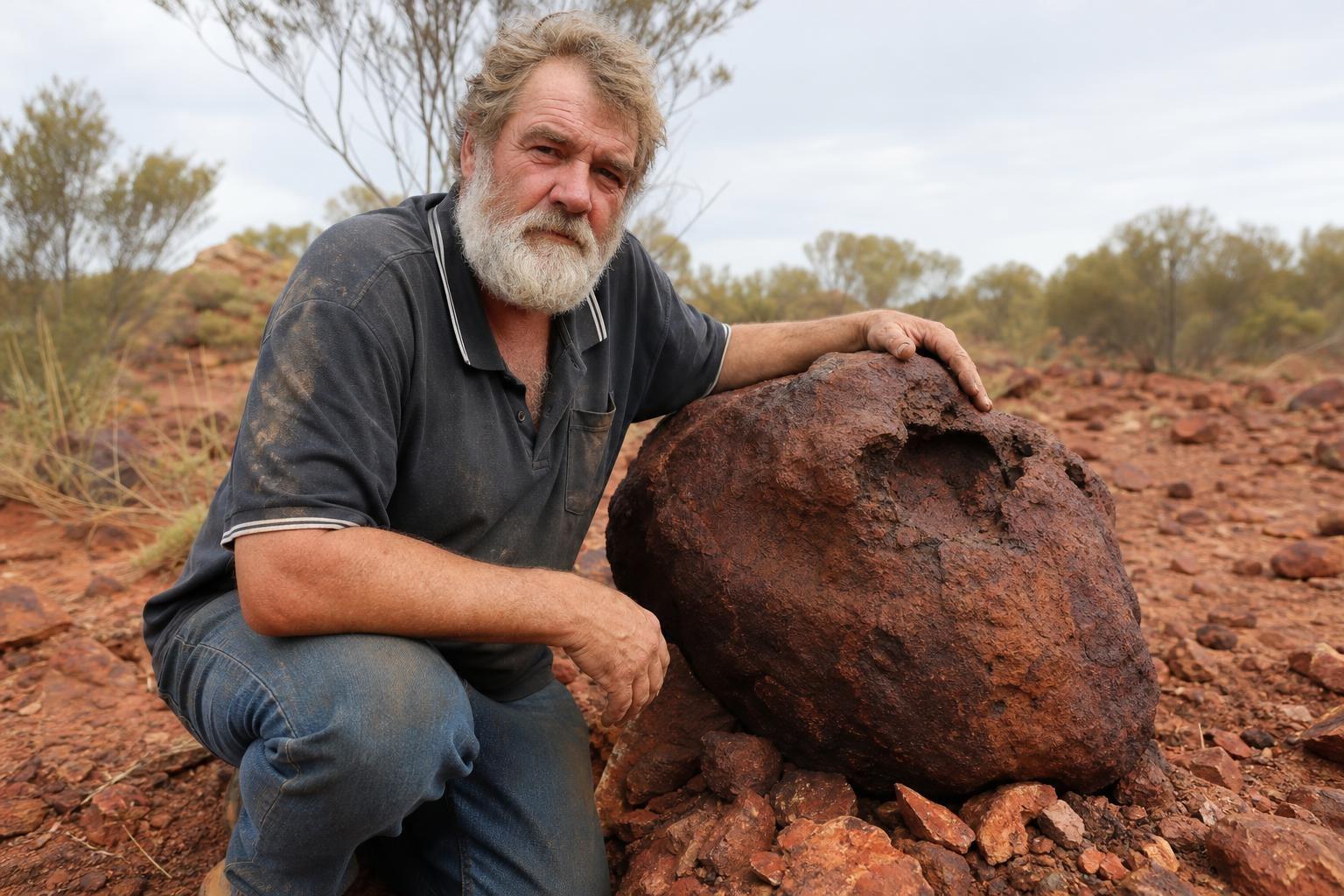
He didn’t look like a treasure hunter, just a patient weekend prospector with a battered metal detector and a stubborn streak. In the red-dusted bush of Victoria, he lifted a heavy stone that pinged the detector so hard it felt like a promise. The surface was rust-red, the heft surprising, and the hope simple: inside, there might be gold.
For years, he tried to break it. A sledgehammer bounced off. An angle grinder cried sparks and gave up. Even a bit of acid barely hissed. “It just wouldn’t budge,” he later said, half amused, half exasperated. He kept the thing anyway. Sometimes you keep a mystery because it refuses to let you go.
From the paddock to the museum bench
When curiosity finally beat secrecy, he walked the stubborn stone into a local museum. Within minutes, the geologists leaned in closer. “That’s not your typical rock,” one murmured. The surface held soft thumbprint pits, like clay pressed by a giant hand. The color was a weathered red, the interior—tested by a tiny cut—a metallic, speckled gray.
“It has that sculpted skin we see when objects fall from space,” a curator said. “They melt a little on the way in, and the wind of their descent shapes them.” The room went quiet with that special, private silence scientists make when the ordinary tilts toward the cosmic.
Older than every mountain you know
Under the lab lights, instruments told the longer story. The rock was rich in iron, laced with nickel, studded with chondrules—the tiny, once-molten beads that record the first moments of our planetary neighborhood. Age estimates landed around 4.6 billion years, which is to say: as old as the solar system itself.
“People look for gold, but sometimes the Earth hands you the universe,” a geologist joked, eyes still on the polished slice. In the cross-section, metallic flecks gleamed like starlight caught in cooled lava. This wasn’t a nugget from a vein. This was a fragment of a shattered asteroid, a pilgrim that wandered until gravity tugged it down to a sheep paddock in Australia.
What the prospector missed—and why anyone would
Out in the field, a meteorite can masquerade as a lump of ironstone. It’s heavy, yes, but so are many earthly rocks. It rusts on the outside. It gathers dust. It looks like everything you’ve walked past a hundred times. The difference hides in texture, in metal content, in the way a magnet clings like it has a secret.
He had swung a hammer and heard the unpromising clank. He had watched the grinder’s teeth skitter. Those defeats were actually clues. Dense nickel-iron alloys shrugged off the casual tools of impatience. “If I’d known, I would have taken it in sooner,” he admitted. “But I thought I needed to open it to see the value.”
Why these space stones matter
Museums love chondrites because they are archives in mineral form. They hold whispers of pre-solar dust, record ancient heating events, and trap the chemistry of earliest worlds. Cut thin enough, they reveal chondrules frozen mid-swirl, like raindrops hardened into glass. Each slice is an invitation to ask better, older questions.
From a research bench in Melbourne to labs around the world, samples like this help refine models of planetary birth. You can weigh them, magnetize them, zap them with beams, and read their isotopic clocks. You can listen for the echo of collisions in the asteroid belt. You can chart how water, carbon, and metal first met.
For anyone who finds a strange rock tomorrow
You don’t need a million-dollar scanner to guess you’ve found a visitor from space. You need careful eyes, a gentle touch, and the humility to ask for help.
- Is it unnaturally heavy, slightly magnetic, and dressed in a thin, dark, melted-looking crust with shallow “thumbprint” dimples? You might be holding a piece of elsewhere.
If the signs stack up, wrap it carefully, avoid cutting or cleaning, note the exact find location, and call a local museum or university. The wrong wire brush can erase vital clues. The right phone call can open the door to a larger story.
The man and the meteorite, after the reveal
The prospector didn’t lose his wonder when the gold dream evaporated. He gained a timeline. “I held something that started before Earth,” he said, shaking his head. “You can’t put a price on that.” He still walks the scrub with his detector, still listens for that generous beep, but now he listens a little differently.
He knows the land can occasionally hand you the sky.
And he knows that a stubborn, red-streaked stone that refuses to open might be trying to tell you something older than any map, any mine, any name we give to the ground under our boots.
