
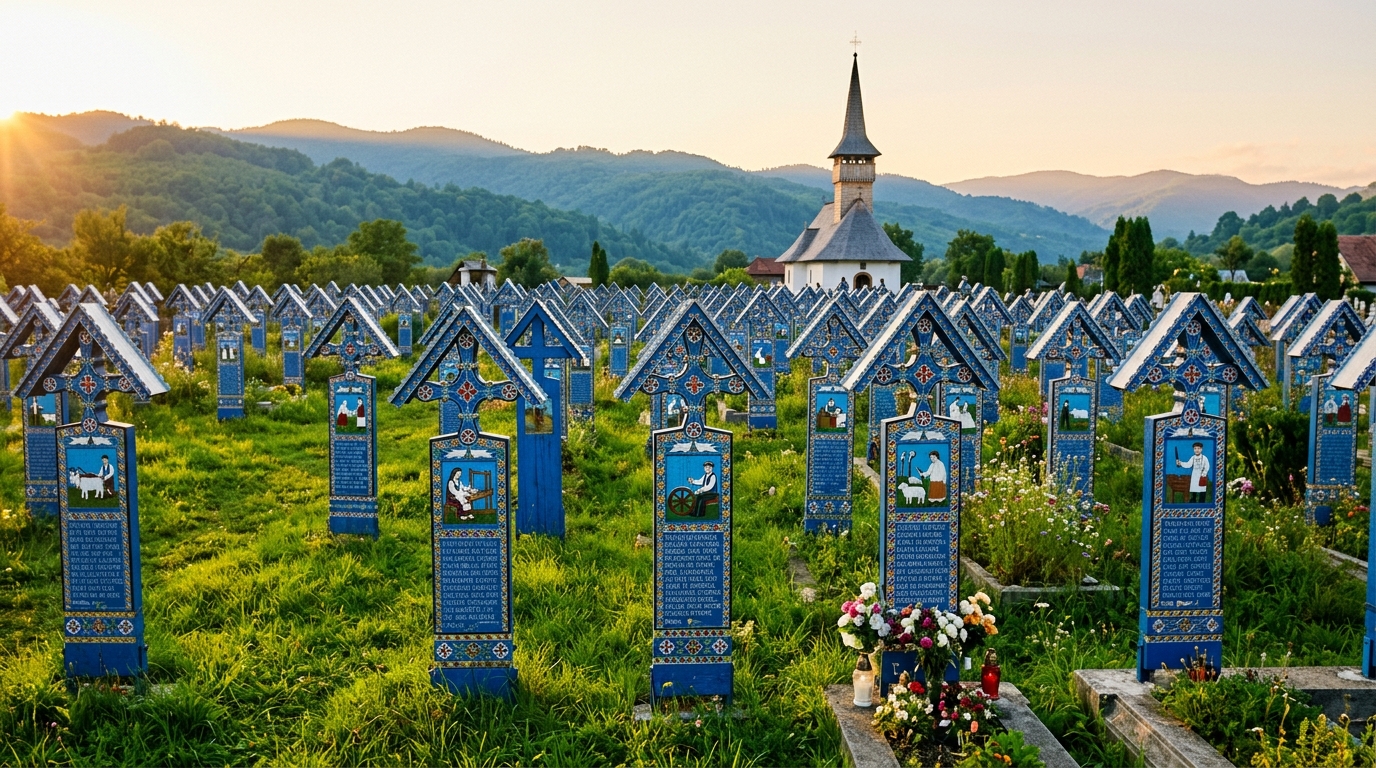
In Romania, an entire cemetery turns away from the usual silent mourning. The reason? A woodcarver decided in 1935 to replace the standard funeral formulas with mocking verses and scenes of life painted in vivid blue. The result: more than 800 crosses where humor prevails over sadness.
- In 1935, the sculptor Stan Ioan Pătraș created the Joyful Cemetery of Săpânța by carving humorous epitaphs on oak crosses painted in bright blue.
- After Pătraș’s death in 1977, his apprentice Dumitru Pop Tincu took over the workshop to carry on this family craft.
- This tradition is threatened by massive illegal logging of local oak, with Maramureș affected by illegal cuts and clear-cutting documented on thousands of hectares.
- A local sculptor who turned mourning into a burst of laughter
- Epitaphs that tell life with disarming frankness
- A family workshop that has preserved a world-unique art for nearly a century
A Local Sculptor Who Turned Mourning Into a Burst of Laughter
Everything begins in Săpânța, a village in Maramureș, a mountainous, wooded corner in northern Romania. It is there that one of the most singular cemeteries I’ve had the chance to discover while preparing this article surrounds the Orthodox church Nașterea Maicii Domnului as if nothing were out of the ordinary.
The story starts with Stan Ioan Pătraș, a woodworker settled in this remote corner of the Carpathians. In 1935, he carved his first epitaph on a cross, breaking with the usual gravity of cemeteries. His gesture might have seemed banal at the time, but it would give birth to a tradition that now spans nearly a century.
Each cross is carved from oak, a sturdy material able to withstand the region’s harsh winters. It is then painted in a distinctive shade locally nicknamed the blue of Săpânța. On this colorful backdrop, Pătraș added a naïve drawing depicting the deceased in a scene from daily life, accompanied by a short poem.
Epitaphs That Tell Life With Disarming Frankness
What strikes first is the tone used on these epitaphs. Rather than pious formulas or customary regrets, they feature verses that plainly recount the small flaws, occupations, habits, or even the vices of the deceased. Humor mingles with tenderness, sometimes with biting irony.
A dispatch from the Associated Press described the site as an ensemble of more than 1,000 wooden Orthodox crosses, engraved with colorful epitaphs that clash with the traditional image of a cemetery. This unapologetic frankness turns a visit into an almost joyful experience, far from the silent reverence one might expect.
Pătraș’s idea rested on a simple conviction: death is part of life, so tell it honestly rather than gilding it. This philosophy shines through in every cross, where the portrait of the deceased seems almost to wink at you from beyond the veil.
A Family Workshop That Has Preserved a World-Unique Art for Nearly a Century
Stan Ioan Pătraș died in 1977, but his know-how does not fade with him. His apprentice, Dumitru Pop Tincu, took over the workshop and continued to carve, paint, and engrave new crosses according to the same codes. Even today, the cemetery continues to expand, driven by this direct master-to-apprentice transmission.
Săpânța remains a modest village, with 3,031 inhabitants recorded on an area of 139.17 square kilometers. Yet this commune in Maramureș has managed to project a popular art far beyond Romanian borders, thanks to the fidelity of this family workshop to Pătraș’s original gesture.
But this tradition depends on a growingly fragile resource: local oak. Maramureș is one of Romania’s historical centers of wood, and the national forest inventory still cites about 20 million cubic meters of wood illegally felled each year across the country. In 2020, Romania’s Environment Minister Costel Alexe even announced thefts exceeding 100,000 cubic meters of wood on 340 hectares of Maramureș forests, calling it the largest illegal logging operation recorded in Romania in five years.
Environmental organizations have also documented more than 10,000 hectares of clear-cutting within the Natura 2000 site of Maramureș, in a complaint filed with the European Commission. The PRIMOFARO study, published by EuroNatur in 2019, identified 525,000 hectares of potential primary and old-growth forests in Romania, of which only a small portion currently enjoys strict protection. A striking paradox, given that these same forests provide the raw material for a heritage of art that is truly singular.
The Joyful Cemetery of Săpânța illustrates how a popular tradition can transform our relationship with death while remaining closely tied to its natural environment. Between disarming humor and threats to the Maramureș forests, this place tells far more than a tourist curiosity: it bears witness to a fragile balance between culture, craft, and local resources.
