
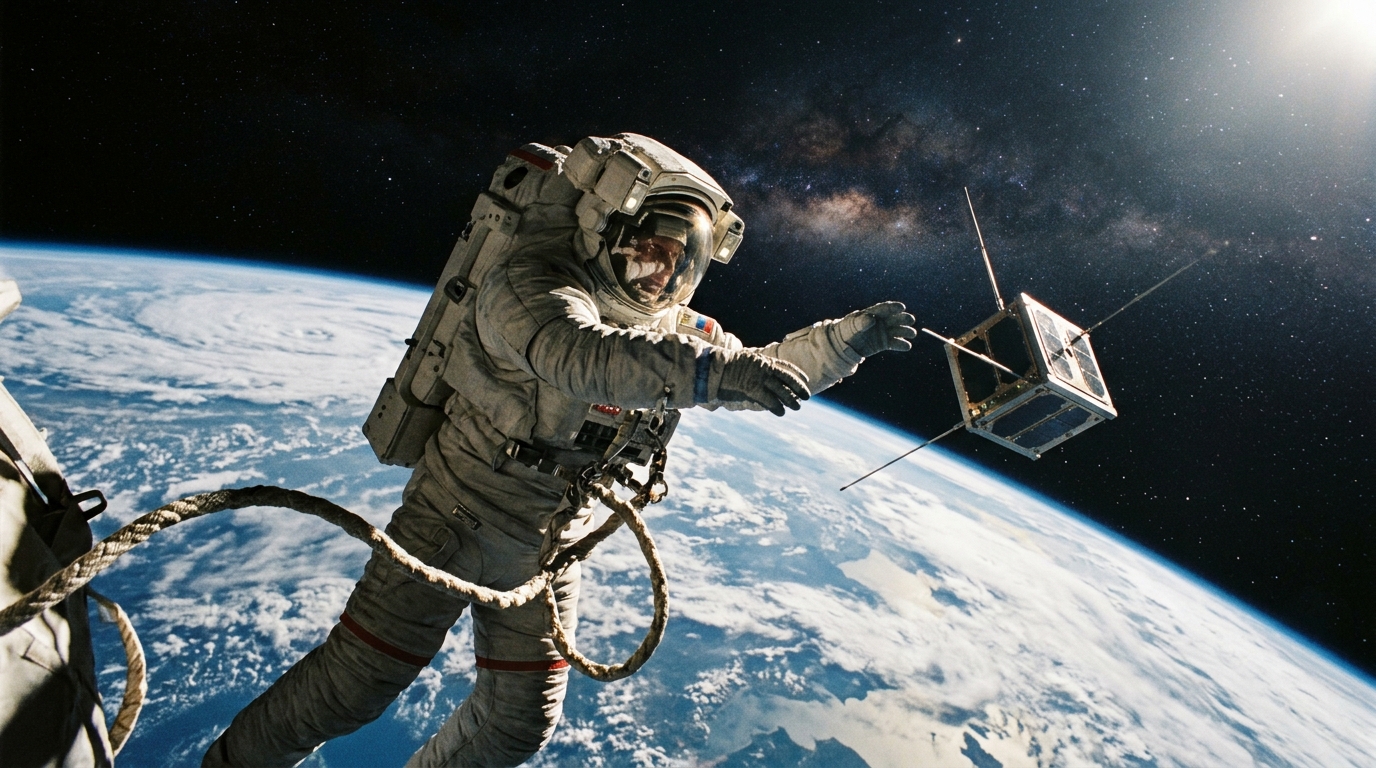
In the vacuum of space, some satellites are not propelled by an engine nor ejected by a sophisticated deployment system: they are simply launched by hand by astronauts during an extravehicular activity. A banal, almost childlike gesture that is enough to place an object into Earth’s orbit.
- Russian cosmonauts hand-launch small nanosatellites weighing 5 to 11 kg from the ISS, a routine practice since at least 2014
- These satellites automatically inherit the station’s velocity (about 28,000 km/h); the cosmonaut’s gesture only serves to move them away from the ISS
- Launches are governed by strict safety rules that limit ground risk to less than a 1 in 10,000 chance
- An arm throw that is worth millions of dollars in rocket launches
- The simple gesture that is enough to conquer weightlessness
- These hand-thrown nanosatellites that change the space landscape
For many years, Russian cosmonauts have taken advantage of their extravehicular activities to engage in an exercise that entirely defies the traditional imagination of space launches. Rather than entrusting these tiny devices to a launcher or an automated deployment system, they literally eject them with their hands from outside the International Space Station.
An arm throw that is worth millions of dollars in rocket launches
This has been the practice of Russian cosmonauts for several years: during spacewalks, they deploy small devices not by a rocket or a deployment mechanism, but by throwing them by hand from the outside of the station.
This is precisely what happened in August 2017, when Fiodor Iourtchikhine and Sergueï Riazanski deployed five nanosatellites from a ladder attached to the outside of the Pirs airlock. Each device weighed between 5 and 11 kilograms, roughly the weight of a well-packed grocery bag. In other words, the operation looked more like a dexterity challenge than a heavyweight aerospace engineering feat.
Among these five satellites, one carried a housing manufactured by 3D printing, named Tomsk-TPU-120. Designed by Tomsk Polytechnic University, its mission was to test the behavior of 3D-printed materials when exposed to the extreme conditions of low Earth orbit. Another broadcast a multilingual message commemorating the launch of Sputnik 1, which could be received by amateur radio operators worldwide according to Roscosmos.
This extravehicular activity, initially planned to last six hours, ended up extending by more than an hour and a half, concluding shortly after midnight. A reminder that even the simplest gestures in the vacuum of space require time and absolute precision.
The simple gesture that is enough to conquer weightlessness
To understand why a simple arm throw can place an object in orbit, one must shed a common misconception. In space, it is not about defeating Earth’s gravity, but about giving an object enough speed to maintain its orbit rather than fall back. The International Space Station is already traveling at nearly 28,000 kilometers per hour.
A nanosatellite released by hand therefore automatically inherits that immense velocity. The cosmonaut’s gesture merely adds a small additional impulse, sufficient to move the device away from the station and set it on its own trajectory. It is a bit like dropping a ball from a car already moving at full speed: the ball continues to travel with the vehicle’s momentum, it does not need a motor to do so.
This method has been used well before 2017. As early as 2014, a Russian cosmonaut had hand-thrown a small Peruvian satellite into the void during an EVA. This practice is therefore not a single anomaly, but a well-established routine on the Russian side.
The advantage is clear: no need for a complex deployment system, no extra mechanism to transport up to the ISS. All it takes is an airlock, a spacesuit, and a cosmonaut sufficiently trained to open their hands at the right moment.
These hand-thrown nanosatellites that change the space landscape
This practice has continued and even strengthened over the years. In August 2018, during the 212th extravehicular activity in the ISS’s history, Oleg Artemiev and Sergueï Prokopiev spent almost eight hours outside the station. The program: the manual launch of four CubeSats and the installation of the Icarus experiment.
These four satellites had a particularly touching origin. Two of them, the Tanyusha, had been built by students of Southwestern State University, while the other two, the SiriusSat, had been assembled by Russian schoolchildren and equipped with particle detectors. Prokopiev launched them by hand, just outside the Pirs airlock, reproducing a method that had now become proven.
Not all Russian spacewalks, however, lead to this kind of deployment. In May 2026, Sergei Koud-Svertchkov and Sergei Mikaïev simply installed a solar-radiation experiment on the Zvezda module, without releasing a single nanosatellite. That EVA nonetheless brought the total number of extravehicular operations conducted from the station to 278.
Moreover, this kind of launch remains bounded by strict safety rules. Any object capable of surviving atmospheric reentry with kinetic energy greater than 15 joules must be accounted for in the calculation of the overall risk to ground populations, which must stay below a 1 in 10,000 chance. A simple hand gesture therefore never completely escapes the rigors of space engineering.
Behind its apparent simplicity, this method illustrates a reality often forgotten: space is not always synonymous with extravagant technology. Sometimes, a human arm is enough to do what one would normally expect from an entire launcher, provided you are already in orbit and the object fits in a pair of gloved hands.
