
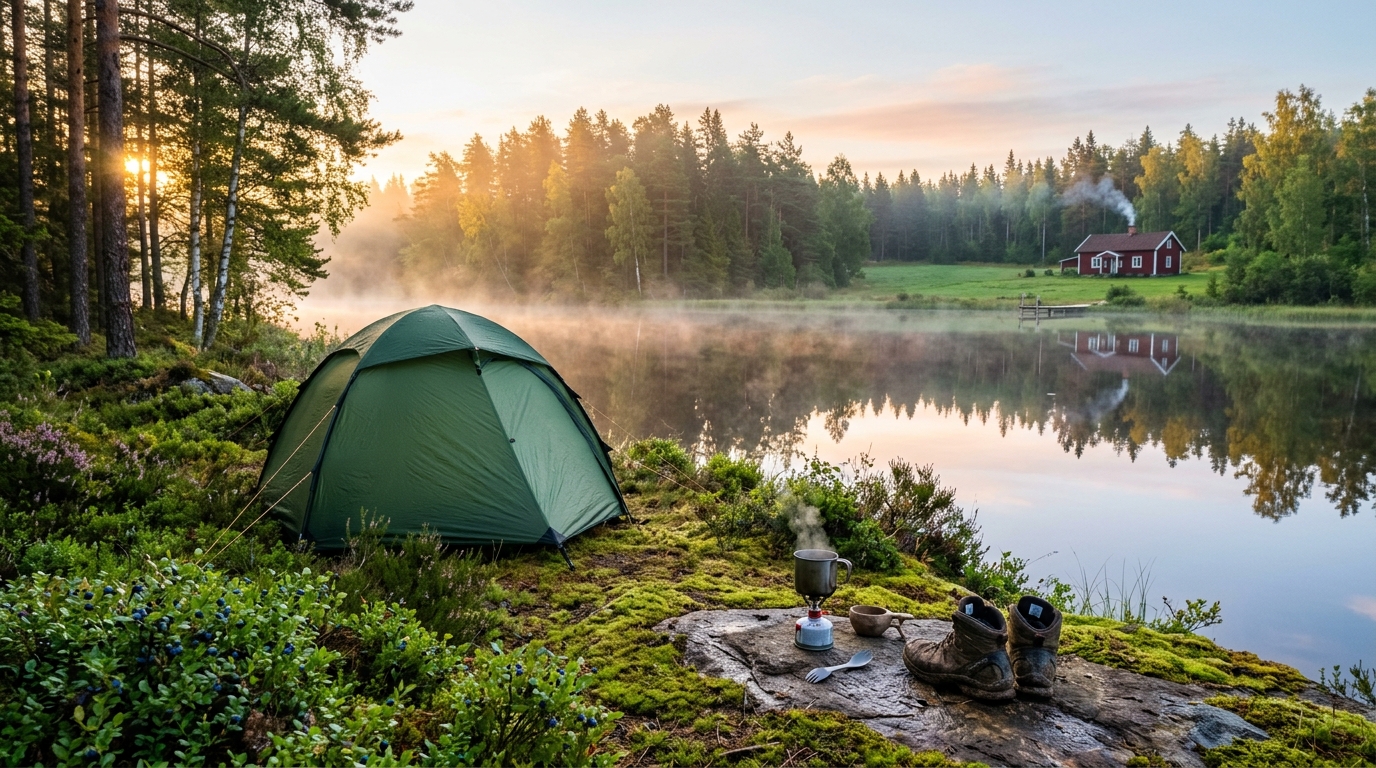
We instinctively think one should knock on the owner’s door before pitching a tent somewhere. In Sweden, this logic collapses completely. A hiker can settle on private land, sleep there one night or two, without ever asking for permission. This right even has a place in the Constitution.
- The allemansrätten, an ancestral right enshrined in the Swedish Constitution since 1994, allows anyone to camp on private land without permission for one or two nights at most.
- This right excludes private gardens, the immediate surroundings of homes, and cultivated lands, and requires not disturbing or destroying places.
- Similar principles exist elsewhere in Europe, such as Dartmoor in England since May 2025 or in Scotland since the Land Reform Act of 2003.
- This ancestral right that defies conventional private property logic
- Two or three tents, one night or two: the little-known limits of this freedom
- Why Sweden has protected this right in its constitution since 1994
This ancestral right that defies private property logic
In France, the very idea of pitching a tent on land that isn’t ours triggers an instinct of caution. We imagine the landowner arriving, furious, ready to call the police. In Sweden, that scenario simply does not happen.
For generations, the country has applied a principle called allemansrätten, literally the right of everyone. It allows anyone to hike, bike, ride a horse, ski, or camp on any land, whether it belongs to the state or to a private owner.
Of course, this right does not apply to all of Sweden’s spaces without distinction. Private gardens, the immediate surroundings of homes, and cultivated lands remain protected. But elsewhere, nature becomes a common good that no one can truly appropriate.
What is striking is the antiquity of this tradition. The allemansrätten does not spring from a recent law designed to attract tourists. It sinks its roots into a rural custom much older than the modern Swedish state itself.
Two or three tents, one night or two: the little-known limits of this freedom
It would be tempting to believe that Sweden gives a free pass to anyone who wants to camp wherever they please. The reality is more nuanced, and that is precisely what makes this right interesting to unpack.
According to Visit Sweden, the national tourism office, you can pitch a tent for one or two nights at most. You simply need to avoid settling too close to a house, on agricultural land, or on pastures where animals graze.
The agency Naturvårdsverket, responsible for environmental protection, sums up this philosophy in a simple formula: do not disturb, do not destroy. Two or three isolated tents go unnoticed. A mass camp, by contrast, requires the explicit permission of the owner.
Other restrictions also apply. Sports grounds, national parks, and nature reserves may ban wild camping, with each municipality able to adjust its own local rules. Even foraging follows a similar logic: berries and mushrooms remain accessible to all, but truffles, which require digging the ground, require prior authorization.
Why Sweden has protected this right in its constitution since 1994
What really distinguishes Sweden is the level of protection afforded to this right. Chapter 2, Article 15 of the Swedish Constitution has protected this right since 1994, the year the principle was codified in the Environment Code, the Miljöbalken. The constitutional text mentions access to nature under the allemansrätten, without precisely defining it, deliberately leaving room for interpretation.
This choice is not a legal accident. By enshrining this principle in its fundamental law rather than in a mere regulation, Sweden states that access to nature is part of its national identity, on par with other fundamental freedoms.
To help foreign visitors understand these subtleties, Naturvårdsverket published in 2025 an English edition of its guide titled The Right of Public Access. This code of conduct outlines best practices to follow, aiming to prevent abuses that could undermine a system built primarily on mutual respect.
This Swedish model is not entirely isolated in Europe. In May 2025, the British Supreme Court unanimously affirmed the right to bivouac on the commons of Dartmoor, rejecting the appeal of landowners who opposed the Dartmoor National Park Authority. This decision rests on the Dartmoor Commons Act of 1985, but it remains an exception: Dartmoor remains the only place in England where camping without permission is legal. Scotland, for its part, has opened access more widely to its lands and inland waters thanks to the Land Reform Act of 2003, evidence that this Nordic philosophy is slowly spreading elsewhere on the continent.
This contrast among European countries speaks volumes about how each society views the relationship between private property and the common good. Sweden has made a clear choice: to view nature as belonging primarily to those who know how to respect it, not only to those who hold the title.
