
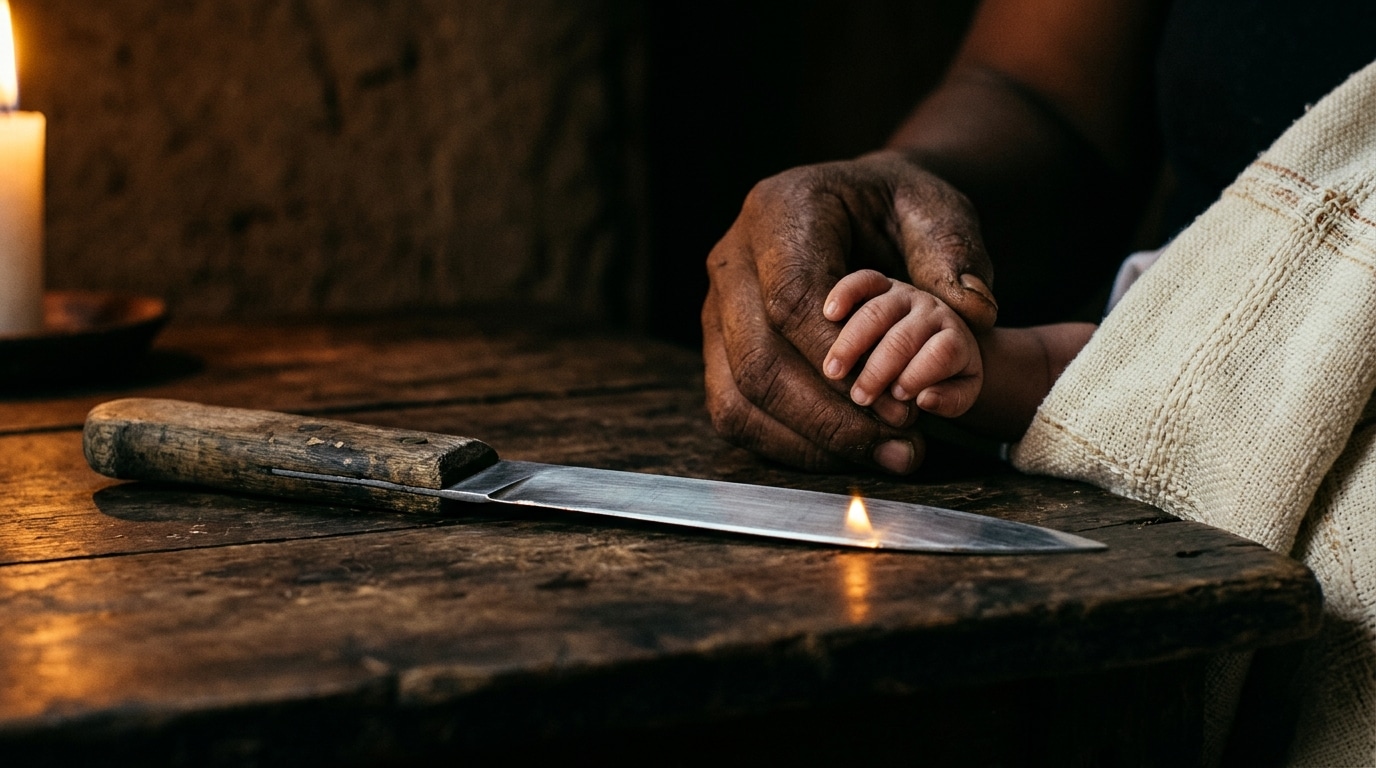
A lone woman, in a cabin perched high in the Mexican mountains, takes a kitchen knife and opens her own abdomen. No doctor, no anesthesia, no second chance. Yet she and her son survive. This medical case, published in a respected scientific journal, continues to fascinate the world.
- On March 5, 2000, Inés Ramírez Pérez, isolated in Río Talea in Oaxaca, performed a 17 cm incision with a kitchen knife to deliver her son Orlando, without anesthesia or medical assistance.
- Sutured only sixteen hours after the event and subjected to a second surgery for intestinal injuries, Inés left the hospital alive ten days later, as did her child, a case published in 2004 in the International Journal of Gynecology & Obstetrics.
- The World Health Organization records about 260,000 maternal deaths worldwide in 2023, and although Mexico still shows a high ratio according to the OECD, Oaxaca posted a 78.4% decrease in such deaths between 2022 and 2023.
- A night in Oaxaca when everything changed
- The impossible act: saving herself with her own hands
- A medical report that stunned the whole world
A Night in Oaxaca When Everything Changed
Río Talea is a hamlet clinging to the mountains of Oaxaca state, in southern Mexico. A one-room house, with unreliable electricity, no nearby doctor, no phone at hand. It is here that Inés Ramírez Pérez, a Zapotec peasant in her forties, awaits her seventh child.
The night of March 5, 2000 tilts toward midnight. Twelve hours of contractions have already passed. No midwife, no car, no passable road at that hour. The nearest hospital lies about eight hours away, a distance that, under these circumstances, feels like the other side of the world.
Inés senses that something is wrong. Labor is no longer progressing. Her husband is absent, having gone to drink at a village bar, according to the case documents. She is alone facing a pain that won’t ease and a baby that does not descend.
The Impossible Act: Saving Herself with Her Own Hands
Facing a dead end, Inés makes a decision that few humans would have the courage, or the determination, to consider. She drinks alcohol, probably to dull what is about to follow, and then grips a kitchen knife about 15 centimeters long.
She performs a vertical incision of roughly 17 centimeters, to the right of the navel. No anesthesia, no sterilization, no trained medical intervention. Just survival instinct and the conviction that staying inactive would mean losing her child, or even life itself.
The baby is born alive. Inés names him Orlando. She cuts the umbilical cord herself with scissors, before losing consciousness, exhausted by the pain and blood loss. This moment, suspended between life and death, would later become one of the most discussed cases in the world’s medical literature.
A Medical Report That Stunned the World
Inés’s wound is sutured only sixteen hours after the event, once aid finally reaches Río Talea. A second surgical intervention becomes necessary on the seventh day to address intestinal injuries caused by the initial incision. She ultimately leaves the hospital ten days later, alive, as does her son.
The case first surfaced at a medical meeting the following year, before being formally documented. The case was published in 2004 in the International Journal of Gynecology & Obstetrics as a self-inflicted cesarean section with maternal and fetal survival. The article, signed by Molina-Sosa, Galvan-Espinosa, Gabriel-Guzman and Valle, details every step of this extraordinary intervention.
Rafael Valle, co-author of the study and an obstetrician at Northwestern University in Chicago, publicly confirmed in 2004 that this story was not a hoax. A literature review by Szabó and Brockington would later classify this type of act among extreme acts of despair, recording several similar cases around the world, but rarely with a outcome as favorable as this one.
This improbable ending is partly explained by the almost surgical precision of Inés’s act, which avoided vital organs despite the total absence of medical training. The Mexican press continues to relay this story regularly, as evidenced by a La Razón de México article from October 2025, proof that this case has not lost its force twenty years after the events.
This tale, as extraordinary as it is, points to a broader and far less cheering reality. The World Health Organization estimated about 260,000 maternal deaths worldwide in 2023, roughly one every two minutes, tragedies largely deemed preventable. In Mexico, the maternal mortality ratio remains high according to the OECD, with 44 deaths per 100,000 live births on the three-year average, according to the 2025 Health Panorama. Locally, however, notable progress has been recorded: Oaxaca’s Health Services announced in 2026 a 78.4 percent drop in maternal deaths in the state, from 37 cases in 2022 to just 8 in the same period of the following year. The story of Inés Ramírez Pérez, born of extreme isolation and an out-of-reach health system, resonates today as a symbol: that gap that can exist between survival and access to care, and the work still needed to close it.
