
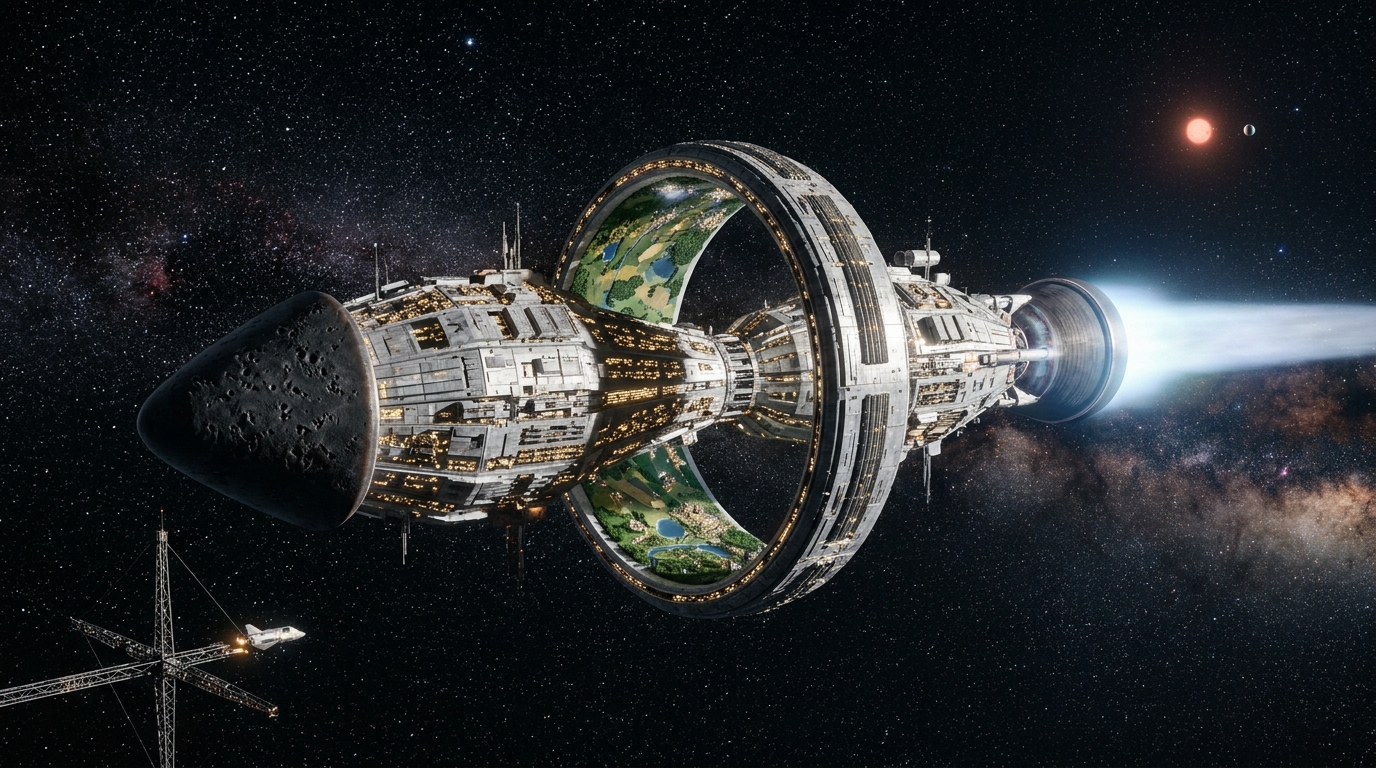
Imagine a great-great-great-granddaughter who is born, grows old, and dies without ever laying eyes on the planet that her ancestors had set as a goal. This is exactly the scenario proposed by Chrysalis, a ship awarded in 2025 by the Initiative for Interstellar Studies: a four-century journey to Proxima b, where generations will live and die in orbit, trapped by a dream they will never see come to fruition.
- Chrysalis, a ship designed by an Italian team, won in 2025 the Project Hyperion Design Competition of the Initiative for Interstellar Studies with a 400-year voyage project to Proxima b
- Measuring 58,000 meters in length and 6,000 meters in diameter, with a total mass of 2.4 billion tonnes, the ship would accommodate between 1,500 and 2,400 inhabitants thanks to direct fusion propulsion and artificial gravity achieved by rotation
- No initial generation aboard would see the arrival on Proxima b, an exoplanet whose habitability remains uncertain, and the technology required for the project does not exist yet today
- Chrysalis, the ship that turns humanity into a multigenerational species
- 1 500 to 2 400 souls confined: the demographic gamble of a one-way voyage
- Born, live and die in orbit: the human price of an odyssey toward Proxima b
Chrysalis, the ship that turns humanity into a multigenerational species
In July 2025, the jury of the Project Hyperion Design Competition, organized by the Initiative for Interstellar Studies (i4is), named its grand winner. Named Chrysalis, this project was designed by an all-Italian team consisting of Giacomo Infelise, Veronica Magli, Guido Sbrogio, Nevenka Martinello and Federica Chiara Serpe. The results were officially published in early August 2025.
The numbers are dizzying. The ship stretches 58,000 meters long with a diameter of 6,000 meters, for a total mass of 2.4 billion metric tonnes. To put it in perspective, it would be like propelling an entire city into space—with its buildings, infrastructure, and population—into the void.
Its propulsion relies on a Direct Fusion Drive powered by deuterium and helium-3. The principle is straightforward: an acceleration of 0.1 g during the first year, followed by four centuries of inertial flight, then a final year of deceleration as it nears Proxima b. The jury particularly praised the coherence at the system level and the modular habitat design, a direct nod to the world-ship concepts that dominated science fiction in the 1980s.
1 500 to 2 400 souls confined: the demographic gamble of a one-way voyage
The competition brief set a precise objective: to embark 1,000 inhabitants, with a margin of 500 people, for a journey of roughly 250 years toward a potentially habitable planet. Chrysalis deviates markedly from this framework with its 400-year scenario, a goal chosen by the winning team and not imposed by the official brief.
The population model envisioned by the designers contemplates about 1,500 people in a stable population, distributed across three active habitat levels. The maximum capacity cited climbs to nearly 2,400 inhabitants, providing room to absorb demographic surges or health contingencies.
Concretely, as the winner of the Project Hyperion competition by the Initiative for Interstellar Studies, Chrysalis envisions roughly 1,500 to 2,400 inhabitants on a journey of about 400 years toward Proxima Centauri b. A figure that immediately raises a question: how to organize the social, economic, and cultural life of a community confined for four centuries in a metal tube streaking through the interstellar void?
The assembly of the ship is envisaged at the Lagrange points, those gravitationally balanced zones where forces cancel each other out. The artificial gravity would be produced by rotation, a principle that science fiction has popularized, but which remains, to this day, purely theoretical for a structure of this scale.
Born, live and die in orbit: the human price of an odyssey toward Proxima b
The destination of this extraordinary voyage is Proxima Centauri b. Announced on August 24, 2016 by the European Southern Observatory (ESO), this exoplanet orbits its star at a distance of just 0.04848 astronomical units, completing a full revolution in only 11.18 days.
But here’s the snag: no one really knows whether this planet is habitable. Its star, a red dwarf, belches ultraviolet eruptions of formidable intensity, capable of stripping away an atmosphere entirely. In other words, the ship could run perfectly, complete its journey without major technical hiccups, and land its passengers on a world that is utterly hostile.
For the generations aboard, this uncertainty takes on an almost philosophical dimension. The initial passengers will depart our solar system knowing they will never see Proxima b. Their children won’t either. Nor their grandchildren. Only a very distant generation born on board will have the chance to glimpse the promised planet through a porthole, without knowing whether they will ever set foot on it safely.
It should also be noted that no fusion reactor suitable for this type of propulsion is currently operational. Chrysalis therefore remains a conceptual design exercise, a way to explore the limits of engineering rather than a project ready to be built in the coming decades.
Such a project reminds us how interstellar travel, for now, remains a challenge that far exceeds our current technological capabilities. Yet it holds the merit of posing essential questions about our ability to project ourselves across centuries, to design entire societies capable of persisting in a closed space far from any home planet. Chrysalis may be only a stylistic exercise born from a design competition, but it perhaps foreshadows the first steps of a humanity that one day will truly have to learn to live, reproduce, and die among the stars.
