
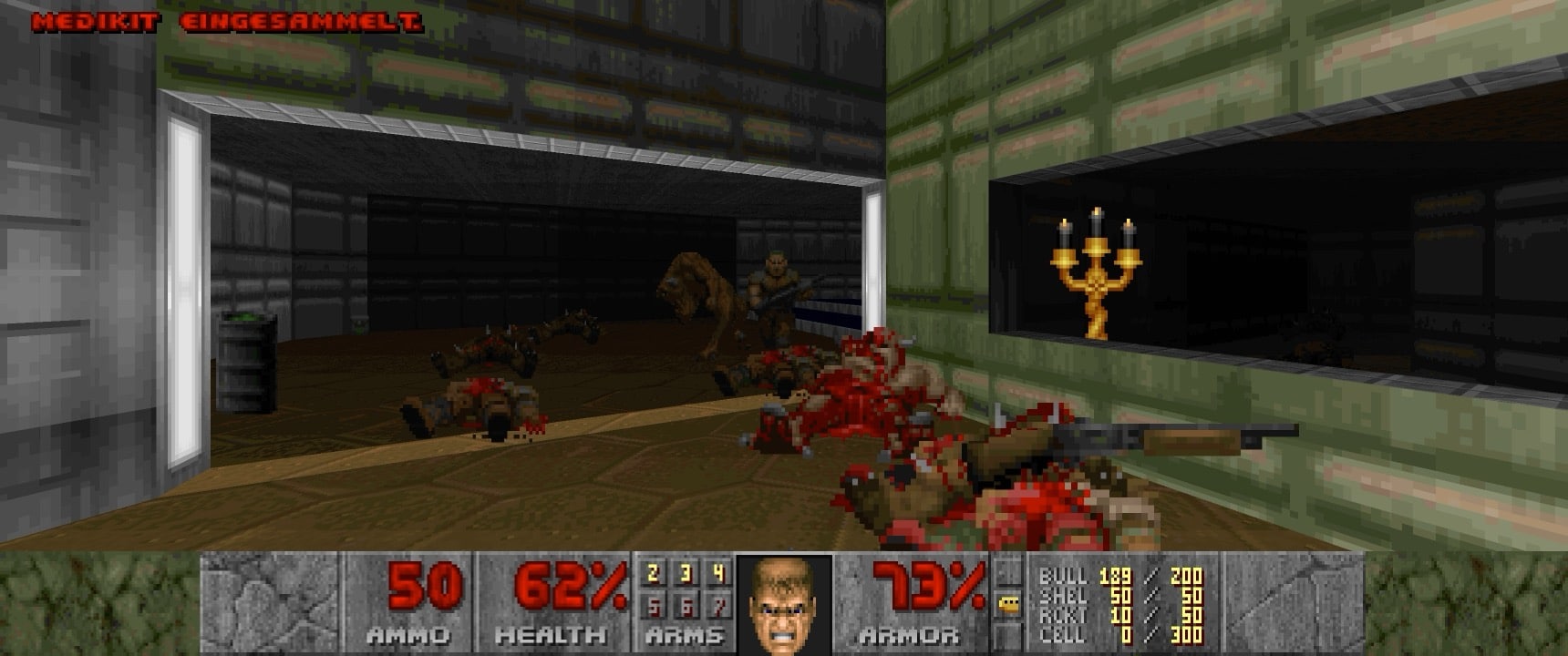
After teaching brain cells to play the retro game Pong, biotech research has just moved beyond a milestone worthy of the best science‑fiction tales. Australian researchers from the startup Cortical Labs have succeeded in linking 200,000 living human neurons to a silicon computer chip and have trained them to play Doom, the renowned 3D shooter from the 1990s. A spectacular advance that signals the dawn of “biological computers,” a hybrid technology with extraordinary energy efficiency.
What you will learn
How 200,000 brain cells organize themselves to play a 3D video game.
How the CL1 chip functions, this interface that translates virtual signals into electrical impulses.
Why biological brains outperform traditional artificial intelligence chips in terms of energy use.
From complete novice to demon hunter
To design this biological computer, scientists cultivated 200,000 human neurons from donor-derived stem cells. After mastering the simple two‑dimensional movements of Pong, this cluster of cells was dropped into the chaotic, three‑dimensional universe of Doom, where players explore corridors and take down monsters.
Initially, the neurons’ skills resembled those of a complete beginner. “They would crash into walls, shoot into empty space, spin around, do odd things,” explains Alon Loeffler, chief scientist at Cortical Labs. But as sessions progressed, the cells learned to adapt to real‑time stimuli and to target enemies with increasing precision. The execution remains imperfect—the system often has to fire several shots and adjust several directions before hitting the mark—but it demonstrates that a tissue of living cells can learn with a goal‑directed objective.
The CL1 chip: the universal translator between silicon and biology
How do you teach a video game to a group of cells? Engineers converted Doom’s digital environment into patterns of electrical signals that neurons can interpret.
When a monster appears on screen, targeted electrodes stimulate the cells of the chip (named CL1), triggering a response in the neural network. In return, the various electrical activity patterns produced by the neurons are translated into concrete game commands: fire, move forward, or turn left and right. From a computer monitor, researchers watch these thousands of tiny electrical dots to adjust their interventions and guide the training of this micro‑brain.
Biological intelligence: the future of eco‑friendly tech?
Beyond performance in video games, the CL1 chip embodies a form of alternative intelligence, potentially more sustainable and capable than traditional computing. While the giant servers that run today’s artificial intelligences consume astronomical amounts of electricity, the human brain operates with an estimated power draw of only 20 watts. It is precisely this energy efficiency that biotechnology seeks to harness.
“This isn’t about replacing what AI does,” cautions Brett Kagan, scientific director of Cortical Labs, “but about giving us capabilities we’ve never had before.” The applications of this technology extend far beyond gaming:
-
Personalized medicine and disease modeling: directly testing molecules on miniature human brains.
-
Drug screening and pharmacology.
-
Robotics and machine learning.
For the moment, these living chips have a lifespan limited to six months and do not yet deliver results that are consistently programmable on an industrial scale. But for semiconductor experts, this is a serious line of inquiry with the potential to break the energy‑consumption barrier plaguing current silicon chips. This unconventional project is no longer science fiction; it is a laboratory reality in vibrant evolution.
