
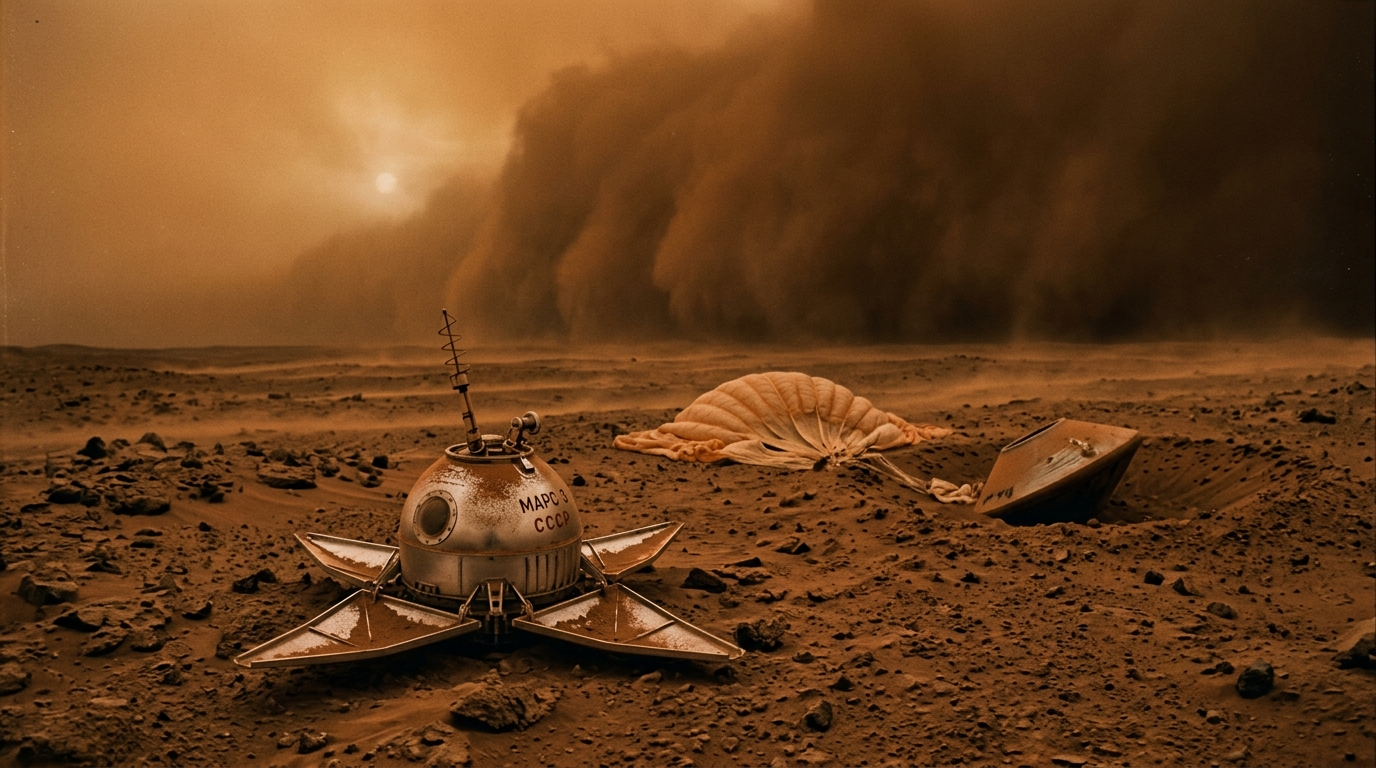
Imagine a robot traversing millions of kilometers, enduring the heat of reentry, deploying its parachute, braking with its retrorockets, landing softly on an unfamiliar surface, and then falling silent less than fifteen seconds later. This is not fiction. This is the story of Mars 3, still lying up there, in the Martian dust.
- On December 2, 1971, the Soviet lander Mars 3 touched down softly on Mars but transmitted for only 14.5 to 20 seconds before going silent, probably due to a global dust storm that damaged its electronics.
- Unlike Mars 3, whose descent sequence was fixed with no option to adjust, the American probe Mariner 9 was able to wait in orbit for the storm to subside before carrying out its mission under ideal conditions.
- In April 2013, images from the Mars Reconnaissance Orbiter allowed the debris of Mars 3 (parachute, heat shield, retrorocket and lander) to be spotted in the Ptolemaeus crater.
- Fourteen and a half seconds of glory before total silence
- An unteachable robot: why Mars 3 was doomed from the start
- Mariner 9, the probe that had the patience to win the race
We often imagine space exploration as a succession of resounding triumphs. The reality is harsher, more human as well. More than a half-century ago, the Soviets achieved a colossal technical feat on Mars, only to see it fade away in the space of a few heartbeats. A look back at an episode as fascinating as it is little known of the conquest of space.
Fourteen and a half seconds of glory before total silence
On December 2, 1971, the Soviet lander Mars 3 achieved what no human-made device had done before: a soft landing on the surface of the Red Planet. An absolutely remarkable technological feat for the era, achieved after a millimeter-perfect descent through a Martian atmosphere that was poorly understood.
Then, almost immediately, nothing more. According to NASA’s Jet Propulsion Laboratory data, transmissions stopped after only 14.5 seconds. The European Space Agency notes a slightly longer duration, around 20 seconds. In any case, we are talking about a radio silence that fell in an unbelievably short time, barely long enough to say hello before fading away.
The exact cause of this failure remains unconfirmed to this day. The most solid hypothesis points to a global dust storm of exceptional violence, enveloping the entire planet. A meteorological onslaught capable, according to experts, of damaging the antenna or the probe’s delicate electronics in the earliest moments after contact with the ground.
What makes the story even more striking is that it is not isolated. Five days earlier, on November 27, 1971, the twin lander Mars 2 became the first human-made object to touch down on Mars. But in its case, there was no soft landing: the craft simply crashed, likely a victim of the same hostile climate that would, a few days later, silence its brother.
An unteachable robot: why Mars 3 was doomed from the start
To understand what actually unfolded during this mission, one must go back to how Soviet engineers designed their flight plan. And there lies the most revealing explanation of this story.
Scheduled before launch, Mars 3 could not wait. Its entire descent, landing, and deployment sequence was fixed in its onboard software months in advance, with no possibility to adjust it once the probe was en route. It’s a bit like sending a parcel with delivery instructions that cannot be modified, even if the weather turns stormy on the big day.
But, precisely, the weather took a turn for the worse. A global dust storm rose over Mars exactly as the mission entered its critical phase. Mars 3 had no means to wait in orbit, to await a lull, or to postpone its descent. Its internal clock was ticking down relentlessly, ignoring the actual conditions on the ground.
Result: the lander touched down in the midst of a storm, surrounded by winds laden with abrasive particles, in near-total darkness despite Martian daylight. A catastrophic scenario that no one had anticipated with such intensity, and that the rigidity of the flight program simply made impossible to avoid.
Mariner 9, the probe that had the patience to win the race
A few weeks apart, another probe crossed the exact same storm, with a radically different fate. Mariner 9, from NASA, entered orbit around Mars on November 13, 1971, becoming at the same time the first human-made craft to orbit a planet other than Earth.
Unlike Mars 3, Mariner 9 possessed a decisive advantage: it was reprogrammable from Earth. Faced with the global dust storm that obscured almost all Martian relief, with the exception of the southern polar cap and the top of a high mountain poking above the clouds, the JPL teams simply chose to wait.
While the dust slowly settled, Mariner 9 did not remain idle. The probe used this downtime to photograph Phobos and Deimos, Mars’ two tiny moons, gathering valuable data about these bodies still poorly understood at the time.
Once the Martian sky cleared, Mariner 9 was able to carry out its mission under ideal conditions. After about a year of observation, it had sent back 7,329 photographs and mapped 85% of the Red Planet’s surface, a scientific record unlike any of its Soviet counterparts, silenced in just a matter of seconds.
Yet Mars 3’s story does not end there. In April 2013, Russian enthusiasts spotted in images from the Mars Reconnaissance Orbiter shapes reminiscent of the parachute, the heat shield, the retrorocket, and the lander itself, in the Ptolemaeus crater, not far from the planned landing site. Mars 3 thus still waits there, frozen in the dust, at the very spot where it fell silent. And while its wreckage waits, the exploration of the Martian surroundings continues to be written: the Japanese MMX mission is set to return samples from Phobos with the Franco-German rover Idefix aboard, while China prepares its Tianwen-3 mission for the end of the decade. Proof that, even after fifty years of radio silence, Mars continues to fascinate as much as it intrigues.
