
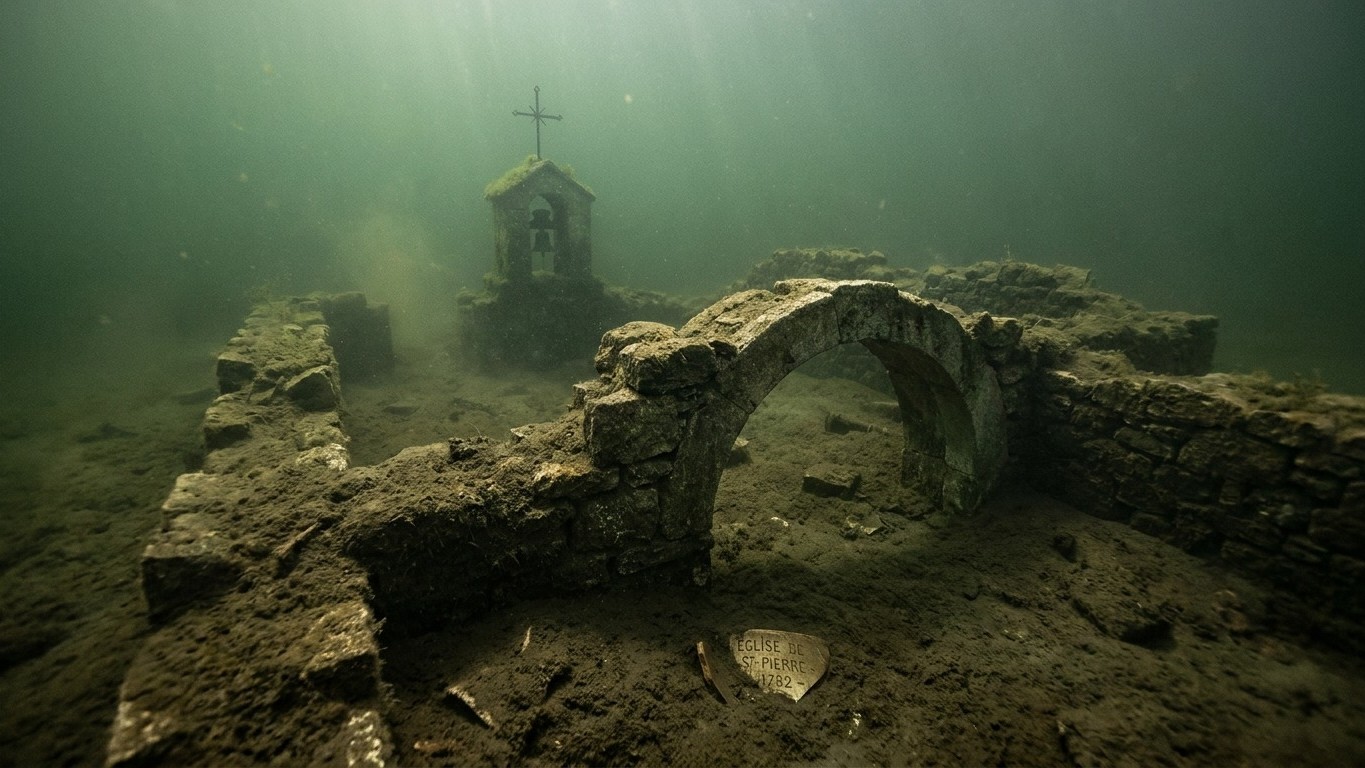
Under 150 meters of turquoise water, between the ski resorts of Tignes and Val-d’Isère, a steeple waits. Since 1952, it has only resurfaced on three occasions, during the Chevril lake drawdowns organized by EDF to inspect its dam. Each time, the same images circulate: stone walls rising from a cracked bed of mud, a century-old bridge found intact, the foundations of an entire village that French electricity made disappear.
Key takeaways
- A church steeple waits under 150 meters of water for seven decades
- Thousands of visitors crowd in each time the lake empties
- Modern technology could prevent the village from ever surfacing again
A village erased from the map to produce electricity
The story begins in a France drained by scarcity, where coal is scarce and factories run slowly. To answer this deficit, the state chooses to dam the Isère at the Chevril lock, in Haute-Tarentaise. A town of nearly 400 inhabitants that the state had dynamited and then drowned in 1952 to build the tallest dam in France. Old Tignes was not merely a mountain hamlet: it was the seat of the commune, perched at the bottom of the Isère valley at an altitude of 1,659 meters, with its church, its flocks and its hamlets, La Chaudanne, La Reculaz, Les Boisses, Les Brévières. Local archives even mention lace-making practiced by the village women, evidenced by period postcards, a sign of a long-standing community life in this valley.
The inhabitants did not leave of their own accord. Three-quarters of the Tignards refused to sell their properties and, as a result, were expropriated, only a quarter agreeing to sell. The conflict escalated to the courts: the commune even pursued EDF for compensation that would be acceptable. Nothing worked. In April 1952, the gates opened. Under the direction of the Prefect of Savoy, furniture and archives were cleared away in front of the powerless mayor, while a bulldozer cleared the cemetery path for gravediggers tasked with moving the dead. To evict the remaining holdouts, the last Tignards were removed by 500 police officers. Just over a year later, in July 1953, President Vincent Auriol inaugurated the dam, presented as a national pride for a country badly short of energy. The structure, designed by engineer André Coyne, remains today one of the highest arched dams in Europe, standing 180 meters tall and retaining 235 million cubic meters of water, the equivalent of 94,000 Olympic swimming pools.
When the lake empties, the village comes back to life
A village entirely submerged is not merely a geological anecdote. It is an event that EDF and a handful of former residents meet roughly every decade. The first major documented resurfacing occurred in March 2000. The lake was drained for inspection, and many Tignards, including some of the old residents, were able to organize a mass in the ruins of the ancient church now buried. An almost surreal scene: residents returning to pray in the ruins of a place of worship that had vanished half a century earlier, surrounded by mud and bare stones.
Fourteen years later, another draining, another wave of emotion, but on a much larger scale. During the 2014 draining, the ruins of old Tignes reappeared for several weeks, drawing more than 30,000 visitors who were fascinated by this testament to local history. Thirty thousand people came to view walls coated in silt, right in the heart of one of the Alps’ most touristy regions. That figure speaks volumes about the fascination these time-stopped places exert: people travel not for the scenery’s aesthetic appeal but because something buried literally rises to the surface.
2024: the last appearance?
The scene repeated itself once more in April 2024, during a decennial operation undertaken by EDF. The Chevril lake was partially drained, an operation necessary for maintenance of the dam, and it had an unexpected side effect: certain ruins of the submerged village reappeared, having remained intact beneath the water and mud for decades. On social networks, the photos were interpreted as an apparition: naked foundations, a century-old bridge, the outlines of a life suspended since 1952.
But this resurfacing may be the last of its kind. EDF now favors less spectacular, yet more effective methods for monitoring the structure. Inspections are carried out by underwater robots, and no full decennial draining is planned. The steeple may well remain submerged forever, with no chance of resurfacing again. The paradox is bitter: the technology that sank Tignes in 1952 is now replaced by technology that prevents it from rising, even briefly.
The new village of Tignes, for its part, was rebuilt on higher ground in 1956 thanks to state subsidies, and it has become one of the Alps’ most frequented ski resorts. A single detail encapsulates this two-speed story: a handful of survivors from the old Tignes still occasionally gather to recall the vanished hamlets, La Chaudanne or Les Boisses, while hundreds of thousands of tourists now descend the slopes built a few kilometers from their former, submerged graveyard.
Sources: skywayback.com | ina.fr
