
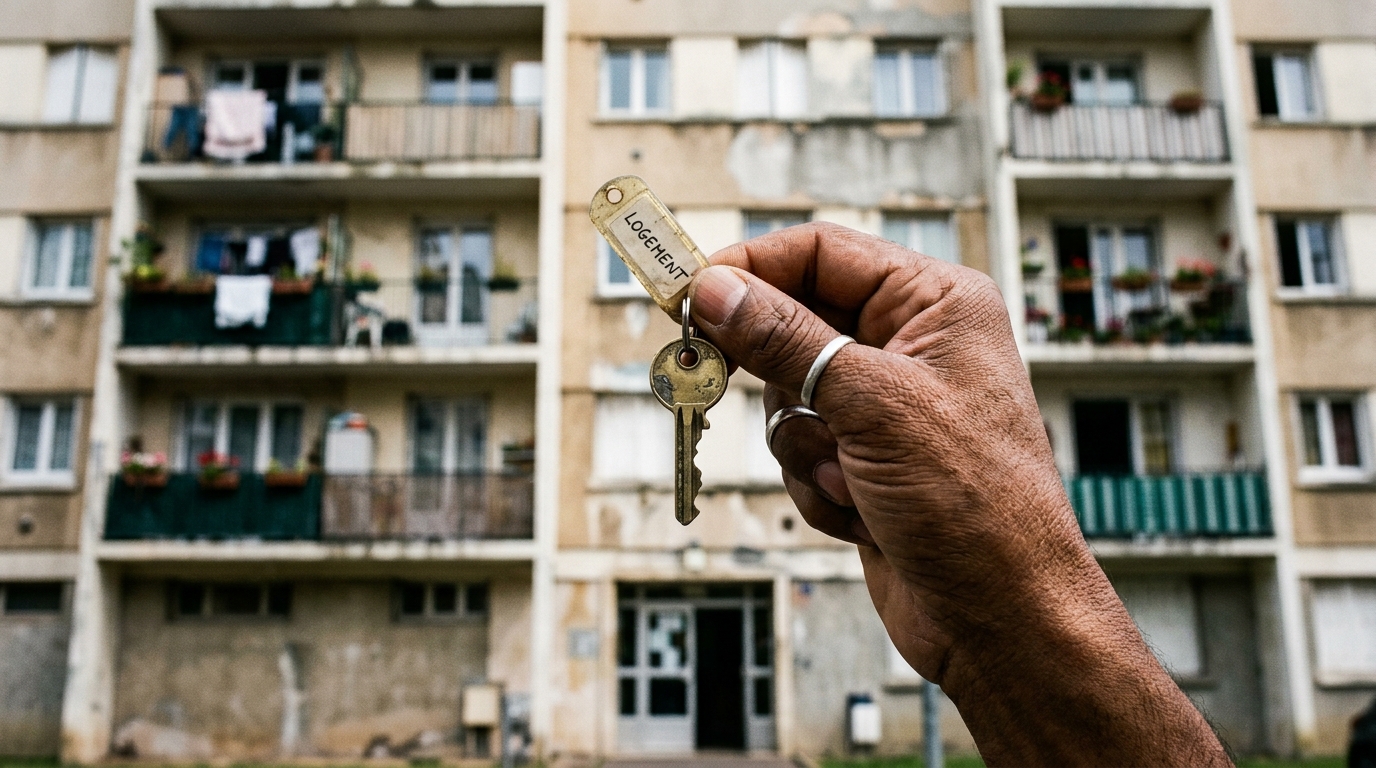
In 2023, France counted 3.1 million vacant housing units according to INSEE — or 8.2% of the total stock. At the same time, 4 million people were inadequately housed according to the Abbé Pierre Foundation. A paradox documented by the official institutions themselves, which raises a simple question: why aren’t these vacant homes being used to house those in need?
What you will learn
- What INSEE figures reveal about the evolution of vacant housing in France since 1990
- Why these 3.1 million homes cannot simply be reintroduced to the market — the documented reasons for their vacancy
- What public policies have tried to do and why results remain limited
3.1 Million Vacant Homes — and 4 Million People Poorly Housed
This stands as the most documented paradox of the French housing market. According to the INSEE study published on January 16, 2024, 3.1 million housing units were vacant in France outside Mayotte in 2023, representing 8.2% of the total stock of 37.8 million housing units. A figure that has risen by 60% since 1990, when there were 1.9 million vacant homes.
What makes this assessment especially striking is the contrast with households’ situations. According to the Abbé Pierre Foundation, cited in a written question to the National Assembly in 2024, more than 4 million people are inadequately housed in France. On one side, millions of empty homes. On the other, millions of people without decent housing. These two realities coexist on the same territory, without market mechanisms able to reconcile them.
A Rise That Accelerated Since 2005
Housing vacancy is not a new phenomenon in France. But its rate has clearly accelerated over the past twenty years. According to INSEE, between 2005 and 2023, the number of vacant homes grew 2.3 times faster than the total number of dwellings — at an average pace of 2.5% per year. A worrying dynamic that signals a structural imbalance between available supply and real demand.
This rise is far from uniform across the country. Vacancy is higher in the least dense areas — rural zones, small towns, departments along the low-density diagonal — and lower in the large urban areas. In Paris and in cities with more than 700,000 inhabitants, the vacancy rate reaches 7%. In towns with fewer than 50,000 inhabitants, it climbs to 9.6%. Vacancy is increasing in almost all departments, with two exceptions: Hérault and Corsica.
Why These Homes Stay Empty
The initial impulse — that they could simply be mobilized — runs into a more complex reality. Not all vacant housing is the same, and not all vacancies are equivalent. INSEE distinguishes several very different situations.
Some homes are temporarily and legitimately vacant: a property owner has just died, an inheritance is in progress, a tenant has just left and the home is being prepared for occupancy. This so-called “frictional” vacancy is unavoidable in any active real estate market.
Other homes are vacant for structural reasons: housing in too poor a condition to be habitable, owner absent or untraceable, necessary works that the owner — often elderly or on modest income — cannot finance. According to a written question to the National Assembly in 2024, 1.1 million homes are in so-called structural vacancy, meaning unoccupied for more than two years. It is these homes that pose the real political question.
Finally, some homes are deliberately kept empty by their owners — waiting for appreciation, a future sale, or because rental yields do not justify the burdens of letting in certain territories.
Tax Tools and Their Limited Effectiveness
To fight vacancy, the State has had since 1999 a tax on vacant housing (TLV), applicable in the so-called tight zones — about 1,000 municipalities where rental demand exceeds the available supply. This tax is progressive: it amounts to 17% of the cadastral rental value in the first year, then 34% from the second year onward. Outside these tight zones, a vacant housing tax (THLV) applies, with less punitive rates.
In 2020, the government launched a National Plan to combat vacant housing, specifically aimed at bringing back onto the market the 1.1 million homes in structural vacancy. This plan mobilizes several levers: renovation aid via ANAH, support for owners, and rental intermediation. But results remain difficult to measure on a large scale.
What 2025 Data Reveal
The provisional INSEE data published in September 2025 point to a slight inflection: 3.0 million vacant housing units as of January 1, 2025, or 7.7% of the stock — down from the peak of 8.1% reached in 2019. This stabilization trend, or even a slight decline, is notable. But it does not resolve the fundamental paradox: 3 million vacant homes for 4 million people inadequately housed, in a country that builds fewer new dwellings than ten years ago.
Housing vacancy illustrates one of the deepest tensions of the French real estate market: between owners whose rights are protected, tenants whose needs are urgent, and a state whose fiscal tools and incentives struggle to reconcile these realities in the territories where the need is greatest.
Sources : INSEE, 1,2 million de logements vacants supplémentaires depuis 1990, janvier 2024 (INSEE Première n°1979) — INSEE, Parc de logements au 1er janvier 2025, septembre 2025 (INSEE Focus n°359) — Assemblée nationale, question écrite n°4226, 17e législature — Fondation Abbé Pierre, rapport annuel 2024 — Banque des territoires, janvier 2024
