
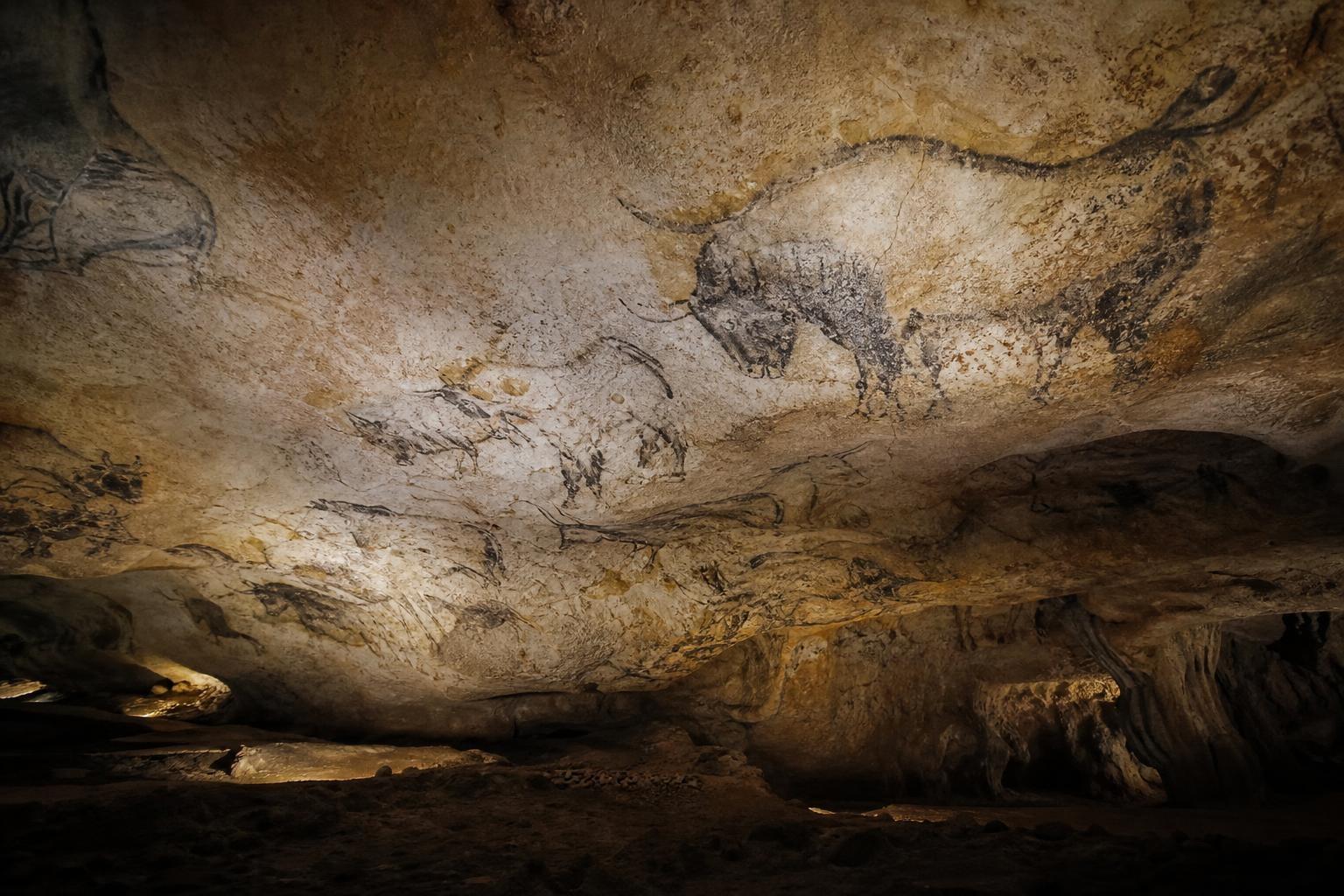
They were young, they were curious, and they were looking for a dog. On a September afternoon in 1940, four teenagers from the village of Montignac followed their runaway companion to a hillside punctured by a dark hole. With a lantern, a rope, and the kind of courage that comes only before adulthood hardens its edges, they lowered themselves into a stone throat. The air turned cool, the light flickered, and then—“animals appeared on the walls.” What they found would redraw the story of art.
A hillside at war, a valley at peace
The Dordogne was quiet, even as Europe burned. The boys—Marcel Ravidat, Jacques Marsal, Georges Agnel, and Simon Coencas—were children of a village rhythm, their days shaped by fields and riverbank footpaths. Their dog, often called Robot, had slipped into a burrow revealed beneath a fallen tree. They returned with a lamp, scrambled past limestone tangles, and slid into a chamber that seemed to breathe.
“Look,” one of them said, as the lantern swung. On the stone, a parade of bulls thundered, larger than life, flanks stained in ochre and black, lines as sure as a heartbeat. The hillside had opened, and time itself fell away.
First steps into deep time
The chamber later known as the Hall of the Bulls filled their vision. The paintings surged—bison, horses, and stags, some more than five meters long. The walls carried roughly 600 paintings and over a thousand engravings, layered like a chorus across ceilings and curves. Every figure felt moving: manes flying, hooves lifted, bodies modeled with shadows pulled from charcoal and clay.
The boys crawled farther, past niches where the rock tightened, into galleries that felt like cathedrals of stone. “It was like a church,” one later recalled, “only the saints were animals and the altar was the earth.” Archaeologists would soon date the images to about 17,000 years ago, at the dawn of the Magdalenian period, when mammoth steppe met forest, and people painted by marrow light.
When science found its voice
Word traveled from farmhouse tables to scholarly desks. Prehistorian Abbé Breuil came, sketchbook in hand, listening to a silence older than any written word. Teams mapped the chambers, photographed the panels, and tracked microclimates as carefully as footprints. Their methods, delicate and inventive, turned awe into knowledge:
- Sampling charcoal for approximate ages, while protecting the pigments
- Tracing panels to capture line, gesture, and superimposed figures
- Charting airflow to understand moisture and mold
- Photographing with diffuse light to preserve surface grains
“Every mark,” one conservator said, “is a decision, and every decision is a risk.” The cave was not just an archive—it was a patient.
The fragile miracle
Crowds came quickly after the war, and the cave paid a steep price. Human breath raised humidity; carbon dioxide stressed the walls; lights encouraged a “green disease” of algae. In 1963, the French government closed the original to visitors, preserving silence as a form of care. Replicas—Lascaux II in 1983, then the International Centre for Parietal Art (Lascaux IV) in 2016—offered fidelity without harm, translating ancient gesture into modern access.
Conservation became a vigil, measured in sensors and swabs, in climate curves and protocols. The cave taught a paradox: the more the world loves a masterpiece, the more it must renounce it to keep it alive.
Reading the animals
What do these images say? Perhaps that survival begins as a story. The painters mixed mineral earths with binders, blew pigments through hollow bones, and animated walls with curves that move as you pass. The famous Shaft scene—bison struck, bird-headed figure, broken-spear motif—feels like ritual, or trauma, or coded myth. We cannot decide with certainty, and perhaps that’s the point.
Look closely: clusters of dots, entwined antlers, headlong motion shaped by the rock’s bulges. The cave is not mere decoration; it’s choreography between hands and stone, a cinema of fire and shadow. “They painted time,” a scholar once said, “and time kept faith.”
The boys become their own legends
Lives unfolded after the lamps were packed. Ravidat returned as a caretaker; Marsal guided early visitors, his voice echoing under painted ribs of stone. Simon Coencas, a Jewish evacuee from Paris, survived the war and later built a life far from the hillside that once opened at his feet. Fame brushed them, then receded like a tide, leaving gratitude and memory.
They had not intended to change the archive of humanity. They were boys with a dog, chasing noise into a hole. Yet they became the hinge on which an entire epoch swung open.
Why it still matters
Stand—if only in a replica—beneath those vaulting creatures, and you feel your own heart align with a rhythm beyond history. The figures insist that art is not an ornament to life but a tool for it: a way to steady fear, to praise abundance, to imagine future days. In a century scarred by war, four teenagers offered the world a gallery of peace painted by people who had almost nothing except skill, nerve, and shared belief.
What began with a lost dog became a found inheritance. The cave still breathes, carefully, behind gates and gauges, and those ancient lines still carry news: that the human urge to make meaning is older than any nation, deeper than any script, and bright enough to light a hill from the inside.
