
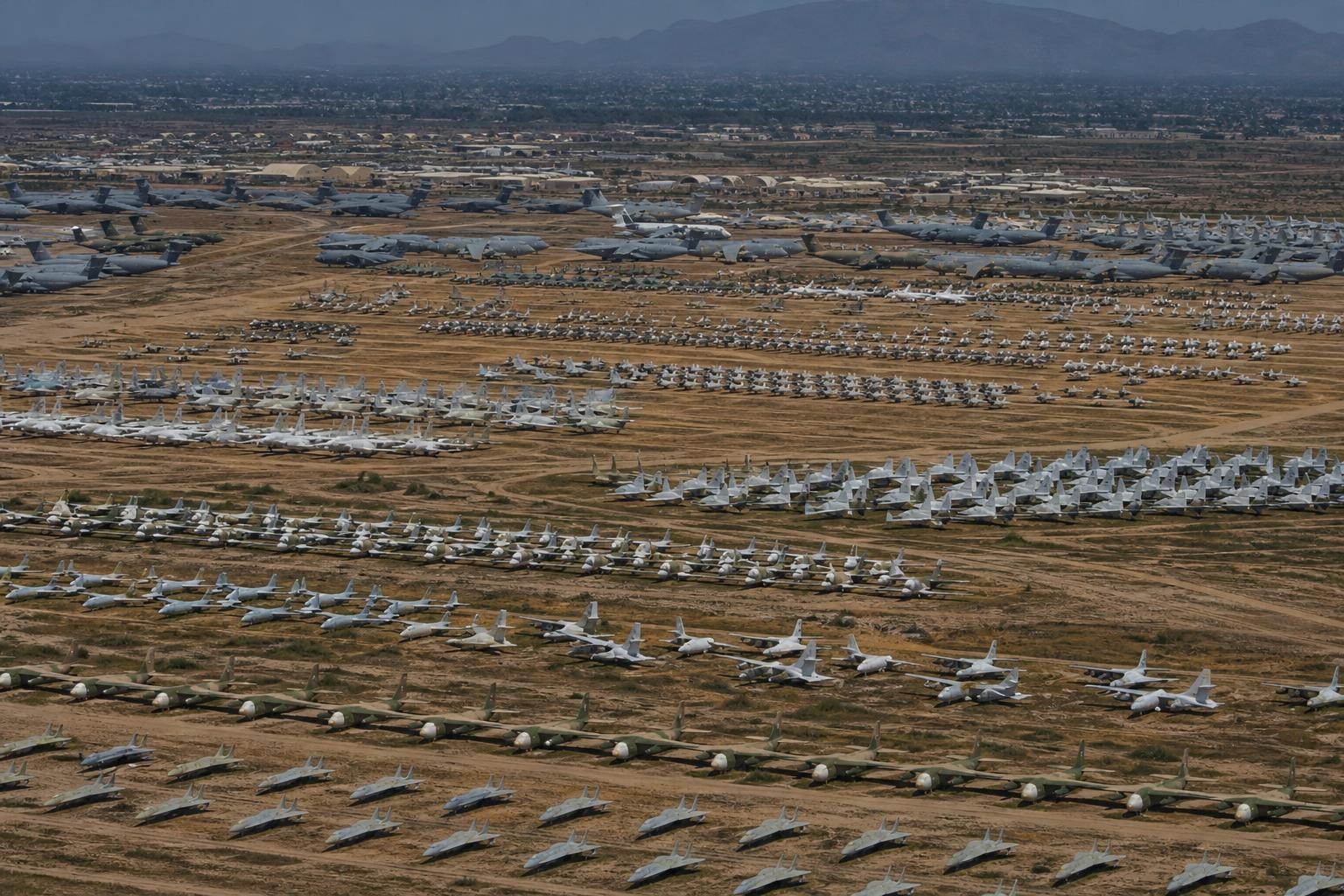
Under the hard Arizona sun, a vast fleet lies silent, their shadows cutting thin lines across the desert floor. Here, metal cools, paint fades, and decades settle like dust upon wings that once chased horizons. Most will never feel throttle or sky again, yet their presence remains immense and strangely alive.
Step closer and the quiet feels engineered, not accidental, like a library of airframes arranged for a future that may never arrive. The air is sharp, the light merciless, and the purpose both practical and poetic: preserve what can be saved, honor what can be used, and keep what must be counted.
“This place is where time pauses,” a worker might say, dusting a gloved hand over aluminum, “and where the past is always available.”
A city of metal and memory
This is AMARG, the 309th Aerospace Maintenance and Regeneration Group, tucked against Davis–Monthan Air Force Base in Tucson. Over roughly 2,600 acres, more than 3,000 military aircraft rest in orderly rows, a postwar mosaic that keeps expanding and evolving. Since the 1940s, fighters, bombers, transports, and patrol planes have arrived, each tagged, inspected, and assigned a fate.
The locals call it the boneyard, but that sells the precision short. Every tail number is tracked, every panel logged, every bolt potentially part of a jet that still flies today. The operation is less a cemetery than an archive, and less an archive than a toolbox big enough to outfit a fleet.
Why the desert works
The climate is the technology here. Tucson’s dry air slows corrosion, the lack of salt preserves skins, and a hard “caliche” substrate keeps landing gear from sinking into the earth. “Moisture is the enemy,” technicians like to say, and the desert keeps that enemy at arm’s length.
Before storage, aircraft are washed to remove residues, then defueled and drained to prevent swelling, leaks, or hidden rot. Openings are sealed with bright spraylat, a rubbery coating that keeps dust out and sunlight off critical seams. In the end, each jet looks mummified, its contours softened, its purpose paused—but never entirely erased.
The long sleep, step by step
- Arrival and assessment: records reviewed, systems checked, and category assigned for reuse, parts, or disposal.
- Preservation and sealing: fluids drained, sensitive areas protected, and coatings applied.
- Periodic maintenance: desiccant changed, covers inspected, tires rotated, and corrosion checks logged.
- Reclamation or reactivation: parts pulled for active fleets, or full aircraft returned to service when needed.
- Final demilitarization: stripping, shredding, and certified compliance with treaty or export rules.
Second lives and silent endings
Most arrivals are destined to be donors, their avionics, pumps, actuators, and panels pulled to keep current squadrons in the air. This quiet cannibalization saves the Pentagon millions, shortens lead times, and keeps legacy types viable long after factories have gone dark. “Every salvageable part is a day of readiness won,” says the line, and the arithmetic rarely lies.
Some jets do return to flight, reawakened after careful inspections, fluid refills, and system tests that unfold like a reverse mummification. Others become museum centerpieces, their stories retold in hangars from Dayton to San Diego. A few are converted into full-scale drones, remote-piloted targets that help train modern weapons for threats no pilot should have to face. And for those past any salvation, the process ends with the methodical unmaking of a machine—cut lines measured, composites separated, aluminum returned to the market as ingots and memory.
The view from the fence
From the perimeter you can read eras at a glance: the knife-edged profiles of F‑4 Phantoms, the humped backs of B‑52 Stratofortresses, the workhorse lines of C‑130 Hercules, and maritime P‑3 Orions with their watchful radomes. Some wear ghosted unit insignia, others sit bone-white under protective skins, like whales stranded on a bright shore.
Tours have long been arranged through the nearby Pima Air & Space Museum, where docents speak in crisp verbs—regenerate, reclaim, repurpose—and visitors whisper in the presence of such concentrated history. “These rows feel like sleeping giants,” someone always says, and the quiet answers with heat.
The paradox in the sand
There is a dignity in this stillness, a recognition that machinery built for force can end in careful stewardship. The desert preserves what time would consume, yet its very success ensures many airframes will never rise again. Rust is held at bay, but the missions have moved on; tactics change, budgets shift, and old shapes become lessons more than solutions.
What remains is a landscape of potential, constrained by policy, physics, and the arithmetic of age. It is both memory and inventory, both archive and armory, both an ending and a waiting that never fully ends. Out here, under light that shows every rivet, you understand an old truth: the sky forgets us quickly, but the earth—when it wants to—remembers for a very long time.
