
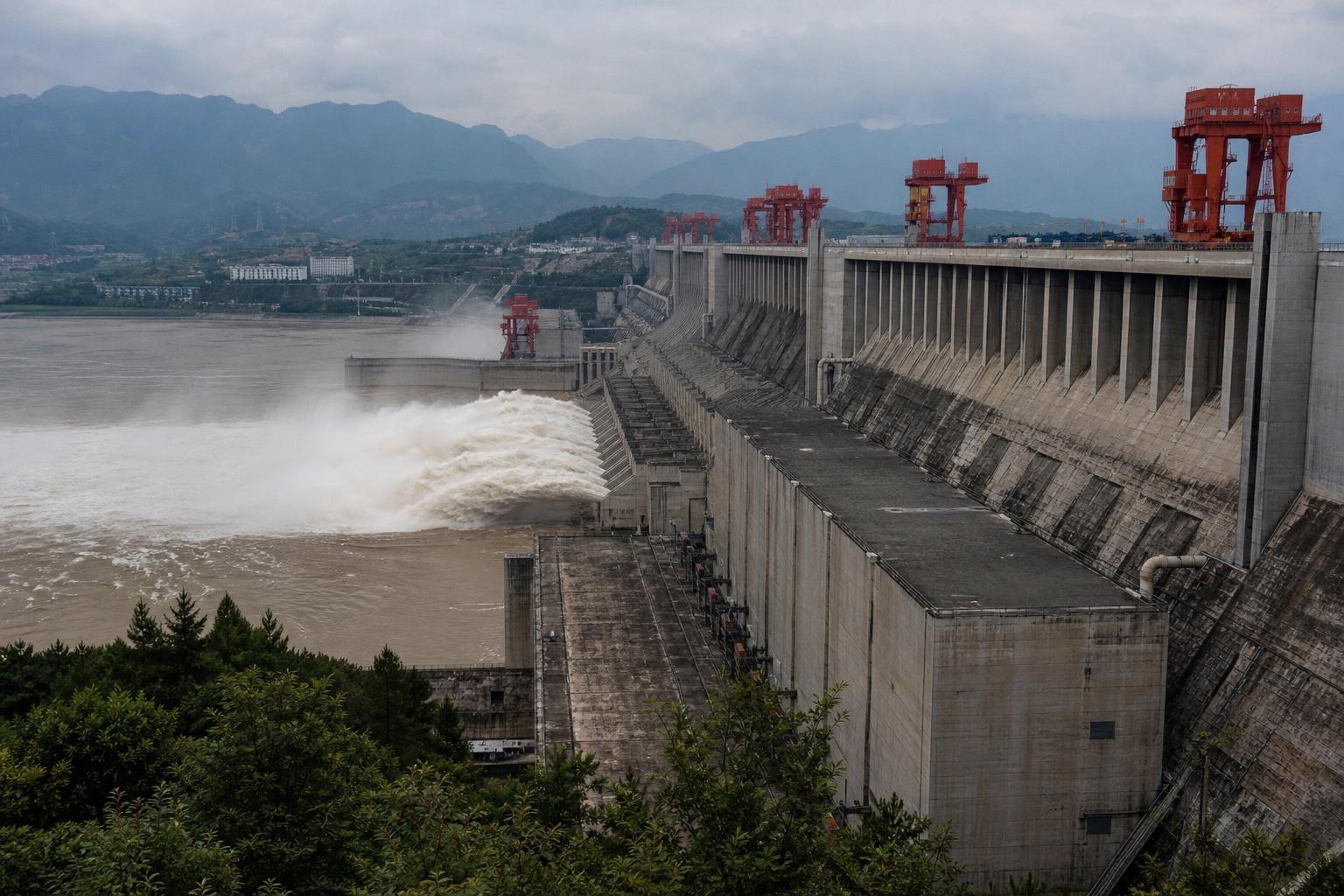
When an immense reservoir fills, Earth itself subtly responds. By corralling tens of billions of cubic metres of water behind concrete and steel, engineers don’t just alter rivers—they brush the planet’s rotation, adding an almost imperceptible sliver of time to every spin. “It’s like a skater extending their arms,” scientists often say, invoking a metaphor as old as rotational physics itself.
The quiet physics behind a louder world
Shift mass outward and you increase the moment of inertia. With angular momentum roughly conserved, rotation must slow, if only by a whisper. A filled mega-reservoir takes water once spread across valleys and pushes it higher and often farther from Earth’s axis, subtly tweaking the global balance. The result is a day that’s fractionally longer, a geophysical sigh most clocks will never hear.
Turning enormous volume into tiny time
Take a reservoir that holds around 39 billion cubic metres of water—a staggeringly large pool with the mass of a midsize mountain range melted and poured into a single basin. NASA-linked analyses once estimated that impoundments of this scale nudge the length of day by about 0.06 microseconds—roughly 60 nanoseconds—and shift polar motion on the order of a few centimetres. That’s smaller than a blink of an eye, yet big enough for precision geodesy to notice.
“Numbers like this feel trivial,” one geophysicist might admit, “until you realize the Earth is an exquisitely sensitive gyroscope.” Instruments tracking Earth’s rotation can detect timing drifts far below human perception, turning backyard-scale intuition into satellite-calibrated truth.
Tiny, but not trivial
On any given week, winds, ocean currents, and shifting air pressure can sway the day by tenths of a millisecond, utterly dwarfing the microsecond-scale tweak from a single reservoir. Powerful earthquakes can also redistribute mass, altering rotation and the planet’s wobble. Still, the reservoir effect is clean, predictable, and human-made—a rare chance to watch engineering echo through astronomy.
To place things in context, consider that timekeepers add leap seconds to reconcile atomic time with Earth’s uneven spin. That correction is a million-fold larger than a reservoir’s nudge, yet arises from the same universal principle: move mass, and rotation answers.
A planet reshaped by plumbing
Human water management reshuffles weight on a continental scale. Build a dam, and mass pools upstream. Pump aquifers, and mass leaves the ground, trickling toward the sea and changing ocean-bottom pressure. Over decades, these motions push the spin axis like a slow, wandering compass, with studies suggesting measurable pole shifts tied to groundwater loss.
- Large reservoirs redistribute inland water and slightly slow Earth’s spin.
- Groundwater depletion moves mass to the oceans, nudging polar motion.
- Glacial melt changes the planet’s mass map, altering rotation more strongly.
- Sediment mining and urbanization also rearrange weight, if more locally.
“It’s humbling to realize our civil works have a geophysical footprint,” notes a hydrologist, “not just in rivers, but in the choreography of Earth’s rotation.”
Why engineers and scientists care
For dam designers, the rotation effect doesn’t change safety margins, turbine design, or flood rules. But for space agencies and metrology labs, such mass redistributions belong in the calculus of precise timing, satellite orbits, and reference frames. These communities operate where nanoseconds matter, where centimetres of polar motion can ripple into navigation and Earth-observation algorithms.
Understanding these links also sharpens our grasp of climate-era change. As ice sheets drain and seas rise, Earth’s spin evolves in complex, modelable ways. Reservoirs provide a contained, human-scaled experiment, a contrast that helps validate the math we apply to the cryosphere.
Rethinking scale and consequence
The paradox here is delicious: a single dam does something both vanishingly small and cosmically audacious. It adds a sliver of time to each day—too little to feel, but enough to measure, enough to remind us that the “solid” Earth is a supple, spinning system that tallies every redistributed kilogram.
Step back, and the message is clear. Our infrastructures are not isolated projects; they’re hooks in the fabric of a dynamic planet. Hold back a continent’s worth of rain, and the gyroscope twitches. Pump a century of groundwater, and the pole strays a hand’s width. We are, in the quiet arithmetic of mass and motion, co-authors of the world’s daily rotation.
As one scientist put it, “Nature keeps the books,” and every reservoir, aquifer, and glacier writes a new entry. That 0.06 microseconds is a footnote—small, precise, and stubbornly real—proving that even our most grounded works reach into the sky and tug on the turning of the Earth.
