
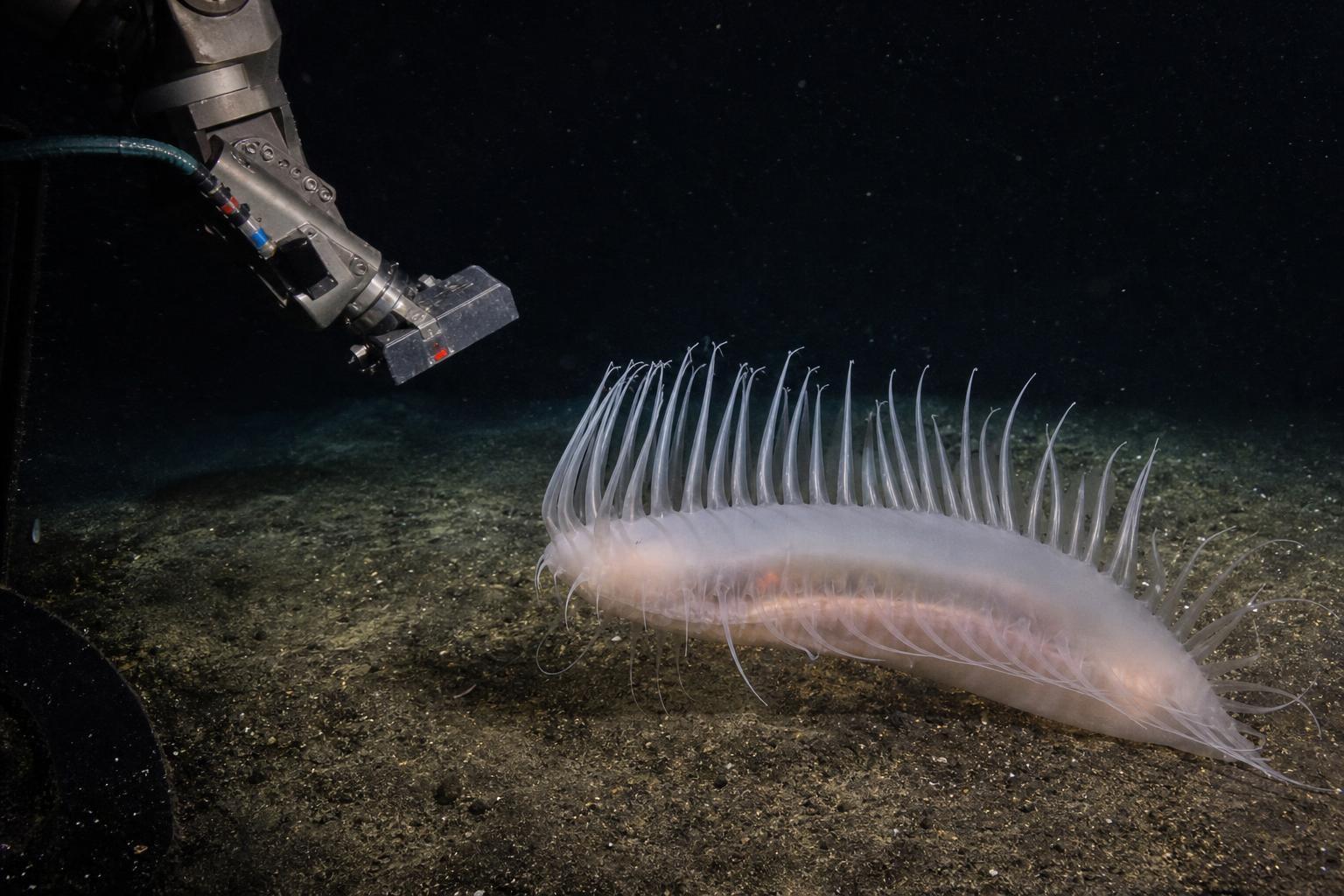
The ocean keeps secrets the way mountains keep snow—quietly, slowly, and on its own terms. Two miles down off the California coast, a team aimed high-powered cameras into a world that swallows light. What they found felt less like biology and more like myth. The screen filled with forms that no one had ever seen alive, drifting in cold water the color of deep steel. “It looked like the galaxy had decided to breathe,” one researcher said.
A camera lowered into night
The vessel hovered above a trench like a question held on the tongue. An ROV unspooled its tether into darkness, every meter adding pressure and silence. The only glow came from the vehicle’s soft lamps, little islands carved into a continent of black. Past the last hints of sunlit life, the machine threaded into the midwater column, where gravity and stillness keep long, cold vigil.
The first figure slid into frame with the grace of a sentence finished just in time. A ribbon of near-invisible tissue wound in slow spirals, its edges shivering with faint light. Then came an orb like a blown-glass lung, pulsing a rhythm so deliberate it felt like deliberate thought. “Every heartbeat was a clue,” the pilot murmured.
Shapes that rewrite the map
What appeared were bodies built from rules we rarely use. Some were almost fully transparent, organs sketched in foggy traces. Others wore armor thin as snowfall, bristling with soft spines that tested the current as if reading braille. Muscles flickered under gelatinous skins, and mouths were arranged in rings, slits, or patient petals.
A coiled drifter flexed like a slinky, inhaling plankton with a ribboned wave. A sheet-like predator billowed open, then shut, like a book learning to speak. “You think you know what a body is,” a biologist whispered, “and then the ocean edits the definition.”
The choreography of survival
Down here, motion is a currency. Every twitch is a cost. Creatures move by trading tiny debts of energy for gain measured in breaths. Fins fold into low-drag angles. Bellies glow with bioluminescent script that signals or deceives, depending on who is reading. Predation plays out at the speed of deliberation, not panic.
- Filaments flare blue to lure or warn; bodies vanish by matching the water’s index; jaws swing like hinged lanterns, then close without a sound.
Why the footage matters
This is not just a catalog of strange faces. The midwater zone moves carbon and heat, acting as a living elevator between surface bloom and seafloor archive. If we want to predict storms, fisheries, or even the price of food, we need to understand the quiet workers of this dark factory. Their bodies are ledgers of chemistry, and their migrations redraw the planet’s daily pulse.
“Every new species on film is a doorway,” said the lead scientist. “It lets us measure what we previously had to guess.” In a century of rapid change, the unknown is not a luxury; it’s a risk. Documentation becomes both record and refuge.
Tools that listen to quiet
Capturing these scenes required hardware tuned to shyness. Lights were dimmed to a moonlit whisper, wavelengths chosen to cross water but spare delicate retinas. Cameras worked at high sensitivity, trading noise for presence and error bars for first sight. The ROV held still as a held breath, thrusters pulsing in fractional nudges.
It was less a hunt than a vigil. The pilot kept the frame wide, then narrow, then still, respecting distances the way one respects wildness. The point was to witness without wounding, to archive without claiming.
Names will come later
Taxonomy is a patient craft. What looks new needs careful proof—tissue samples, genetic strings, and long, sober comparisons. For now the team speaks in working labels: the veil, the fan, the comet, each a placeholder around which awe can gather. Paperwork will eventually forge Latin names, but first comes the stubborn work of not rushing what deserves care.
“We are walking into an attic of the Earth,” one researcher said. “It’s dusty with time, and every box is still sealed.”
What the surface cannot teach
Back on deck, the air felt almost loud. Gulls made familiar rackets, and the horizon did its straight-line thing. But minds were still two miles down, where pulses take their time and hunger is a thread that never quite snaps. The footage looped on a lab monitor, and people watched the way you watch a first heartbeat.
In the ship’s galley, someone poured quiet coffee. Someone else annotated frames with careful dots. “We thought we were looking at them,” a diver said, “but really, they were showing us our own limits.”
What comes next
The plan is to return with gentler lights, longer soaks, and sensors tuned to chemistry as much as to image. New algorithms will sift shadows for rhythm and pattern, learning to tell muscle from mirage. Outreach will pull the abyss onto classroom screens, because wonder is a form of public infrastructure.
The ocean does not offer answers so much as it offers better questions. In that darkness, we meet the edges of our language and our tools, and we step a little closer to the planet we think we know. For now there is film, and there is silence, and between them swims a future still deciding what it wants to be.
