
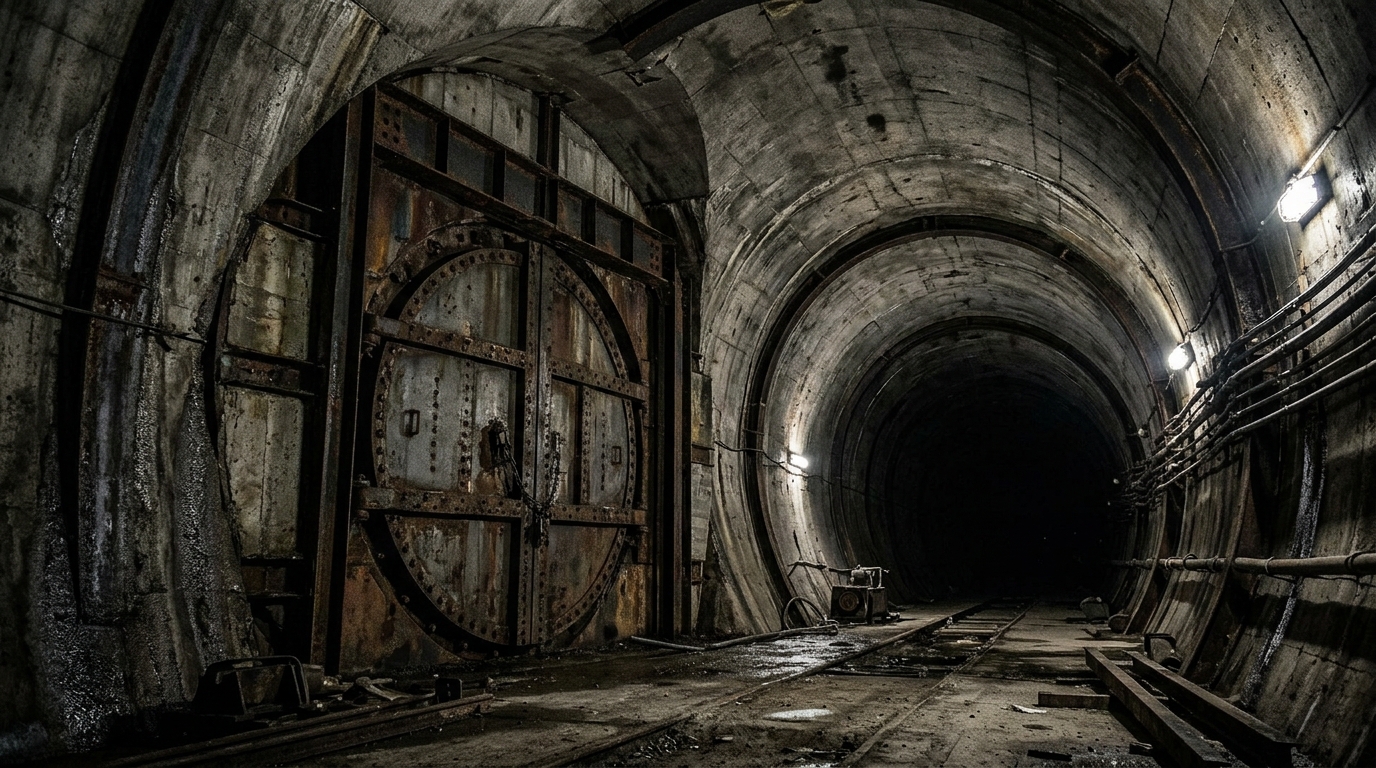
A 22.5-kilometer tunnel dug underground in Texas, $2 billion spent, and in the end no particle collisions. The Superconducting Super Collider was meant to dethrone CERN. It ended up as an empty plot bought by a chemical company.
- Launched in 1988 in Texas, the Superconducting Super Collider was intended to form an 87.1‑km ring to dethrone CERN, but it was canceled by Congress on October 21, 1993 after budget overruns pushed the cost to $8.4 billion
- At the moment of cancellation, $2 billion had already been spent to bore 22.5 km of tunnel, drill 17 access shafts, and construct 18,600 m² of buildings, with no particle collision ever taking place
- The site was bought in 2012 by the chemical company Magnablend, the shafts were filled in, and the remaining tunnel sections now serve only to collect rainwater
- A Giant Tunnel Dug for Nothing: the Wild Bet of the Superconducting Super Collider
- When Congress Killed the World’s Largest Accelerator in a Single Day
- Two Billion Dollars Underground: What Remains Today of the Texas Dream
A Giant Tunnel Dug for Nothing: the Wild Bet of the Superconducting Super Collider
Imagine an underground ring 87.1 kilometers in circumference, capable of colliding particles at energies never before reached. This was the project the United States launched in 1988, when the Waxahachie site in Ellis County, about 50 miles south of Dallas, was officially chosen to host the Superconducting Super Collider.
The ambition was colossal. Promoters pledged 4,500 jobs during the construction phase, then 2,500 full-time scientist positions once the machine was running. It was advertised as a transformation of this corner of Texas into a true global science hub, comparable to what CERN represents for Europe.
To make room for this giant ring, roughly 16,000 acres of land had to be expropriated, nearly 6,500 hectares. About 90 houses disappeared from the landscape. The drills started biting into rock, access shafts rose from the ground, and the first buildings took shape. On paper, everything seemed to be progressing.
When Congress Killed the World’s Largest Accelerator in a Single Day
The trouble, however, was that the figures soon spiraled out of control. In February 1993, the General Accounting Office, the American equivalent of the Court of Auditors, flagged a budget overrun of $630 million on an initial construction budget of $1.25 billion. A month later, the total estimated cost had surged to $8.4 billion.
That was the death blow. On October 19, 1993, the House of Representatives outright rejected funding for the project. Senators tried to salvage the program, but without success. Two days later, on October 21, 1993, Congress formalized the cancellation.
The financial tally is stark: $2 billion had already been spent, including $400 million paid by the State of Texas, with the remainder coming from the Department of Energy. At the moment the axe fell, roughly 20% of the project was completed. Concretely, that meant two dozen kilometers of tunnel bored, i.e., 22.5 km, 17 access shafts, and 18,600 square meters of buildings already erected. Not a single particle ever traversed that ring.
Two Billion Dollars Underground: What Remains Today of the Texas Dream
After the cancellation, the land and buildings initially passed into the hands of the State of Texas, then to Ellis County. The site remained largely abandoned for more than a decade, a quiet relic of a scientific ambition that never came to fruition.
In August 2006, the property was finally sold to a group of investors. A new twist followed in 2012: Magnablend, a chemical company, acquired it. Today, the former science buildings house the industrial activities of this firm, a far cry from particle physics.
The 17 access shafts have been filled, and the remaining underground tunnel sections serve only one purpose: collecting rainwater. A rather ironic fate for an infrastructure conceived to pierce the mysteries of the infinitesimally small.
This fiasco resonates with the CERN news. In May 2026, the European Council recommended the Future Circular Collider for electrons and positrons as a priority project, a 91-kilometer ring with an estimated cost of 15.3 billion Swiss francs, roughly 19 billion dollars. The final decision is anticipated in 2028. The story of the Superconducting Super Collider serves as a reminder that such colossal projects remain as much dictated by political will as by technical prowess.
