
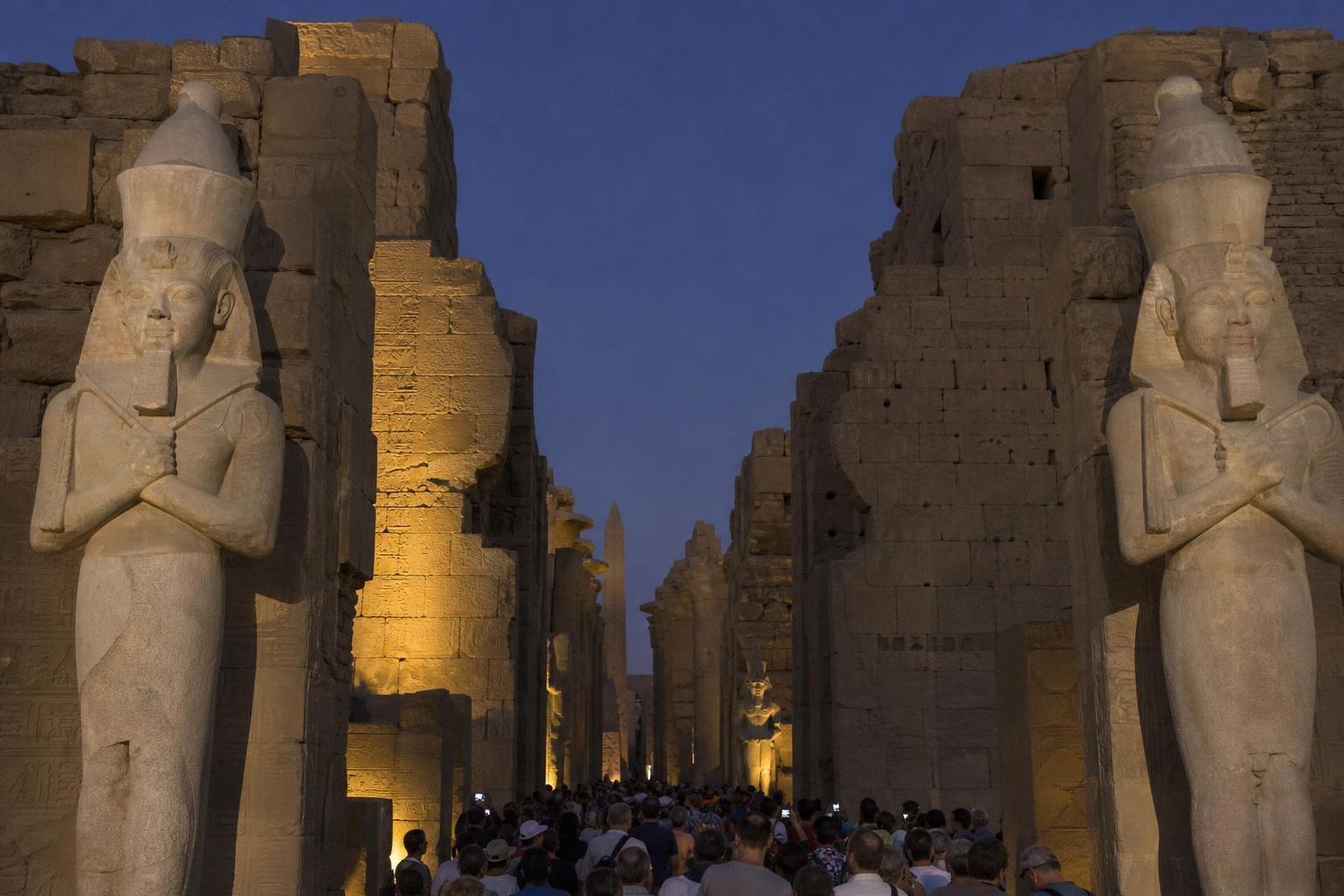
In early August 2027, the desert light above the Nile will dim, and the air itself will seem to hold its breath. For a few astonishing minutes, the world’s most visited open-air museum will be reborn in midnight hues, as the Moon’s shadow settles over Luxor and lingers longer than any similar land-crossing event for generations.
A river city in sudden darkness
Luxor, cradled by the Nile and ringed by the Theban hills, sits almost perfectly on the centerline of the Moon’s racing umbra. Around midday, the Sun will be completely covered, turning hot daylight into a cool, eerie twilight. Expect a swift drop in temperature, a chorus of confused birds, and a horizon glowing like a ring of distant dawn.
“Everything you know about daylight is inverted,” say veterans of long totalities. “The sky goes electric blue-black, and the corona looks alive.”
Why this one lasts so long
The Moon will pass close to Earth in its elliptical orbit, appearing slightly larger than average. The track also hugs the equatorial regions, where Earth’s rotation maximizes the apparent speed of the Sun’s cover. Put together, those factors stretch the darkness to a rare length over land, with the sweet spot centered near Luxor’s timeworn monuments.
Astronomers call this a near-ideal geometry, where orbital mechanics turn seconds into extra, heart-racing minutes.
From Iberia to the Red Sea
The path of deep shadow will sweep from the Atlantic across parts of the Iberian Peninsula, arc over North Africa, and continue toward the Arabian Peninsula, before fading over the Indian Ocean. Along that ribbon, local conditions vary, but Upper Egypt in August is famed for stark, cloudless skies.
“Climatology gives Luxor superb odds,” note eclipse planners. “If you crave a long, clean view, the Nile’s east and west banks are hard to beat.”
What to expect in those six-plus minutes
First, the light gets strange—colors go metallic, shadows sharpen, and the Sun’s bite deepens into a glowing crescent. A shiver of wind may arrive, and daytime stars can prick through. Then, in a heartbeat, true totality: the corona blooms, a ghostly crown unfurling in pale streamers across the darkened vault of sky.
Venus often appears brilliant, Mercury shy but present, and the solar chromosphere can flash in ruby arcs. “It looks impossible,” people whisper. “And then it keeps going longer than you expect.”
Fieldwork under a velvet sky
For scientists, long totality is a windfall. The extended corona can be imaged in multiple wavelengths, tracking dynamic structures and solar wind seeds. Teams may probe atmospheric waves triggered by the shadow’s supersonic sweep, while wildlife biologists log abrupt behavior shifts along the river’s edge.
“Every additional minute multiplies opportunity,” as one research lead puts it. “The corona is not still—longer views reveal motion.”
Viewing essentials for travelers
If you’re heading to Luxor, plan early, think light, and move with respectful care around ancient sites. Local authorities may set limits, and temperatures will soar before and after the event. Consider bases on the West Bank or quieter eastern suburbs, and build in recovery time.
- Certified solar viewers (ISO 12312-2), a wide-brim hat, high-SPF sunscreen, 3–4 liters of water per person, a lightweight tripod, and a printed map of your viewing site with access and exit routes
Safety and smart etiquette
Never look at the Sun without proper filtration except during full totality. Use filters on binoculars and cameras at all times outside those precious dark minutes. If you plan to shoot the corona, rehearse your exposure bracketing and remove filters only during the full covering.
Mind the ground you stand on. Many vantage points lie near priceless antiquities; follow posted rules, avoid climbing, and leave no trace. “The past is not a prop,” a local guide likes to remind. “Treat it as a living archive.”
Echoes of ancient wonder
Here, cosmic rhythms meet human memory. Millennia ago, priests watched the Sun, built calendars, and linked heavenly cycles to earthly power. To witness totality amid pylons and colonnades is to feel time fold, as if the sky and the stones are briefly in whispered conversation.
“A hush falls,” say seasoned chasers. “You hear your own heartbeat, and even the city seems to listen.”
After the shadow moves on
Crowds will surge, heat will rise, and transport will clog. Wait a little, hydrate well, and let normal daylight return to your senses. Then, consider lingering for the golden hour along the Nile, where feluccas cut silver paths and the temples glow like banked embers.
Long totalities over land are vanishingly rare. The next of similar stature won’t stride across terrestrial ground for a very long time. If you can make this journey, the sky above Luxor promises a memory carved in bright darkness, a masterpiece of shadow and fire that will live with you for the rest of your days.
