
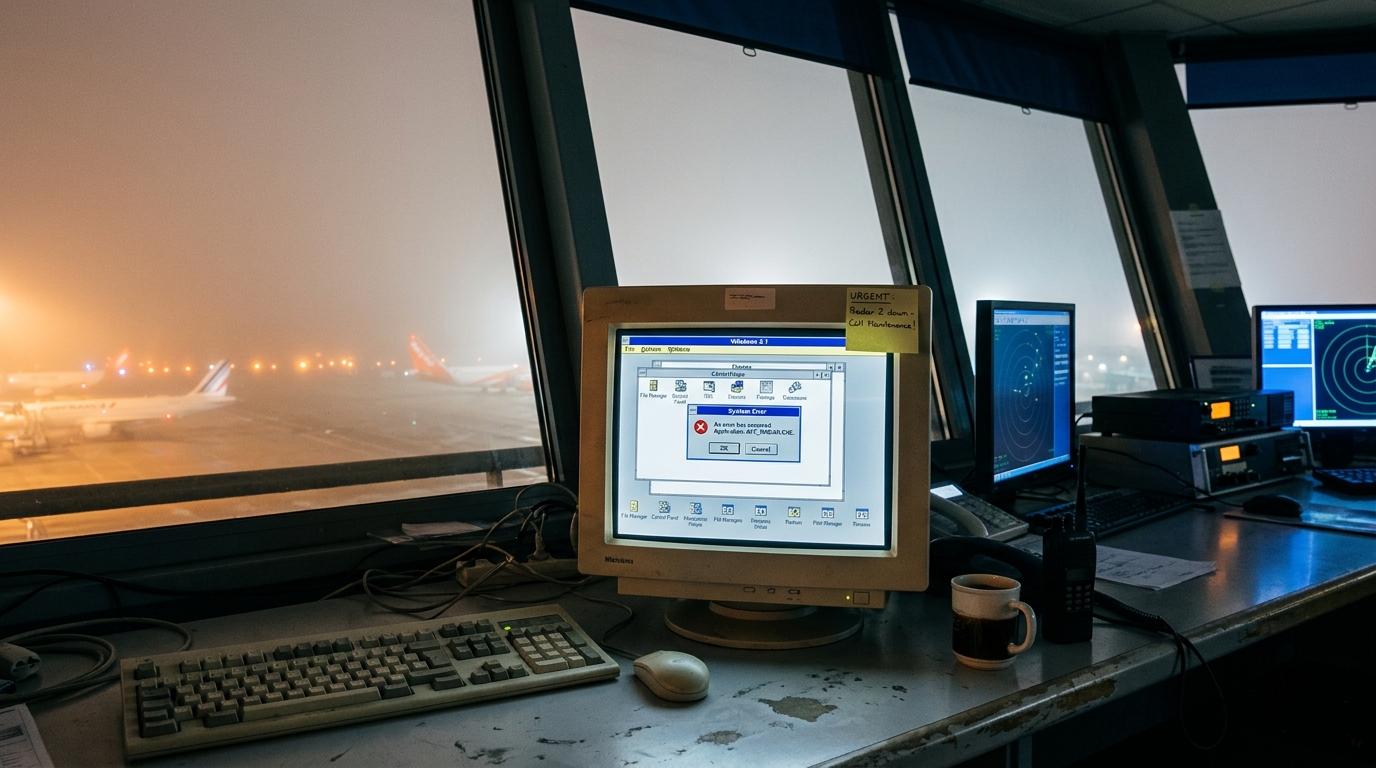
A thick fog, thousands of passengers stranded, and at the heart of the problem: a computer still running Windows 3.1, an operating system released in 1992. That day, Orly airport tipped into a museum-worthy outage, revealed by Le Canard enchaîné.
- In November 2015, the DECOR software, dating from 1992 and running on Windows 3.1, transmitted visibility data to pilots and air traffic controllers at Orly and Roissy
- Only three technicians in France were still capable of intervening on this obsolete system in case of a failure
- A fog event following a Friday night outage caused twelve flights to be diverted and the Orly tarmac to be closed for over an hour
- A 25-year-old software was piloting the pilots’ visibility
- Three men alone in the world capable of repairing the outage
- An airport paralyzed by a simple frozen screen
November 2015. A Saturday morning at Orly like any other, except that fog arrives and nothing goes right. Traffic comes to a complete halt, both for departures and arrivals. Aéroports de Paris acknowledges, with a careful nod on Twitter, a failure affecting “the weather tools.” A cautious formulation to mask a far more tangible truth, which Le Canard enchaîné would reveal a few days later.
A 25-year-old software was piloting the pilots’ visibility
The culprit is DECOR, an acronym that is a bit technical for “environmental data control for Orly and Roissy.” Its role is nonetheless vital: transmitting in real time to controllers and pilots the essential weather information, particularly runway visibility. A tool interfaced directly with Météo-France.
The problem is that this system ran on software dating from 1992, operating under Windows 3.1. To give an idea of the age of the beast, that operating system was released the same year as the first Mortal Kombat video game. Its official support had already ended on December 31, 2001, fourteen years before the outage.
In other words, a tool meant to guarantee the safety of air traffic rested on technology that no manufacturer actively maintained anymore. And this fragility was not confined to Orly: the same DECOR software also equipped Roissy, according to Le Canard enchaîné.
Three men alone in the world capable of repairing the outage
What gives this case its particular flavor is the sequence recounted by the satirical weekly. When the system failed, only three technicians in France still knew how to intervene on this aging software. Three people, and no one else, capable of restoring a vital link in aviation safety.
This situation illustrates a well-known phenomenon among IT professionals: skills that disappear with the hardware. When no one uses a language or a system anymore, the experts able to maintain it become scarce, or even vanish. Here, an entire Paris airport depended on this fading know-how.
Asked by Le Canard enchaîné, the Ministry of Transport tried to sound reassuring, claiming that modernization of the equipment was planned for 2017. A promise that, looking back, deserves to be considered in light of what happened next.
An airport paralyzed by a simple frozen screen
In detail, the incident’s chronology deserves to be recalled. The software had, in fact, failed as early as Friday evening, with no immediate consequences since traffic continued normally. It was the Saturday morning fog that tipped everything, making the failure suddenly critical.
Without reliable data on visibility, it was impossible to guarantee the safety of ground movements and approach maneuvers. The result: twelve flights diverted to Lyon or Roissy, and Orly’s tarmac remained closed for a little over an hour. Air France confirmed that it was indeed a computer fault affecting the weather-data feed feeding the control tower.
What stands out is the contrast between the allegedly minor cause on paper and the real-world consequences for thousands of travelers stuck on the ground. A frozen screen, an aging software, and an entire swath of Île-de-France air traffic suspended by the capriciousness of three technicians.
This episode was, unfortunately, not isolated. In 2018, a Senate report already highlighted a twenty-year lag in French air traffic control technology compared with its European peers, deeming the systems of the towers and approach procedures of the DSNA obsolete and disparate. More recently, in June 2026, a new report from the Senate Finance Committee quantified delays in French air traffic control at 6.6 million minutes in 2025, once again underscoring the obsolescence of the DSNA’s technical architecture. As the saying goes, behind every flight delay there is sometimes an old computer story that has deserved a long-overdue replacement.
