
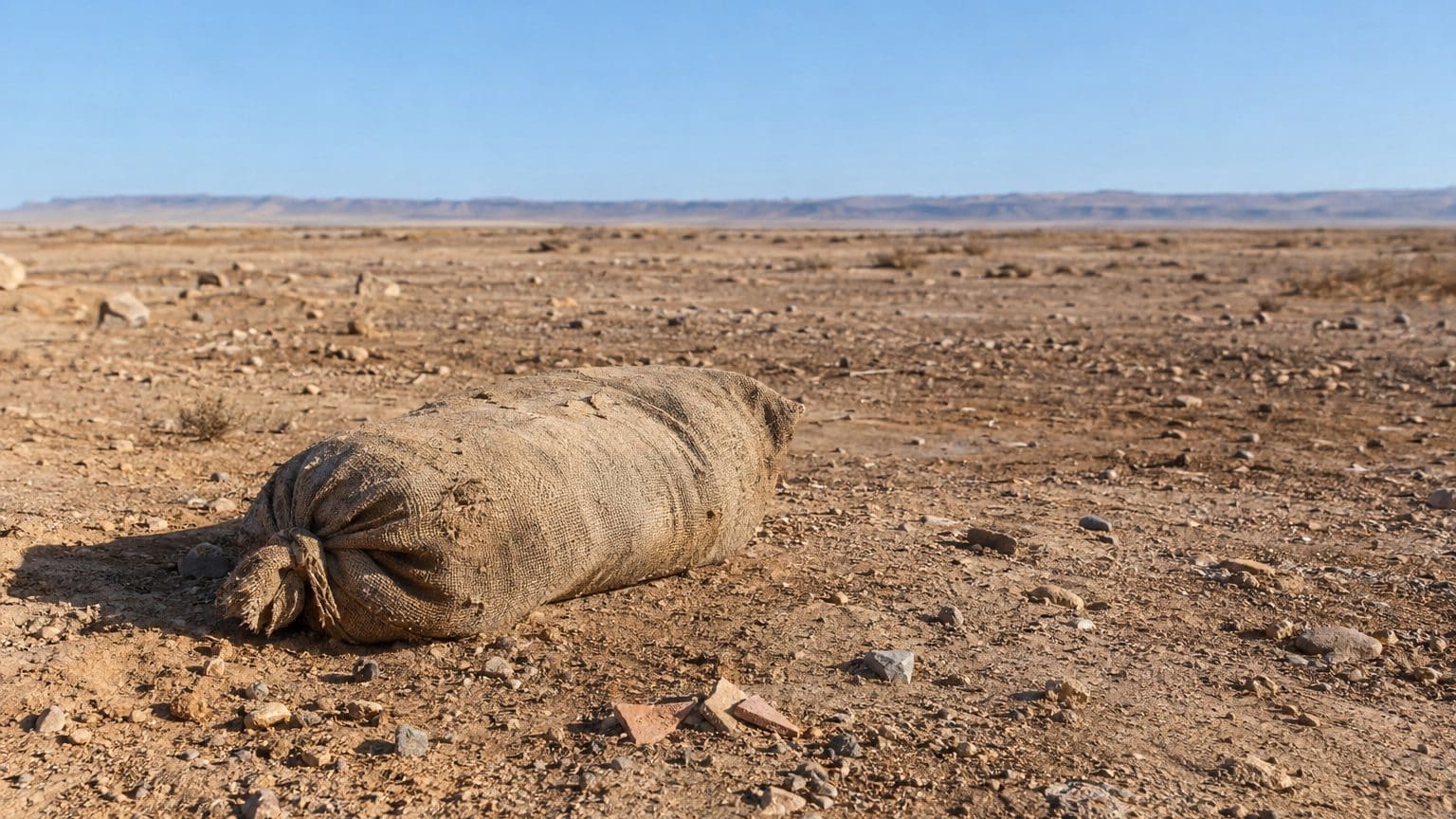
In April 2003, American forces established themselves at the heart of Babylon, and the sandbags meant to protect their soldiers were initially filled with earth from the site itself, full of pottery shards and bone fragments. The camp covered 150 hectares in the middle of a 900-hectare site, more than 200 football pitches laid out on a sixth of the ancient city. It housed 2,000 soldiers at the outset, the equivalent of a large garrison town planted on one of the most famous capitals of Antiquity.
The name Camp Alpha dates from September 2, 2003.
- A 150-hectare camp occupied part of the ancient site of Babylon between April 2003 and December 2004.
- Approximately 300,000 m² of the site were covered with imported gravel, i.e., 30 hectares.
- An order dated November 3, 2003 forbids filling bags with earth from the site without removing prior contributions.
A 150-hectare camp laid on Nebuchadnezzar’s city
The British Museum places the establishment of the camp by American forces in April 2003. UNESCO notes that the coalition occupied the site on April 21, 2003. The command passed to Polish forces in September 2003, but the infrastructure was largely carried out by KBR (Kellogg Brown & Root), an American company. By December 2004, fewer than 400 soldiers remained, and the site was returned to the Iraqi Antiquities Authority, SBAH, on December 22, 2004.
This chronology complicates the assignment of responsibility. Reports refer to a “coalition,” a multinational force, and KBR, and the gravel as well as the trenches cover the entire period: it is impossible to split the damage between the American phase, from April to September 2003, and the Polish-command phase, continuing until December 2004.
Gravel, heliport, trenches: what the ground absorbed
The John Curtis report, from the British Museum, estimates that about 300,000 m² of the site were covered with gravel, i.e., 30 hectares, the equivalent of more than 40 football pitches. The gravel came from outside the site, sometimes compacted and chemically treated, and was used for parking lots, housing, storage, and the heliport. The report warns that it will eventually infiltrate archaeological deposits, mixing modern materials with layers more than 2,500 years old.
The heliport was built on a former asphalt parking area measuring 50 m by 100 m. It was later expanded by 50 m by 200 m, near the Processional Way and the Temple of Ninmah.
The reports also record around a dozen trenches. One trench, oriented east-west near Etemenanki, the ziggurat, measures about 170 m long according to the British Museum, and 162 m long by 1 to 1.5 m wide and 2 m deep according to UNESCO. Its spoil contained fragments of bricks inscribed with the name of Nebuchadnezzar, the king-builder of the 6th century BCE. In UNESCO’s 2009 report, it was noted that it had begun to collapse.
A second trench, 62 m long by 2.5 m deep, lies at the northeast corner of the ziggurat. The 162 m trench is not dated nor attributed to a specific nation, so it is the coalition that must be considered.
Ancient earth bags and an order issued after months
The most telling detail lies in the bags. According to the British Museum report, the sandbags and Hesco barriers were first filled with earth gathered from the Babylon archaeological site. There were shards of ceramics and bones found there.
On November 3, 2003, an order ended this practice.
From then on, only earth brought from outside should be used for filling. But it in turn contaminates the site, following the same logic as the imported gravel, and nothing indicates that these contributions were subsequently removed.
Ishtar Gate and Processional Way, the best-known monuments affected
Nine mušhuššu dragons of the Ishtar Gate, in molded bricks, were damaged.
The Processional Way, dating to the 6th century BCE, had its pavement broken by the passage of a heavy vehicle. Three rows of concrete blocks, each weighing 2 tons, had been placed on top—the weight of a large SUV. They were removed by helicopter only on November 29, 2004. The handover of the site back to Iraq occurred 23 days later.
John Curtis, who authored the report on the Babylon meeting held from December 11 to 13, 2004, compared the situation to the establishment of a military camp around the Great Pyramid of Egypt or Stonehenge. The Guardian published this comparison on January 15, 2005.
The UNESCO final damage assessment report dated June 26, 2009. In 2021, the New York Times recalled that American military subcontractors had built a base on the site, dug trenches, rolled armored vehicles along its fragile streets, and filled bags with earth mixed with pottery and bones. Babylon, for its part, was inscribed on the UNESCO World Heritage List in July 2019, more than 14 years after the soldiers left.
