
An American national park doesn’t come along every day. And yet the one discussed here has existed in another form for more than a century. Chiricahua, in Arizona, has just taken a step that few still expected, after decades spent in the shadow of its neighboring giants.
- Chiricahua, in Arizona, became the 64th U.S. national park after the law was signed by Donald Trump on October 20, 2026, more than a century after its initial protection as a national monument in 1924
- The site houses thousands of columns and fairy chimneys sculpted in rhyolite, born from a volcanic eruption about 27 million years ago
- The park takes its name from the Chiricahua Apache, the people from whose lineage Geronimo was born, near Turkey Creek right at the heart of this territory
- A 27-million-year eruption at the origin of an extraordinary landscape
- Geronimo and the Chiricahua Apaches: the little-known history that gave the park its name
- A Century of Waiting: how a National Monument became the 64th park in the United States
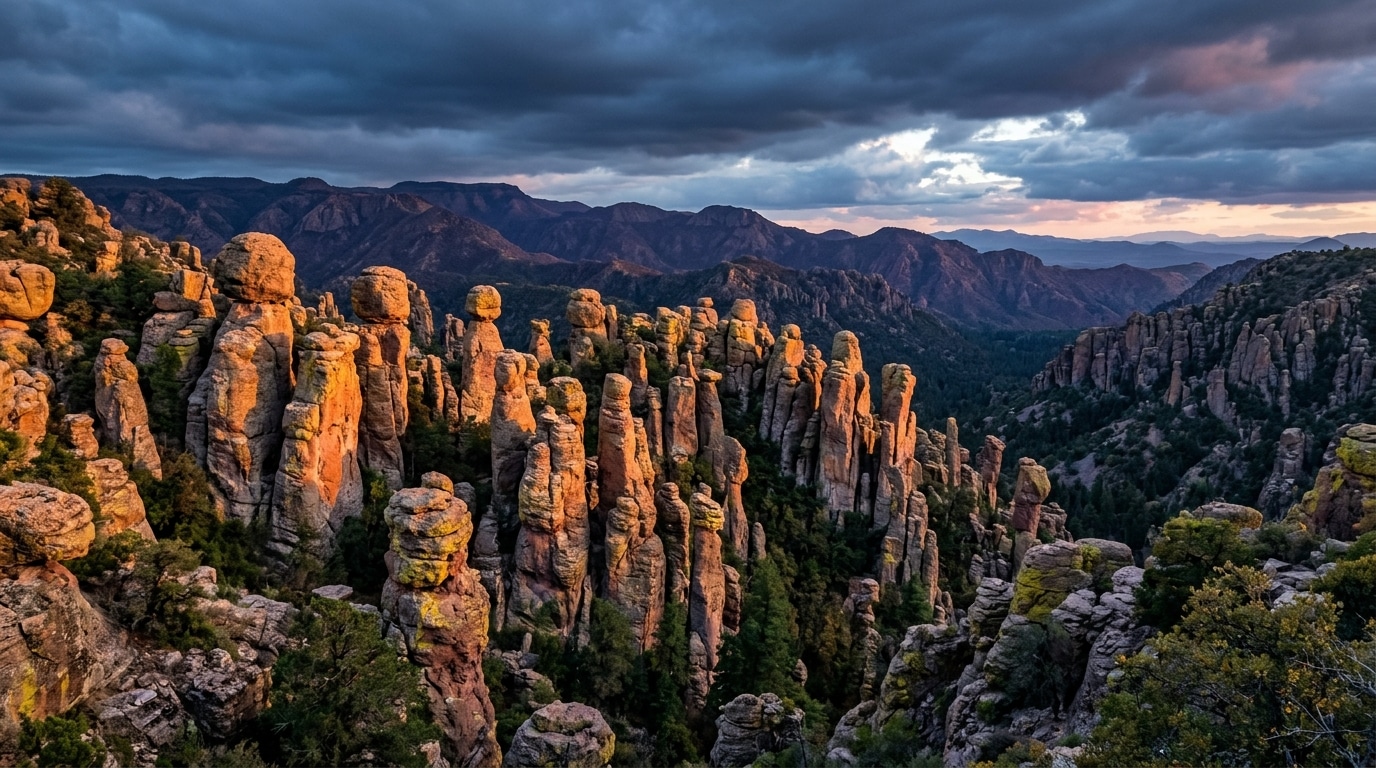
The 64th national park in the United States is now located in Cochise County, in the southeastern corner of Arizona, not far from the town of Willcox, about a two-hour drive east of Tucson. Chiricahua National Park guards a site unlike any other, where thousands of columns and fairy chimneys have been carved into rhyolite following an ancient volcanic eruption. A landscape nicknamed the “Wonderland of Rocks,” a land seemingly drawn from another world.
A 27-million-year eruption at the origin of an extraordinary landscape
This all began with a geological catastrophe of unimaginable scale. About 27 million years ago, a volcanic eruption blanketed the region with scorching ash and pumice. Under the effects of heat and pressure, these materials fused to form a distinctive rock, rhyolitic tuff, a natural cement shaped by fire.
This eruption emptied part of the subsurface, triggering the collapse of a caldera, a vast volcanic depression, known today as the Turkey Creek caldera. One can easily imagine the violence of the event when you learn that this basin measures roughly 19 kilometers in diameter.
Yet the most spectacular occurred later, over an even longer period. For millions of years, faults, erosion, and weathering patiently gnawed away at this rhyolitic tuff, leaving standing columns, dizzying pinnacles, and balancing rocks that seem to defy gravity. A U.S. Senate report accompanying the bill notes that these formations, nicknamed “standing rocks,” owe their very existence to this slow erosion of rhyolite. The result, visible today on roughly 12,000 acres, or about 19 square miles of protected land, resembles a setting that nature appears to have perfected over millions of years.
Geronimo and the Chiricahua Apaches: the little-known history that gave the park its name
Behind this mineral landscape lies also a human story, one often omitted from tourist brochures. The park’s name itself pays homage to the Chiricahua, an Apache people who had inhabited these mountains for centuries, well before European settlers arrived.
These mountains are part of the “sky islands,” isolated ranges where desert, prairie, and forest stack up over only a few kilometers. A rugged terrain that long offered the Chiricahua Apaches a favorable battleground to resist the U.S. Army during the wars that defined the late 19th century.
It is in this setting that emerged one of the most famous figures in Native American history: Geronimo, born near Turkey Creek in the heart of what is now the park. His name remains inseparably tied to the Chiricahua people’s struggle to defend their homeland. By preserving this name, the national park reminds us that this spectacular landscape is not mere scenery: it carries the memory of a people and a conflict that shaped the history of the American Southwest.
A Century of Waiting: how a National Monument became the 64th park in the United States
The official protection history of this site begins well before the creation of the national park. On April 18, 1924, President Calvin Coolidge designated the area as a National Monument, under the Antiquities Act, a U.S. law that allows rapid protection of remarkable natural or cultural sites. Franklin D. Roosevelt later expanded the protected boundary in 1938.
But in the United States, a National Monument and a National Park do not carry the same status. To attain the status of a National Park, a site must receive a law enacted by Congress, a far longer and more uncertain process. Arizona Senator Mark Kelly had introduced an initial bill in 2021, later taken up in the Senate as S. 736 and forwarded to the House of Representatives by Juan Ciscomani.
The measure, named Chiricahua National Park Act and listed as H.R. 6380, took several years to come to fruition. On October 20, 2026, President Donald Trump finally signed the law, making Chiricahua the 64th national park in the United States and the fourth in Arizona, alongside the Grand Canyon, Petrified Forest, and Saguaro. At the ceremony, Interior Secretary Doug Burgum noted that this designation should attract more visitors and support local economies. It marks the first new American national park since the redesignation of New River Gorge in West Virginia.
This good news, however, comes in a broader context of strain for the entire National Park System. The National Parks Conservation Association reminded that the National Park Service is facing budget cuts and staffing reductions, urging a restoration of resources for these protected spaces.
That said, Chiricahua has strong assets to entice visitors. Beyond its striking geology, the site is already designated an International Dark Sky Park, promising night skies of exceptional quality for stargazers. Its diverse ecosystems host a range of fauna, from kangaroo rats to ocelots, including coatis and, more rarely, a few jaguars that pass through. All this makes this newly established national park into a small sanctuary where geology, history, and biodiversity together tell more than a century of waiting.
