
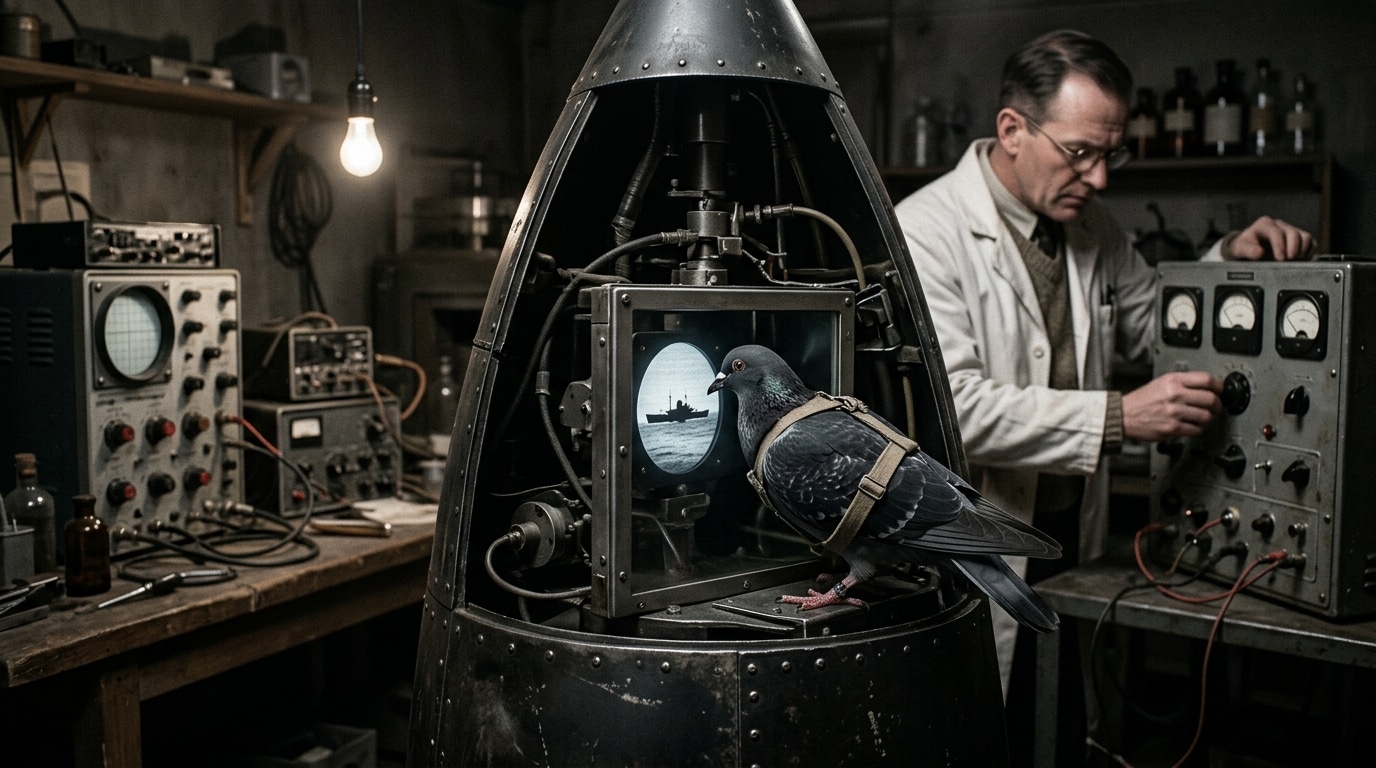
Imagine an American military missile whose sighting system rested not on radar or a computer, but on a hungry pigeon frantically pecking at a screen. This scenario, worthy of an absurd movie plot, did indeed exist. Its inventor was none other than a psychologist who became famous for his work on animal behavior.
- In 1943, psychologist B. F. Skinner conceived Project Pigeon, where pigeons trained by operant conditioning pecked a screen to guide a glide-bomb toward its target.
- Despite convincing technical results (over 80% of impacts within a quarter of an inch of the target), the program was canceled in 1944, deemed too far from practical military use.
- Reintroduced in 1948 under the name Project Orcon by the American Navy, the project was definitively abandoned in 1953 in light of the growing reliability of electronic guidance systems.
- Pigeons Recruited as Precision Pilots by the American Military
- How a Hungry Beak Could Guide a Bomb to Its Target
- A Project Deemed Too Far-Fetched to Survive Its Own Results
Pigeons Recruited as Precision Pilots by the American Military
In the midst of World War II, weapon accuracy remained a major problem. Bombs of the era were severely unreliable at hitting moving or distant targets. It is in this context that the psychologist Burrhus Frederic Skinner, already renowned for his research on operant conditioning, proposed an idea that would ruffle feathers within the American military.
His idea was to use trained pigeons to guide a glide-bomb to its target. The project, nicknamed Project Pigeon, was persuasive enough to secure technical support from the General Mills company. The head of the division responsible for mechanics, having learned of Skinner’s work, persuaded his company to lend its expertise.
This collaboration bore fruit when an official contract was signed in June 1943 with the Office of Scientific Research and Development. The National Defense Research Committee, though skeptical and considering the idea eccentric, nevertheless released $25,000 to fund the research. A risky gamble, but one that was embraced.
How a Hungry Beak Could Guide a Bomb to Its Target
The device Skinner envisioned rests on a principle both ingenious and surprising. Three lenses mounted in the nose of the aircraft project an image of the target onto a screen installed in a small compartment. In front of this screen stand one to three pigeons, previously trained by operant conditioning to recognize and peck at the target.
To test the system, researchers used a non-powered test cell developed by the National Bureau of Standards. This same setup would later serve as the base for the US Navy’s Bat radar-glide bomb, proof that the glide-bomb concept was not entirely far-fetched; it was only the guidance system that raised questions.
The project received a second life in 1948, revived by the American Navy under the name Project Orcon. Tests conducted by the Naval Research Laboratory produced rather impressive results for birds: the pigeons managed to track a target moving at five inches per second for eighty seconds without interruption, under conditions simulating flight speeds close to 400 miles per hour.
Their pecking rate reached four pecks per second, with more than 80% of impacts within a quarter of an inch of the target. The Orcon device further refined the technique: the bird’s beak was covered with a gold electrode, while the translucent screen possessed a semiconductor surface. Each contact instantly transmitted the target’s position to the control mechanism. A note from the Skinner Foundation, dated 1989, even mentions a pigeon delivering more than 10,000 pecks in just 45 minutes, a pace that speaks volumes about the endurance of these animals once well trained.
A Project Deemed Too Far-Fetched to Survive Its Own Results
Despite solid technical performance, Skinner’s initial program was canceled on October 8, 1944. The official reason cited by the military came down to a single sentence: continuing this project would seriously delay other work deemed closer to practical combat use. The army preferred to invest in technologies it already mastered.
The revival of the project under the name Orcon in 1948 ultimately changed nothing. In 1953, the growing reliability of electronic guidance systems definitively sealed the fate of this animal-based approach. The pigeons, no matter how skilled, could not compete with the advances of nascent military electronics.
Yet history has not completely forgotten this extraordinary experiment. In 2025, the BBC dedicated a short video documentary (two and a half minutes) by Darryl Laiu, presenting this project as one of the most unique attempts of World War II to build missiles guided by animals.
The principle of using a living organism as a sensor has not entirely disappeared. Researchers at Nanyang Technological University in Singapore are now remotely piloting Madagascar cockroaches equipped with miniature cameras. These insects, reaching up to seven centimeters in length, embody a technological continuity with Skinner’s pigeons, evidence that the idea of exploiting biological capabilities to guide a machine remains relevant in some laboratories.
There remains the tasty anecdote of a psychologist who, far from his usual work with rats and levers, nearly convinced the American military to entrust the accuracy of its strikes to trained beaks. A little-known page of military history reminding us that innovation sometimes travels along utterly unexpected paths.
