
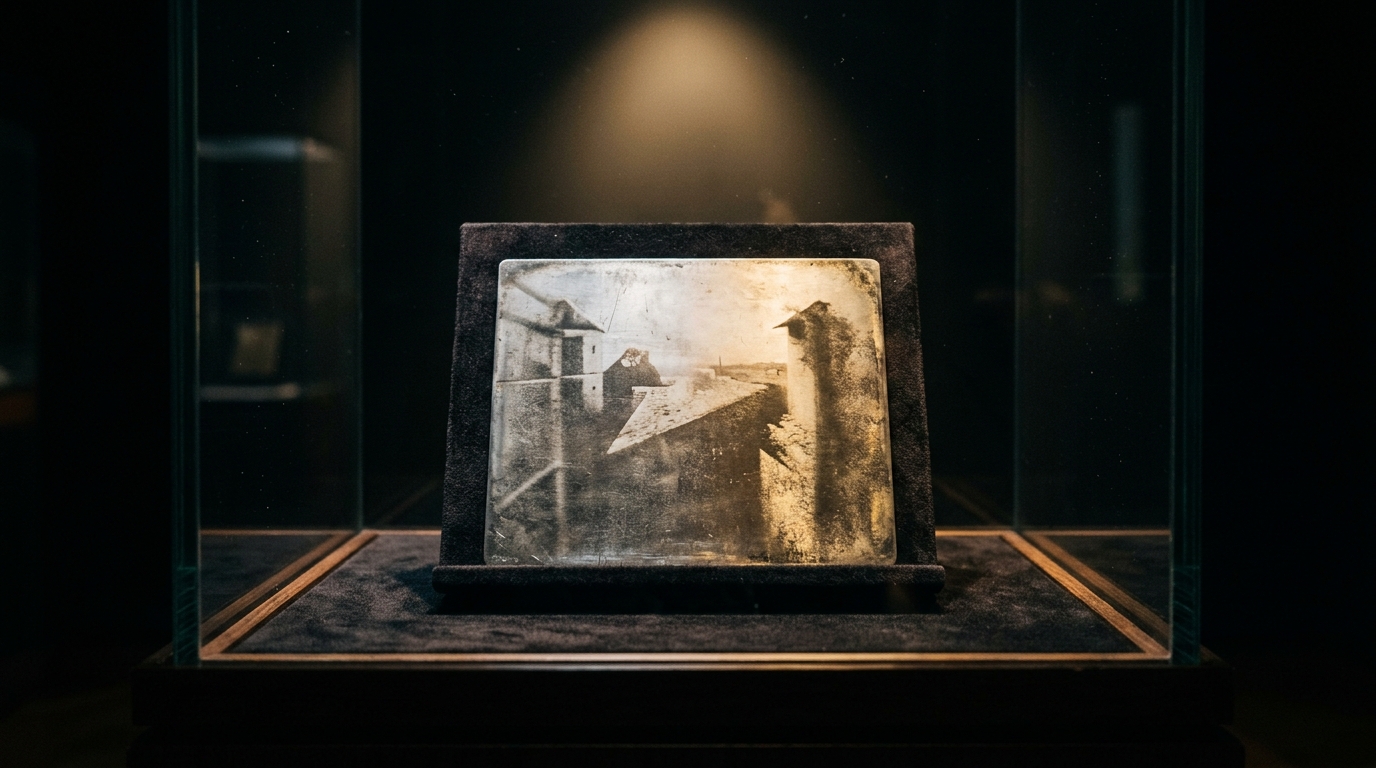
Even before the invention of the daguerreotype or film, a man managed to fix a lasting image of reality onto a metal plate, unknowingly laying the first cornerstone of the entire history of photography. This image, as fragile as it is precious, almost disappeared forever, swallowed for decades in oblivion before resurfacing almost by chance in the middle of the twentieth century. Today, this small tin rectangle continues to fascinate historians of technique as much as lovers of images, because it alone tells the story of an invention born far from modern laboratories, between pitch and lavender oil. And while its history is deeply French, it now rests thousands of miles from the Hexagon, carefully preserved.
- Nicéphore Niépce created “View from the Window at Le Gras” between 1826 and 1827 using heliography, a method that applied Judean bitumen dissolved in lavender oil onto a tin plate.
- The plate, long considered lost, was found in 1952 by Helmut Gernsheim and his wife in a storage room in London.
- Since 1963, it has been kept at the University of Texas at Austin, permanently exhibited under an argon atmosphere to prevent any oxidation.
- A photo from 1827 missing for more than a century
- Nicéphore Niépce and the Forgotten Birth of Photography
- How Helmut Gernsheim Unearthed the Lost Plate in 1952
- Why This French Treasure Lives Today Under Argon, in Texas
A Photo from 1827 Missing for Over a Century
Imagine a snapshot taken more than two centuries ago, at a time when the word “photography” did not yet exist in everyday language. This is precisely what View from the Window at Le Gras is, conceived between 1826 and 1827, and today regarded as the oldest surviving photograph known to us. The image shows a view from a window, fixed on a tin plate measuring 16.5 by 21 centimeters, barely larger than an A5 sheet of paper. Yet what makes this work particularly intriguing is its changing nature: depending on the angle from which it is viewed, it appears as a negative at times and as a positive at others, somewhat like a hologram before its time.
For a long time, however, this foundational piece of our visual heritage was simply considered lost. Shuffled through inheritances and relocations, it eventually slipped from the radar of historians, leaving doubts about its very existence. Many believed that humanity’s very first photograph simply had not survived the ravages of time.
Nicéphore Niépce and the Forgotten Birth of Photography
To understand the value of this plate, one must return to its author, Nicéphore Niépce, a French inventor who sought above all to mechanically reproduce images, without resorting to drawing. His technique, named heliography, rests on a principle as simple as it is ingenious: he dissolved Judean bitumen, a photosensitive substance, in lavender oil, then applied this preparation in a thin layer onto a carefully polished tin plate. Exposed to light for an extremely long exposure, this layer hardens differently according to the illuminated areas, thereby creating a durable image.
The result is a surface where the Judean bitumen, with a cold metallic sheen, reflects light in a variable way across the plate. It is precisely this play of reflection that explains the distinctive negative-positive effect of the work. Niépce probably did not yet realize it, but he had opened the path to an entire discipline that would transform our relationship with images, long before Louis Daguerre popularized his own process a few years later.
How Helmut Gernsheim Unearthed the Lost Plate in 1952
The story could have ended there, with a major invention reduced to legend without any physical proof. Fortunately, that was without counting on the tenacity of Helmut Gernsheim, a historian of photography, and his wife, Alison. In 1952, the couple came upon the plate in a storage room in London, after years of meticulous searching to recover the trace of a treasure believed forever lost.
This rediscovery is enough to thrill any enthusiast of the history of science and technique: to recover, after decades of uncertainty, the founding object of an entire cultural and artistic industry is a bit like exhuming the first fossil of a species thought extinct. Gernsheim immediately understood the importance of his find and set out to have it officially recognized as the oldest known photograph. His collection, enriched by this exceptional piece, would eventually draw the attention of American university institutions.
Why This French Treasure Lives Today Under Argon, in Texas
In 1963, the University of Texas at Austin acquired the plate to integrate it into its Gernsheim Collection, housed at the Harry Ransom Center. The tin plate coated with Judean bitumen, recovered by Helmut Gernsheim in 1952, is kept at the Harry Ransom Center of the University of Texas in a sealed argon-filled enclosure. This choice is not arbitrary: to preserve a work so ancient and fragile, it was essential to shield it entirely from oxygen, the main cause of degradation of organic materials like bitumen.
In 2002, the Harry Ransom Center collaborated with the Getty Conservation Institute to develop an oxygen-free display device, designed and built at the Institute’s facilities in Los Angeles. Inside this sealed frame, an argon atmosphere—an inert gas that prevents oxidation—remains stable thanks to conditioned humidity silica gel paired with Art-Sorb sheets. This technology, typically reserved for scientific objects or sensitive samples, thus allows one of the earliest images in history to endure through the centuries without further deterioration.
To ensure that this protection remains effective in the long term, the center launched a new conservation project in the summer of 2019, in collaboration with imaging specialists and scientists from several institutions across the country. The goal: to guarantee that this heliography, a true ancestor of all our photographs, continues to exist for future generations. Today, Niépce’s plate is permanently on display in the Harry Ransom Center’s hall, alongside another cornerstone of world heritage, Gutenberg’s Bible, as if to symbolize two major revolutions in the transmission of images and knowledge.
There is something vertigo-inducing about thinking that the very first photograph of humanity, born in the French countryside under the impulse of a little-known inventor, rests today under argon in an American university, far from its origins. Yet it also proves that some inventions go far beyond the borders of their homeland to become a shared patrimony of humanity, carefully guarded to continue telling, pixel by pixel—or rather bitumen grain by bitumen grain—the fascinating story of our earliest fixed gazes in time.
