
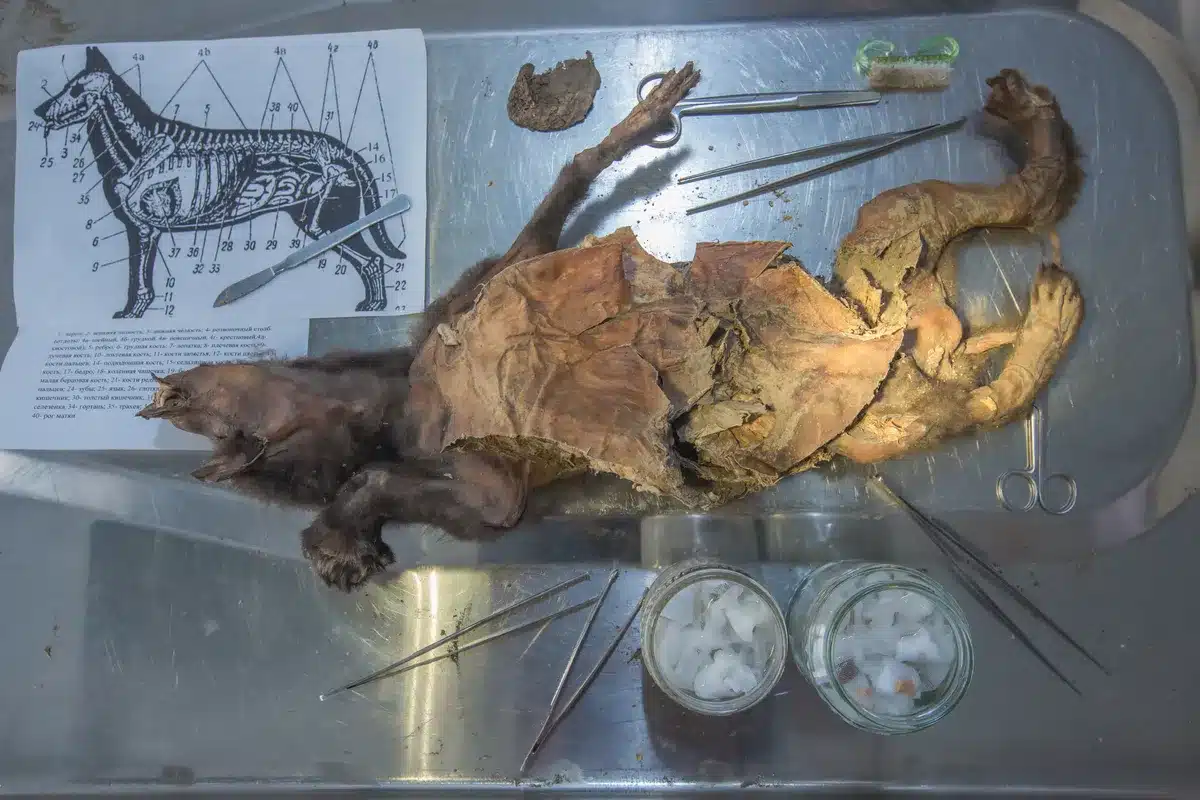
A fossilized Siberian wolf cub has just yielded an extraordinary secret. In its perfectly preserved stomach, scientists discovered a three-centimeter piece of tissue with blond fur still attached. This fragment belongs to a woolly rhinoceros that lived 14,400 years ago, just before the species disappeared from the Earth’s surface for good. Yet this macabre detail hides an unprecedented scientific achievement: researchers managed to sequence the complete genome of this animal, a world first for a glacial-era specimen found in a predator’s stomach. And what this ancient genetic code reveals challenges everything we thought we knew about the end of the Pleistocene giants.
A final meal spanning the millennia
The wolf cub, named Tumat-1 after the northeastern Siberian village where mammoth ivory hunters unearthed him, was only nine weeks old at the time of death. His end was likely brutal, perhaps the collapse of his den, because the contents of his stomach had not yet had time to be digested. This exceptional preservation allowed the tissues to traverse fourteen millennia in remarkable condition.
When scientists opened the cub’s stomach, they first thought they were identifying remains of a cave lion. The blond color of the fur fed that hypothesis. Camilo Chacón-Duque, a researcher at Uppsala University in Sweden and co-author of the study, explains that the youngsters of many megafauna species, notably woolly rhinoceroses and woolly mammoths, indeed wore lighter fur than adults.
Only genetic analysis could settle the question. And it revealed far more than a simple species identification. The team led by Sólveig Guðjónsdóttir of Stockholm University achieved the feat of sequencing the full genome of this rhinoceros at high resolution, despite the notorious fragmentation of ancient DNA.
< / p>
A thriving population right up to the end
The researchers compared this genome with two older woolly rhinoceros specimens dated to 18,000 and 49,000 years ago, respectively. This chronological analysis allowed them to trace the evolution of genetic diversity, levels of inbreeding, and harmful mutations in the final millennia preceding extinction.
The result upends expectations. Fourteen thousand four hundred years ago, woolly rhinoceroses showed no signs of significant genetic deterioration. Their population remained stable and relatively substantial. In other words, the species was not in a gradual decline, slowly dying under adverse conditions. It vanished rapidly, while still genetically robust.
The climate, not humans
This discovery reignites a century-old debate about the causes of the Pleistocene megafauna extinction. Two competing hypotheses exist: overhunting by humans, or climatic upheavals. For the woolly rhinoceros, the genetic data clearly favor the latter explanation.
The arguments are strong. Human settlements had existed in Siberia for at least 15,000 years before the species disappeared, and these populations remained sparsely distributed due to harsh climatic conditions. Woolly rhinoceroses thus coexisted with humans for millennia without major issues.
The moment of their extinction coincides precisely with the Bolling-Allerød interstadial, a brutal warming episode that occurred between 14,680 and 12,890 years ago in the Northern Hemisphere. Woolly rhinoceroses, highly specialized to certain steppe-type habitats and not very mobile, could not adapt quickly enough. Their range had already gradually shrunk during previous Pleistocene climatic fluctuations. At the fatal moment, they occupied only a narrow band in northeastern Siberia.
This study, published in Genome Biology and Evolution, demonstrates that a species can collapse rapidly even without prior genetic fragility, provided its environment changes faster than it can adapt.
