
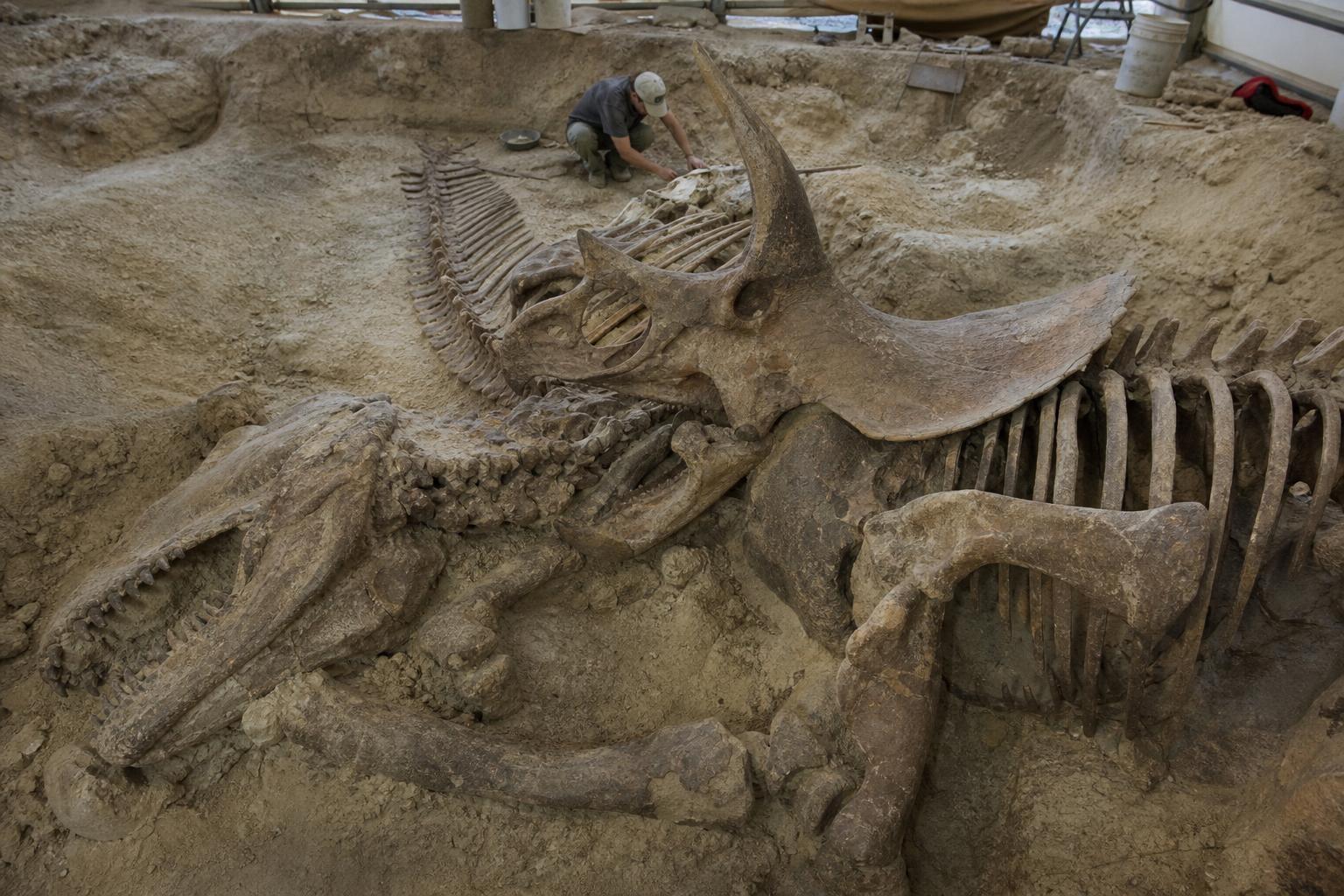
In the badlands of Montana, a stunning fossil tableau froze a desperate struggle in time: a carnivorous dinosaur and a horned giant entwined in their final moments. What followed was a different kind of battle—legal and logistical—that stretched for nearly a decade and a half, before the pair finally reached a public museum. The path from windswept ranchland to climate-controlled gallery remade not only the fates of these animals, but also the pace of modern paleontology.
The day the Cretaceous stopped
The discovery site lay under a quilt of sandstone, where field crews uncovered two skeletons pressed together—a tyrannosaurid predator and a solidly built Triceratops. The bones read like a forensic report: jaws clamped, limbs tangled, damage consistent with a violent, endgame encounter. One team member later summed it up simply: “It’s a snapshot of behavior.”
What made the scene feel almost alive were the traces beyond bone—impressions, textures, and delicate articulations suggesting the animals died where they fell. “Fossils don’t come with instruction manuals,” as researchers like to say, but here the context did much of the speaking.
From ranchland to courtroom
The remarkable find did not go straight to a gleaming atrium. Ownership questions pulled the fossils into a years-long limbo. In Montana, who owns a dinosaur can depend on how state law classifies fossils and how “surface” and “mineral” rights interlock. The result was a tangle of filings, appeals, stalled auctions, and quiet conservation in field jackets.
Over roughly fifteen years, the pair became infamous not just for their dramatic pose, but for the precedent-setting questions they raised. “Let the rocks tell their story,” a preparator said, “but first someone has to agree who owns the book.” Only after court decisions clarified key issues could a museum step forward with a plan for scientific access and public display.
A new home built for science
When the pair finally arrived at a major institution, the priority was careful, transparent preparation. Rather than sequester the work in a closed lab, the museum designed a glass-walled workspace where visitors could watch every scrape, brush, and consolidant drop. The goal was to turn preparation itself into a living exhibit—a front-row seat to how science actually happens.
Funding from public-minded donors helped build specialized infrastructure: micro-prep tools, high-resolution scanners, environmental controls, and room for multi-year, multi-disciplinary teams. “If you’re patient with the rock, the rock pays you back,” one technician quipped as they traced minute boundaries between bone and matrix.
Why this pair matters
Even before every fragment is freed from the stone, the pair promises a windfall of data:
- Behavior locked in place—predator and prey literally in contact, a rare context for testing ecological hypotheses.
- Exceptional articulation, preserving how joints and armor fit and functioned, critical for biomechanics and locomotion.
- Potential soft-tissue traces and microstructures, aiding studies of growth, disease, and healing.
- Two life histories entwined in one event, offering matched paleoenvironmental signals and time-synced taphonomy.
- A legally clearer path that informs future fossil stewardship and museum-community partnerships.
Each line of evidence sharpens questions that have lingered for decades—how tyrannosaurids hunted, how ceratopsians fought, and what a bad day in the Late Cretaceous actually looked and felt.
The science under the dust
Preparation is slow for a reason: the difference between a priceless structure and a lost detail can be one careless stroke. Teams work under microscopes, wick in thin adhesives, and document each step with photographs, field notes, and 3D models. Micro-CT and surface scanning capture internal and external geometry, while geochemical assays probe burial history.
Researchers will examine bite mark patterns, fracture angles, and stress paths through horn cores and jaw bones. Do punctures align with a live struggle, or with post-mortem disturbance and shifting sediments? Do growth rings in the tyrannosaurid’s bones point to a subadult predator, complicating assumptions about who hunted what, and when?
Public eyes on a private world
By placing the lab on public view, the museum reframed the narrative from “dinosaur in a crate” to “science in progress.” Visitors stand meters from the action, hearing the soft rasp of a carbide needle and the murmur of curators cross-checking maps. “This isn’t movie-magic,” a staffer tells guests. “It’s patience, evidence, and the courage to revise.”
That visibility also reminds people that fossils emerge from living communities—ranchers, field techs, landowners, and local governments. After fifteen long years, the pair serves as a case study in how careful negotiation can protect both scientific value and public trust.
What the rocks might still say
Even as bones come free, the most exciting results may be invisible: proteins bound in mineral lattices, microscopic wear on tooth tips, or grains of pollen that pin the season of death. Each microfact is a vote for or against a larger story—a chase, a counterattack, a mutual collapse into shifting, waterlogged sand.
“It feels like the past finally cleared its throat,” one scientist said, watching a vertebra emerge into light. After so much waiting, the work is both painstaking and urgent. The animals are silent, but their bones are finally being heard, one careful pass at a time.
