
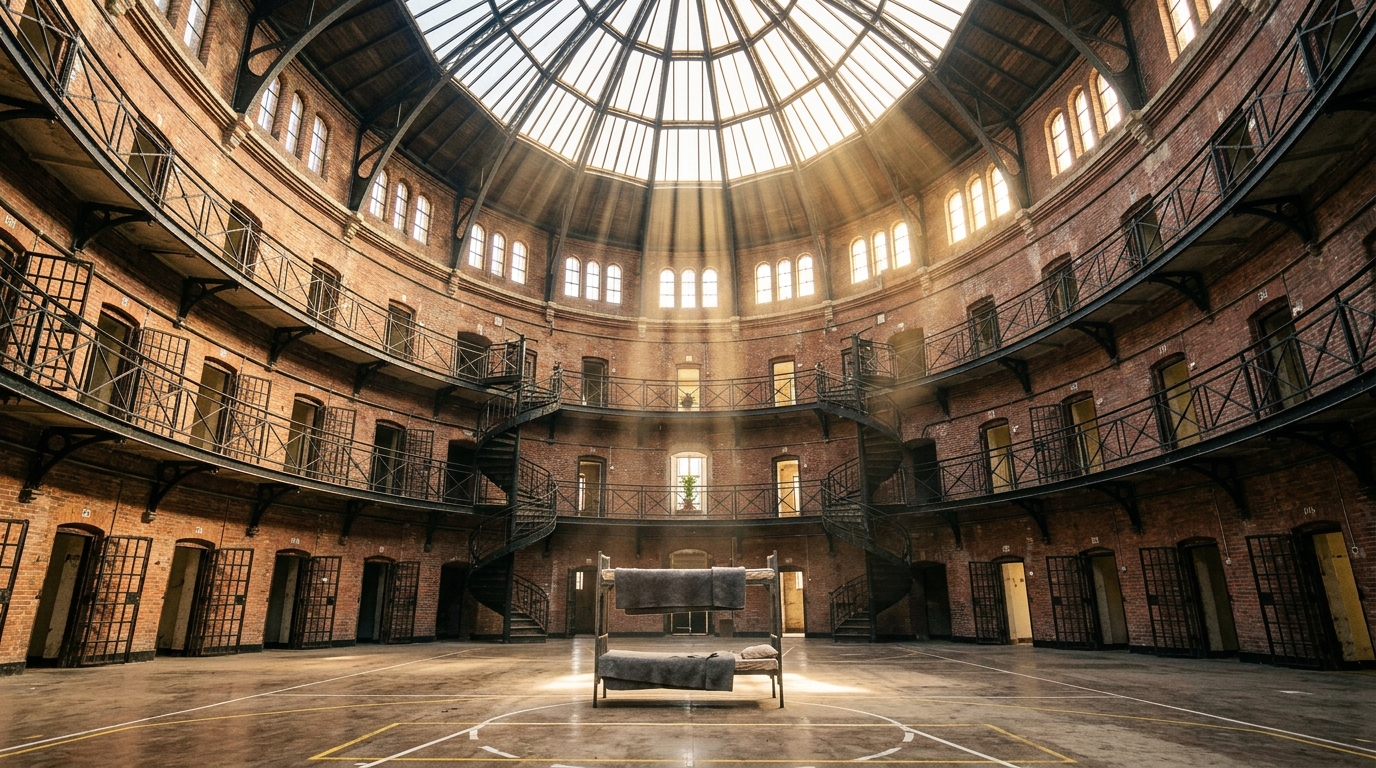
There is an essential distinction between a prison that is understaffed and one that is under-occupied by inmates. In the first case, you lack hands to monitor the cells. In the second, it is the cells themselves that remain hopelessly empty for lack of prisoners to confine. It is precisely this second scenario, as unlikely as it may seem, that led the Netherlands to convert one of its prisons into a seasonal rental for Norwegian detainees. A story that almost reads like an administrative sketch, but which indeed unfolded between 2015 and 2018, with millions of euros at stake and a proper diplomatic agreement in place.
- The decline in crime in the Netherlands led to the closure of 19 prisons for lack of inmates, including Veenhuizen, which was rented to Norway under the Norgerhaven agreement signed on March 2, 2015 for 242 detention places
- The contract provided for a fixed annual rent of 25.5 million euros regardless of occupancy rate, and only about 20% of the 650 inmates housed between 2015 and 2018 were actually Norwegian
- Norway terminated the lease on August 31, 2018, after having cleared its prison waiting lists and spent about NOK 900 million over three years
- A Dutch prison emptied by the decline in crime
- Norgerhaven, the turnkey prison rented to Norway
- €25.5 million per year for 242 places, but not only Norwegians
- A lease not renewed in 2018: why the experiment ends
A Dutch Prison Emptied by the Decline in Crime
In the 2000s, the Netherlands pursued an ambitious prison policy, building new facilities to anticipate a rise in delinquency. Yet reality contradicted the projections. Crime fell year after year, faster and more durably than Dutch experts had anticipated. The result: thousands of brand-new cells stood empty, a paradox for a country that had built these walls with the opposite aim in mind.
Faced with this paradox, Dutch authorities were compelled to close several prisons outright for lack of inmates. Nineteen facilities shut their doors during this period, a figure that measures the scale of the phenomenon. Among the sites at risk was Veenhuizen, an old, historic penal colony nestled in the province of Drenthe. Rather than letting these expensive infrastructures fall into disrepair, The Hague sought a rather original solution: to find a tenant.
Norgerhaven, the Turnkey Prison Rented to Norway
While the Netherlands is buried under vacant cells, its Nordic neighbor faces the exact opposite problem. Norway is seriously short of places to incarcerate its convicts, to the point of building interminable waiting lists before entry. The idea then grows to bring the two countries closer through a mechanism that, at the time, had no precedent of this scale in Europe, even if a similar arrangement had already existed between Belgium and the Netherlands with the Nova Belgica accord, active from 2010 to 2016 without truly alleviating Belgian prison overcrowding.
On March 2, 2015, Norway’s Minister of Justice, Anders Anundsen, officially signs the Norgerhaven agreement with the Netherlands, covering the rental of 242 detention places. The facility retains its Dutch name, but becomes administratively an annex of Norway’s Ullersmo prison. A fairly novel legal arrangement then takes shape: the operation’s management is Norwegian, while the day-to-day prison staff remains Dutch. The first inmates arrive by plane directly from Norway on September 1, 2015, a transfer that is striking when one notes that of the 112 initial transfers decided, only 79 inmates volunteered for this expatriate incarceration.
€25.5 Million per Year for 242 Places, but Not Only Norwegians
The contract between the two countries rests on a simple principle: an annual fixed rent of €25.5 million, regardless of the actual occupancy rate of the prison, provided it does not exceed the planned 242 places. In other words, Norway pays for the availability of the cells, not for their actual filling, somewhat like renting an empty warehouse while committing to pay rent even if the shelves remain only partially stocked.
Between 2015 and 2018, 650 inmates convicted by the Norwegian justice system served their sentences at Norgerhaven. But, far from what one might expect, the overwhelming majority of them did not hold Norwegian nationality. Only about 20% of the inmates housed were indeed Norwegian; the rest consisted of inmates of other nationalities incarcerated on behalf of Oslo, often individuals convicted in Norway but to be expelled once their sentences were completed. This peculiarity did not escape the Norwegian Parliamentary Ombudsman, the Sivilombudet, who was notably critical after a 2016 visit to the facility, highlighting difficulties linked to family separation and the application of Norwegian law on foreign soil.
A Lease Not Renewed in 2018: Why the Experiment Ends
The cross-border prison venture ends rather quickly in light of the project’s initial ambition. On February 23, 2018, Norway’s Minister of Justice, Sylvi Listhaug, officially announces the termination of the contract, explaining that Norway’s waiting lists for detainees had simply disappeared. In plain terms, the country had meanwhile succeeded in rehabilitating enough prison capacity on its own territory to no longer require this supplementary solution from the Netherlands.
The lease thus ended on August 31, 2018, with no renewal, after having cost Norway around NOK 900 million over three years, according to figures released at the time. Several factors weighed in: the logistical burden of managing a distant prison, the geographical remoteness burdening families of the inmates, and, of course, the improvement of the Norwegian prison system itself, which made the arrangement financially less justifiable.
This three-year interlude remains a fascinating case study in European prison policy management. It illustrates how two neighboring nations can find themselves facing diametrically opposed problems—one overwhelmed by empty cells, the other desperately short of spaces—and how tempting, at least on paper, to align these realities through a simple rental contract. Yet the experience also exposed its limits, between jurisdictional questions, human realities, and budgeting calculations that inevitably catch up with even the best administrative ideas.
