
How might you hide an industrial building stretching hundreds of meters from the eyes of potential enemy bombers? The question may seem drawn from a spy thriller, and yet it truly confronted American engineers in the heart of World War II. Faced with the threat of a Japanese attack on the West Coast, the military and Boeing joined forces to devise a solution as surprising as it was ingenious. In 1942, Boeing camouflaged its Seattle Plant 2 beneath a fake residential neighborhood to shield its B-17 production from a Japanese strike. A little-known tale, perched between military ingenuity and the behind‑the‑scenes world of Hollywood, which I invite you to rediscover.
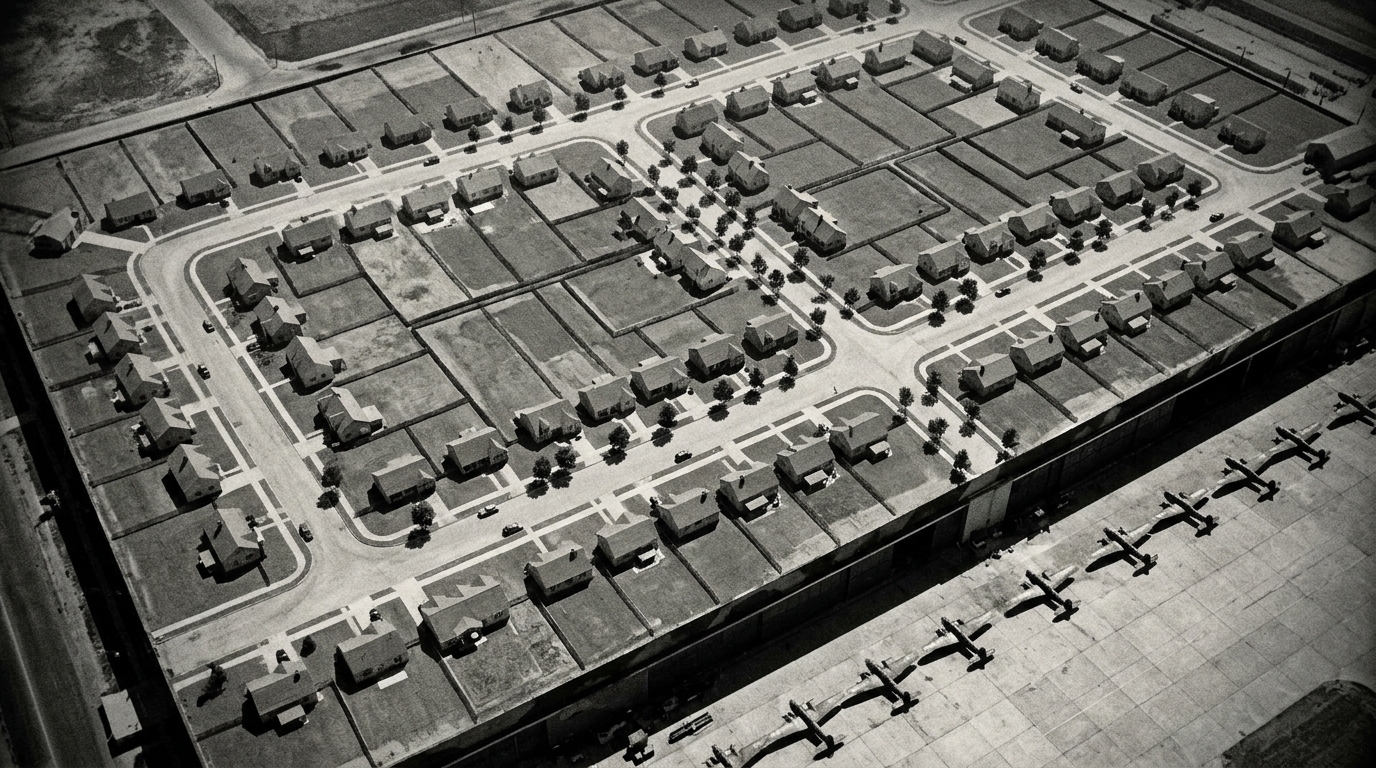
- In 1942, following Pearl Harbor, Boeing and the US Army concealed Seattle Plant 2 under a fake residential district to shield it from a Japanese attack.
- A 26‑acre fake village conceived by a Hollywood set designer featured painted canvas houses, trees and lawns made of canvas, mesh, and fiberglass.
- The camouflage, completed in 1944, was never tested in combat and was dismantled in 1946, while Plant 2 continued operating until its demolition in 2010.
- 1942, Seattle fears an imminent Japanese attack on its armament factories
- A fake residential district built atop the factory
- Hundreds of workers mobilized to fool the enemy seen from above
- The military secret that shaped American aviation
1942, Seattle fears an imminent Japanese attack on its armament factories
To grasp the scale of this utterly audacious project, one must go back a few years. In 1936, Boeing built Plant 2, a facility intended to house the very first prototypes of the B-17 Flying Fortress, the heavy bomber that would become a symbol of American air power, along with the Boeing 307 Stratoliner. The site continued to grow, so that by May 1940, an additional six hundred thousand square feet were added to the existing infrastructure. By the time Japan’s bombs struck Pearl Harbor, the plant already covered about 1,776,000 square feet, the equivalent of several dozen football fields.
That surprise attack immediately altered the calculus for American authorities. The West Coast, previously regarded as relatively safe, suddenly became a potential target. Among the most strategic sites to shield, Boeing’s Seattle plant topped the list since it produced one of the army’s most valuable wartime tools. The task was thus to find, and fast, a method to fool any enemy pilots who might fly over the region.
A fake residential district built atop the factory
This is where the story veers into almost cinematic territory. The US Army Corps of Engineers chose not to settle for a mere camouflage tarp. The idea was far more ambitious: to recreate, directly on the roof of the factory, a genuine residential neighborhood capable of deceiving the eye from the air. To bring this pharaonic project to life, the authorities enlisted a specialist far from the usual engineering milieu: John Stewart Detlie, a Hollywood set designer. His expertise in crafting visual illusions for cinema proved invaluable for devising a scenery that would look authentic from the sky.
The result surpassed imagination. A fake village of 26 acres took shape above Plant 2, with painted-canvas cottages, trees fashioned from mesh and wood coated with chicken feathers, and a verdant lawn entirely made of burlap. The ground itself was a mosaic of burlap, canvases, and chicken wire, while drawn glass-fiber filaments completed the illusion of foliage. To complete this dollhouse-scale landscape, the engineers even christened the fake streets with names as witty as Synthetic Street and Burlap Boulevard, a nod to the materials used in their construction.
Hundreds of workers mobilized to fool the enemy seen from above
Behind this visual feat lay a project of monumental proportions. Building this fake neighborhood required about one million board-feet of lumber—enough to construct several hundred standard houses—along with one and a half million square feet of chicken wire. Add to that 500,000 feet of supporting cables and no less than 500 tons of steel structures, underscoring how seriously the Americans treated this camouflage operation.
Perhaps the most charming anecdote concerns its astonishing effectiveness, perhaps even overly so. The camouflage was so convincing that American allied pilots themselves supposedly had difficulty spotting their own base from the air, disoriented by this artificial landscape that blended seamlessly with the surrounding urban fabric. A paradox for a device designed to fool the enemy, yet evidently successful in confusing even its own troops.
The military secret that shaped American aviation
There is a certain irony in this tale, perhaps what makes it even more fascinating to recount. Despite the colossal resources poured into concealing the factory from prying eyes, the camouflage never had the chance to prove itself against a real threat. Japanese aircraft never managed to reach Seattle, and the device, impressive as it was, was never truly tested in combat.
The fake village did not outlast the plant it protected. Finished in 1944, as the war drew toward its end, it was dismantled a year after the war’s conclusion, its military usefulness having become obsolete. Plant 2, by contrast, kept serving its mission much longer, producing aircraft for several decades before its demolition in 2010. Between those dates, the plant traversed a significant portion of the history of American military aviation, long after its astonishing disguise had vanished from the landscape.
What makes this story so captivating is precisely this improbable blend of military engineering and cinematic trickery, of strategic rigor and artisanal creativity. In an era when war also unfolded on the stage of psychology and concealment, Boeing and the US Army managed to transform a constraint into a genuine technical achievement, to the point of literally erasing one of the country’s most strategic industrial sites from the map. A little-known, astonishing page of history that unquestionably deserves to emerge from the shadows.
