
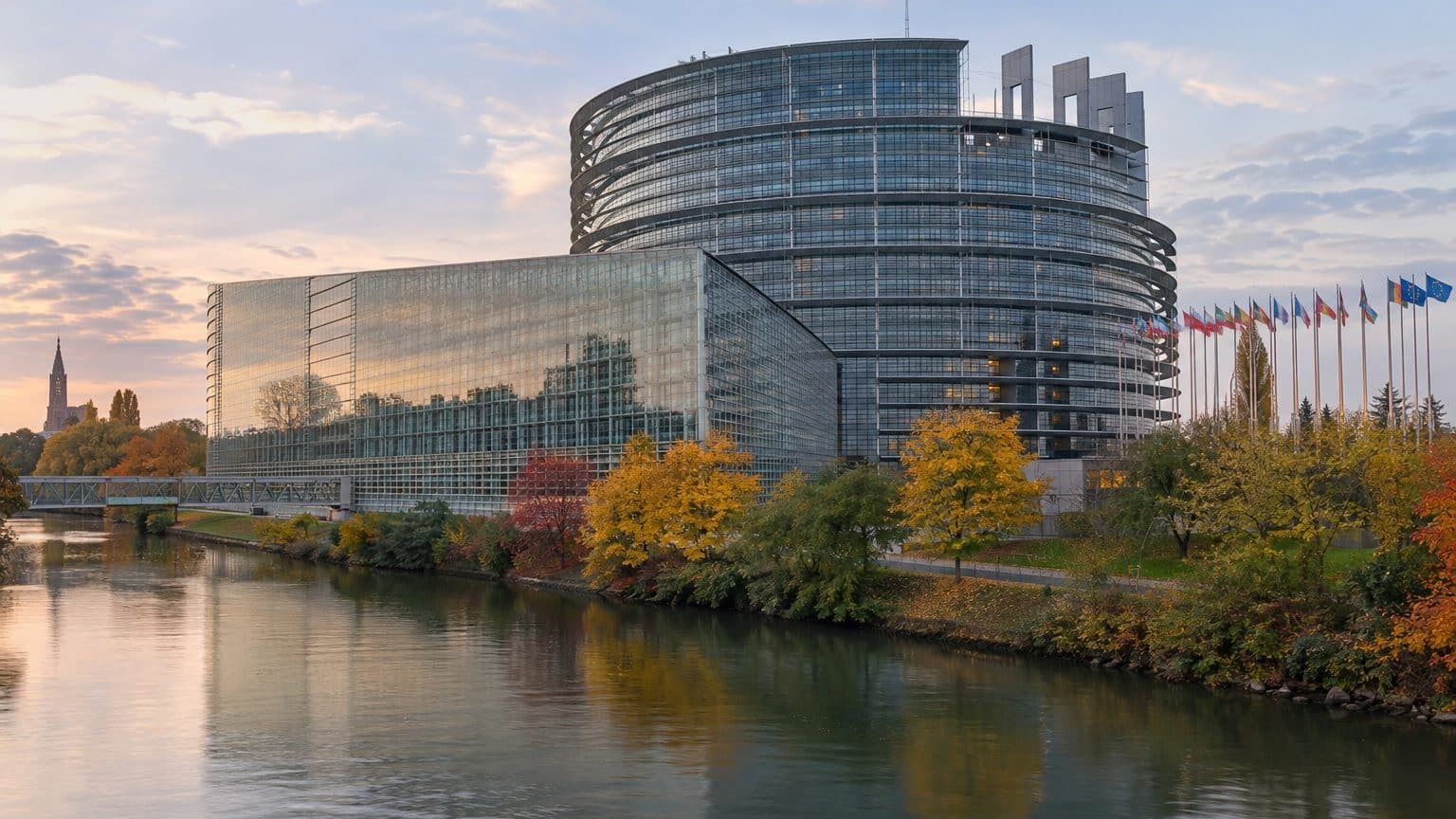
The Louise-Weiss building in Strasbourg is almost encircled by the Ill River and sits on a city-owned plot spanning 4.5 hectares. Its hemicycle contains 750 seats, used for plenary sessions only four days a month. The building was officially opened on December 14, 1999. Its cost is cited as 337 million euros according to Wikipedia. Other sources consulted do not confirm this figure, and some suggest higher amounts.
Four days a month: that is the time during which the deputies sit there.
- The Louise-Weiss building was inaugurated on December 14, 1999 in Strasbourg.
- Its hemicycle seats deputies for four days per month.
- The European Court of Auditors estimates the potential annual saving at 113.8 million euros.
220,000 m² for 4 days of session
Construction began in November 1993 and stretched over six years. The building comprises 20 levels, 17 above ground and 3 underground. Its gross total floor area amounts to 220,000 m², roughly the floor space of about thirty football pitches. The Mérimée database of the Ministry of Culture notes a total area of 200,000 m², evidence that measurements of the edifice vary depending on the source.
In the hemicycle, 750 seats await the deputies. According to franceinfo in 2019, they sit there four days a month for plenary sessions, while the rest of the time the Parliament works in Brussels. Strasbourg hosts the monthly plenary sessions, Brussels houses the work of committees and political groups, and Luxembourg hosts the General Secretariat. These plenary sessions number twelve per year.
Twelve four-day sessions amount to roughly 48 sitting days per year, i.e., 13% of the calendar. This calculation applies to the standard pace and does not account for any extra sessions.
113.8 million euros per year: the figure from the European Court of Auditors
The European Court of Auditors issued in July 2014 an analysis in response to a resolution passed by 73% of MEPs in November 2013. Its verdict: recurring annual savings on operating expenditures could reach 113.8 million euros, i.e., 6.3% of the European Parliament’s annual budget. No scenario of centralization to Strasbourg was studied.
To our knowledge, no official update has replaced this 2014 figure.
Scaled to the 12 annual sessions, the amount corresponds to about 9.5 million euros per plenary session. Other analyses cite around 10 million euros per plenary session. Over 50 years, the savings would reach 3.2 billion euros. The Court adds an exceptional saving of 616 million euros if the Strasbourg buildings were sold. Rue89 Strasbourg regards this figure as artificial, noting that these buildings are not intended for any other activity and that the analysis itself characterizes these values as approximate.
A contested cost, an old carbon footprint
A 2002 report estimated the surplus CO2 emissions from travel at between 11,000 and 19,000 tonnes per year. A February 2012 study by the European Association of Young Entrepreneurs, based on official Parliament documents, brings the annual cost of the seat to 51.5 million euros and the carbon footprint to 4,199 tonnes of CO2. Between the two carbon estimates, the gap ranges from 2.6 to 4.5 times, and neither figure is recent.
For Touteleurope, hosting the plenary represents a significant financial issue for a portion of the city’s economy. A report cited by Le Journal du Dimanche estimates the economic spillovers from the presence of the eurodeputies in Strasbourg at 800 million euros per year.
The seat is set by the treaties, and France opposes any transfer.
What remains is the initial figure. The 337 million euros cited by Wikipedia is not universally accepted: another entry mentions 3.1 billion francs, i.e., 470 million euros, for the building’s construction, and a database of works places it at around 500 million euros. Depending on the estimate used, the building’s price thus ranges from 337 to 500 million euros, i.e., up to 48% higher.
Sources: touteleurope.eu | fr.wikipedia.org | pop.culture.gouv.fr
