
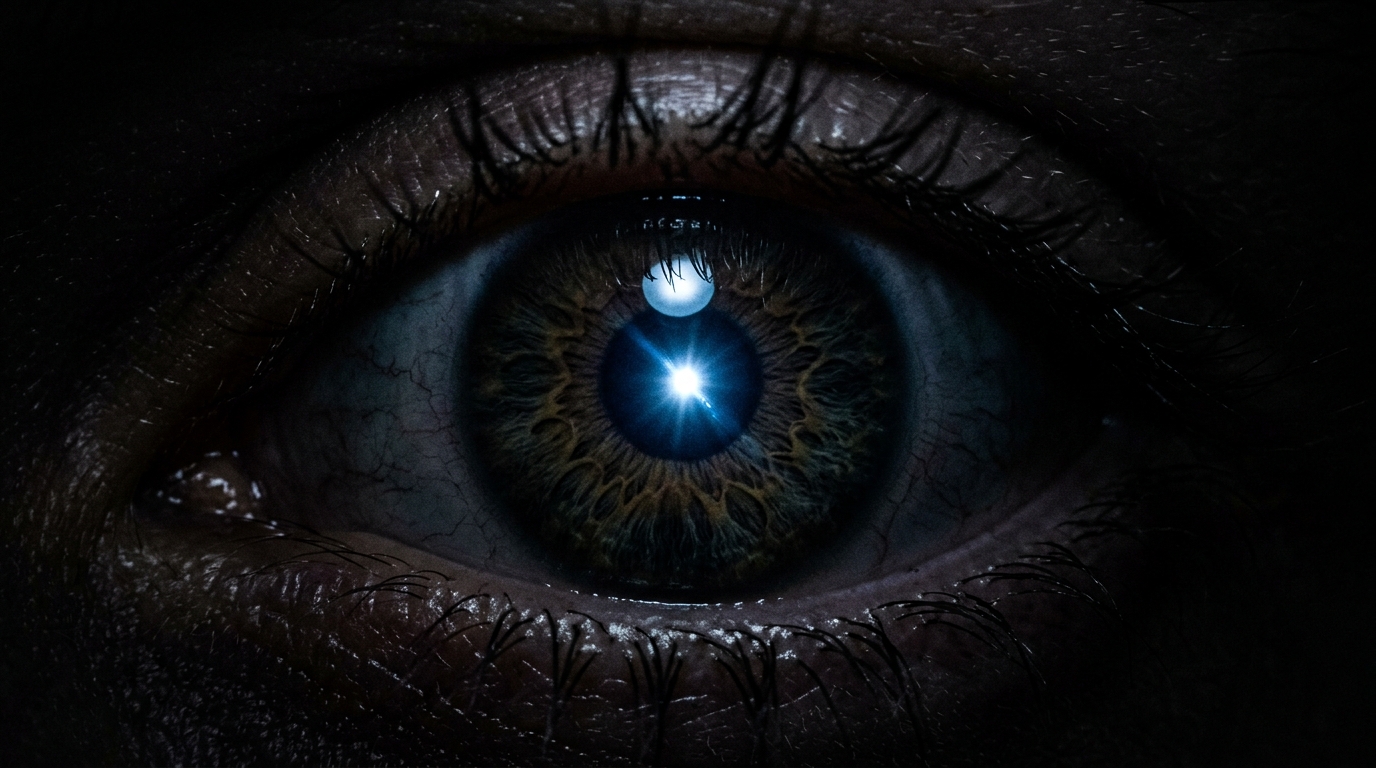
Being able to see a single photon, a lone elementary particle of light, without any optical booster or sophisticated measurement instrument: that sounds almost like science fiction. Yet this is precisely what researchers have managed to demonstrate with relentless scientific rigor. By delivering the light grain by grain into the eye of three volunteers in Vienna, the team led by Alipasha Vaziri literally tested the ultimate limit of human vision. A technical feat as much as a fascinating plunge into the unsuspected capabilities of our visual system, which proved to be far more sensitive than previously thought.
- In 2016, Alipasha Vaziri’s team demonstrated that the human eye can detect a single photon using a quantum source of entangled photon pairs.
- The three volunteers detected the photon in 51.6% of trials, a result statistically above the 50% random chance threshold.
- The detection of a preceding photon increased the chances of perceiving the following photon, suggesting a priming mechanism that temporarily adjusts the visual system’s sensitivity.
- A photon, three volunteers, an extraordinary experiment
- How Vaziri managed to isolate a single grain of light
- 51.6% success: a figure that goes beyond pure chance
- What this experiment reveals about the limits of the human eye
A photon, three volunteers, an extraordinary experiment
The story begins with a question that may seem almost naive, yet has captivated researchers for decades: can a human being perceive a single photon? It was already known that the rod cells in our retina, those ultra-sensitive biological sensors, could respond to isolated photons. But to have the brain transform this minuscule information into a conscious perception, that was another realm. Previous studies on the topic, conducted with subjects acclimated to total darkness, had never managed to go below five to seven photons simultaneously to obtain a reliable answer.
This is where the team led by Alipasha Vaziri, associate professor at New York University’s Rockefeller University and head of the Neurotechnology and Biophysics Laboratory, also affiliated with the Institute of Molecular Pathology in Vienna, enters the scene. To carry out this exquisitely precise experiment, the researchers recruited only three volunteers, all young men in their twenties with excellent visual acuity. A tiny sample, certainly, but one that underscores the extreme complexity of the experimental protocol in place.
How Vaziri managed to isolate a single grain of light
Generating a single photon and ensuring it reaches a volunteer’s eye is a substantial technological challenge. To achieve this, the Vienna team used a quantum source that produces pairs of entangled photons, a phenomenon that guarantees a single, precisely controlled photon actually arrives at the subject’s cornea. Concretely, the setup relies on a process called spontaneous parametric down-conversion: a high-energy photon passing through a specific crystal splits into two photons of lower energy.
One of these twin photons is sent directly toward the volunteer’s eye, while the other travels to a control detector. Thanks to this quantum correlation, the researchers could estimate with high probability that a single photon had been sent to the eye at the moment the detector registered its partner. It’s like sending two identical messengers in opposite directions, knowing that if one reaches its destination, the other has done so as well. This level of experimental control was essential to eliminate any ambiguity about the amount of light actually perceived.
51.6% success: a figure that goes beyond pure chance
The results of this study, published in Nature Communications in 2016, are striking. Across all trials, the three volunteers managed to detect the presence of the single photon in 51.6% of cases. A figure that might seem modest at first glance—barely above half—but it takes on real significance when compared with the pure chance threshold set at 50%. Statistically, this margin proved significant, evidence that the human brain truly processes the information carried by this isolated photon, rather than merely guessing.
Interestingly, the participants did not describe their perception as a bright, obvious flash of light. In the words used by Vaziri, the reported sensation resembled more the impression of seeing something without truly seeing it, a sort of visual intuition on the border of consciousness. A tenuous, fleeting feeling, almost indescribable with ordinary language, yet the participants could distinguish it from a total absence of stimulation.
What this experiment reveals about the limits of the human eye
Beyond the raw numbers, this study highlighted another captivating phenomenon: the probability of detecting a photon was not constant; it varied depending on what had happened immediately before. The researchers indeed observed that the presence of a preceding photon increased the chances of signaling a subsequent photon. This priming mechanism suggests that the visual system temporarily adjusts its sensitivity, somewhat like a camera sensor that boosts its ISO sensitivity for a brief moment after detecting a first source of light.
This discovery opens exciting avenues for understanding how our brain filters, amplifies, or, on the contrary, ignores signals of extreme weakness. It has moreover paved the way for new research on how the human visual system responds to different quantum states of light, a field at the crossroads of biophysics and quantum physics that continues to intrigue scientists worldwide. We are touching something vertiginous here: our eye, that organ we think we know inside out, still hides mechanisms of nearly unimaginable finesse.
What ultimately stands out in this experiment is the resounding demonstration that the boundary between quantum physics and biology is not as clear-cut as one might suppose. Our eyes, these instruments shaped by millions of years of evolution, prove capable of flirting with the theoretical limits imposed by nature itself. A performance that reminds us, yet again, that the human body is full of mysteries that only state-of-the-art instrumentation can reveal, one grain of light at a time.
