
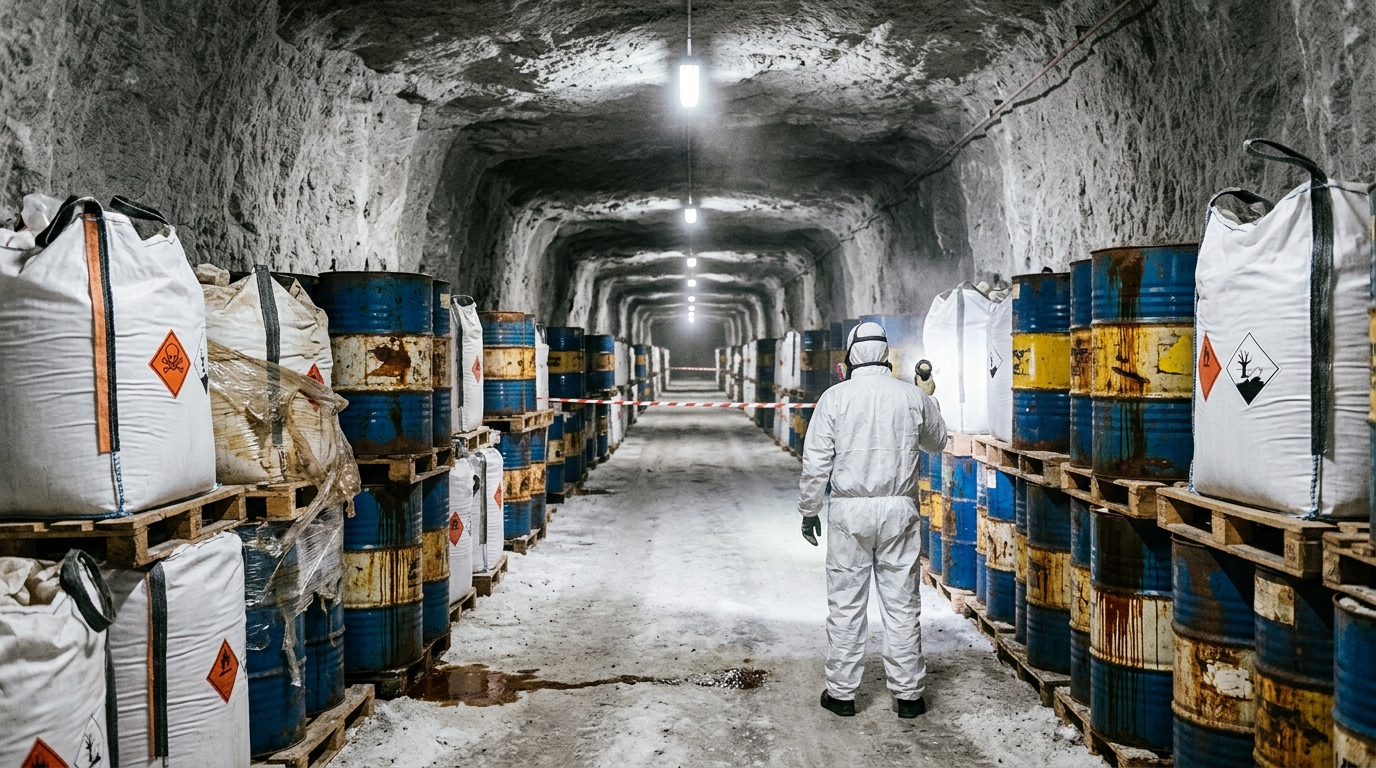
Imagine having to guarantee, for centuries, the perfect seal of a basement filled with some of the most toxic substances ever produced by industry. Yet this is the gamble that France has officially confirmed, in the municipality of Wittelsheim, in Haut-Rhin. After years of legal wrangling, the Strasbourg Administrative Court validated the definitive confinement of 42,000 tonnes of industrial waste, sealed 500 meters underground, just above a groundwater reservoir that feeds around two million people. A decision that closes a file older than thirty years, but which, according to many experts, does not extinguish the risk. It simply postpones it, as one would delay the inevitable.
Forty-Two Thousand Tonnes of Poison Beneath the Alsatian Ground
The Stocamine site is not a mere industrial anecdote. Since 1990, this former Alsace potash mine has housed so-called ultimate wastes, meaning residues deemed impossible to treat or recycle by any other means. In galleries dug half a kilometer underground lie now arsenic, mercury, asbestos, chromium, as well as incineration residues particularly rich in pollutants. All of this amounts to a vertiginous total of 42,000 tonnes, a figure that dizzyingly underscores how small doses of each substance are enough to render water unfit for consumption.
The site’s history is marked by a pivotal event: a serious fire in 2002 within the underground galleries, which abruptly halted operations and exposed the fragility of the arrangement. Since then, Stocamine has become a symbol, one of the industrial choices of the 1990s whose long-term complexity we now understand in hindsight. For one thing, burying waste is one thing. Ensuring that they stay there for eternity, without ever migrating toward surrounding aquifers, is another, far more uncertain challenge.
Concrete, the Last Barrier Before the Aquifer
Given the technical impossibility of safely removing all waste, authorities decided to pursue confinement through concrete barriers, combined with the complete backfilling of access shafts. The concept is straightforward on paper: hermetically seal the galleries to prevent any flow of water or air that could dissolve and transport pollutants to the surface. The judges of the Strasbourg Administrative Court even justified their decision by deeming this the only option capable of guaranteeing long-term impermeability, as full decoupling was no longer feasible within acceptable safety conditions.
Yet concrete, no matter how robust, is not an eternal material, as history has shown with heavily reinforced structures. A 2023 report had already warned about the progressive degradation of the gallery linings, the structures designed to ensure the stability of underground walls. Even more troubling, the same report noted that beyond 100 meters of depth, it becomes mathematically impossible to guarantee the durability of these structures over time. In other words, at 500 meters underground, no one can assert with certainty that the barrier will hold indefinitely against the surrounding geological and chemical pressures.
Why the State Chose Burial Over Complete Stock Removal
This choice of definitive confinement did not emerge overnight. Between 2015 and 2017, partial stock removal did take place, allowing the removal of the most dangerous wastes. But faced with the increasing complexity of operations and the safety risks for workers, the State finally announced, in January 2021, the abandonment of ongoing extraction in favor of permanent burial. A decision with far-reaching consequences, promptly met with opposition from the European Collectivity of Alsace, Alsace Nature, and many local residents, all convinced that a safer solution could have been found given more time and resources.
The dossier then underwent a true judicial saga, with court-ordered suspensions of work, followed by renewed authorizations, until final validation by the Strasbourg Administrative Court. Opponents describe the decision as political first and foremost, guided by budgetary considerations rather than by a genuine guarantee of environmental safety. And it must be noted that the Court of Auditors itself warned that the consequences—economic and environmental—could be severe if the confinement project never reached completion. A stark illustration of the pressure bearing on decision-makers.
Contamination Deemed Inevitable by the Dossier’s Own Experts
This is perhaps the most troubling aspect of the affair. Even the most official technical reports do not rule out, in the long term, the possibility of pollutants seeping into the Rhine aquifer, that immense underground water reserve spanning hundreds of kilometers and supplying drinking water to more than seven million people across France, Germany, and Switzerland. The definitive confinement of these 42,000 tonnes of highly toxic industrial waste within the Stocamine galleries thus condemns, in the long run, this aquifer to contamination deemed inevitable by many of the dossier’s experts, given the lack of an absolute impermeability guarantee for the duration required.
This touches on a challenge well known to nuclear safety engineers or hazardous-w waste management: no artificial barrier can claim to withstand the relentless assault of time, geological pressure, and soil chemistry indefinitely. The question is no longer whether a leak will occur someday, but when, in which decades or centuries, and which future generations will have to bear the consequences of today’s choice.
The Stocamine case perfectly illustrates the limits of our approach to ultimate waste. We long believed that deep burial was the ultimate, most reassuring solution, one that would permanently remove danger from sight and mind. But by piling up technical and budgetary compromises, we are left today with a future bet whose outcome no one can truly guarantee. The Rhine aquifer will, for its part, continue to flow beneath these sealed galleries, quiet and patient, while Alsace waits to see whether the concrete will keep its promises.
