
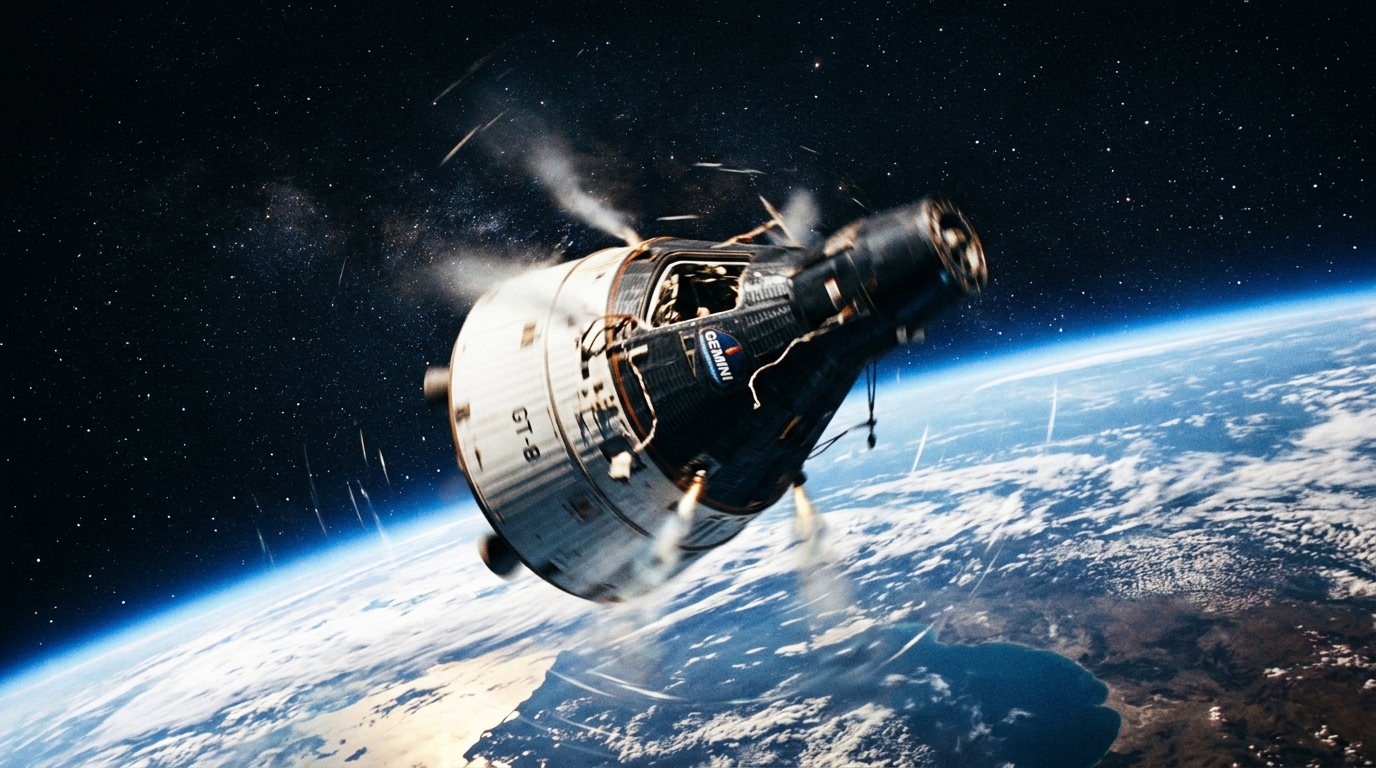
That day aboard Gemini 8, Neil Armstrong and David Scott had just accomplished an unprecedented feat: the very first orbital docking in space history, achieved with the target vehicle Agena. The achievement is hailed from the control center, engineers holding their breath as they witness a maneuver never before attempted. But the celebration is short-lived. Less than half an hour later, the assembly formed by the capsule and Agena begins to rotate and tumble uncontrollably, and what the two astronauts then experience will transform a triumphant mission into one of the tensest episodes in the history of the Gemini program.
- The No. 8 roll thruster of the OAMS system stuck in a continuous-firing position, not the Agena, was the origin of the uncontrolled rotation.
- Armstrong shut down the main control system and activated the reentry control to stabilize the craft, consuming 75% of its fuel.
- The mission ended with an emergency splashdown in the Pacific after only about ten hours of flight, instead of the planned three days.
- The successful docking that turned into a nightmare
- The diagnostic error that could have cost two lives
- Armstrong’s radical decision to stop the rotation
- An emergency splashdown that changed the rules of the space program
The successful docking that turned into a nightmare
Six hours and thirty-three minutes after liftoff from Launch Complex 19, the confirmation arrives: the rendezvous between Gemini 8 and Agena is a complete success. It marks a crucial milestone in American space exploration, since orbital rendezvous techniques would prove indispensable a few years later for the Apollo missions. Armstrong and Scott savor this historic moment, convinced the hardest part is behind them.
Yet, roughly twenty-seven minutes after this success, the crew feels the entire assembly begin to roll and yaw in an entirely unexpected manner. What had been a gentle oscillation rapidly escalates into a violent motion. The two men approach perilously close to the structural limits of their spacecraft, and worse still, to the threshold where they could lose consciousness from the rotation. The situation flips in a matter of seconds, with no warning that could have prepared them for such a scenario.
The diagnostic error that could have cost two lives
In the scramble, Armstrong makes a logical but heavy decision: he suspects the problem originates from Agena, the target vehicle still poorly understood and never tested in this configuration. He proceeds to undock, thinking to isolate the source of the malfunction. It proves to be exactly the opposite. Freed from the weight and inertia of Agena, Gemini 8 begins to rotate even faster, reaching the astonishing rate of one complete revolution per second.
The post-mission investigation would reveal the true origin of the problem: one of the roll thrusters in the OAMS, No. 8, had jammed in a continuous-fire position. In other words, it wasn’t Agena that was at fault, but the capsule itself, which, without anyone realizing it, was feeding one of its own attitude-control motors. A detail almost ironic, given that this misunderstanding led to a maneuver that worsened the situation rather than solving it.
Armstrong’s radical decision to stop the rotation
Faced with untenable rates of roll and yaw, Armstrong has no choice left. He shuts down the entire primary reaction-control system of Gemini, the very system intended to stabilize the craft but which had become the source of the trouble. Instead, he activates the two rings of the reentry-control system, normally reserved for the final phase of flight. It is a risky bet, since this system is not designed for such prolonged use, but it is the only option available to bring the rotation rates back to zero.
The maneuver works. At 18:06:30 local time, the craft finally regains stability. But the cost is steep: seventy-five percent of the reentry system’s fuel has been consumed to halt this uncontrolled drift. It is this almost instinctive decision, cutting the failing attitude jets to switch on those normally reserved for atmospheric entry, that literally saved the lives of the two men.
An emergency splashdown that changed the rules of the space program
Armstrong and Scott still hoped to press on with the mission, including the spacewalk Scott had planned to carry out, which would have marked another milestone for that flight. But ground control decides otherwise. With fuel reserves so substantially depleted, continuing would pose a risk far too great. The order comes during the seventh orbit: an immediate emergency splashdown in the western Pacific, as the mission—intended to last three days—ends after only about ten hours of flight.
The capsule breaches the water at 22:23 Eastern Time, on March 16. The two astronauts are recovered safe and sound by the destroyer USS Mason. The ensuing investigation never arrives at a single definitive cause for the thruster failure, but the most probable hypothesis points to an electrical short circuit triggered by a static discharge that continued to power the motor even after it had been switched off. This incident would leave a lasting mark on NASA engineers.
- Each thruster now receives an electrical circuit isolated from the others
- In-flight diagnostic procedures are strengthened to prevent misattribution of faults
- Contingency-fuel management becomes a major safety criterion for subsequent missions
Gemini 8 remains today a case study, frequently cited to illustrate the calm under pressure required when confronted with a technical surprise. This mission also revealed, well before Apollo 13, how fine the line can be between historic success and tragedy in space exploration. Armstrong, three years later, would set foot on the Moon, but it is perhaps within this capsule spinning at full speed that he demonstrated, for the first time to the world, his ability to stay composed when all seemed lost.
