
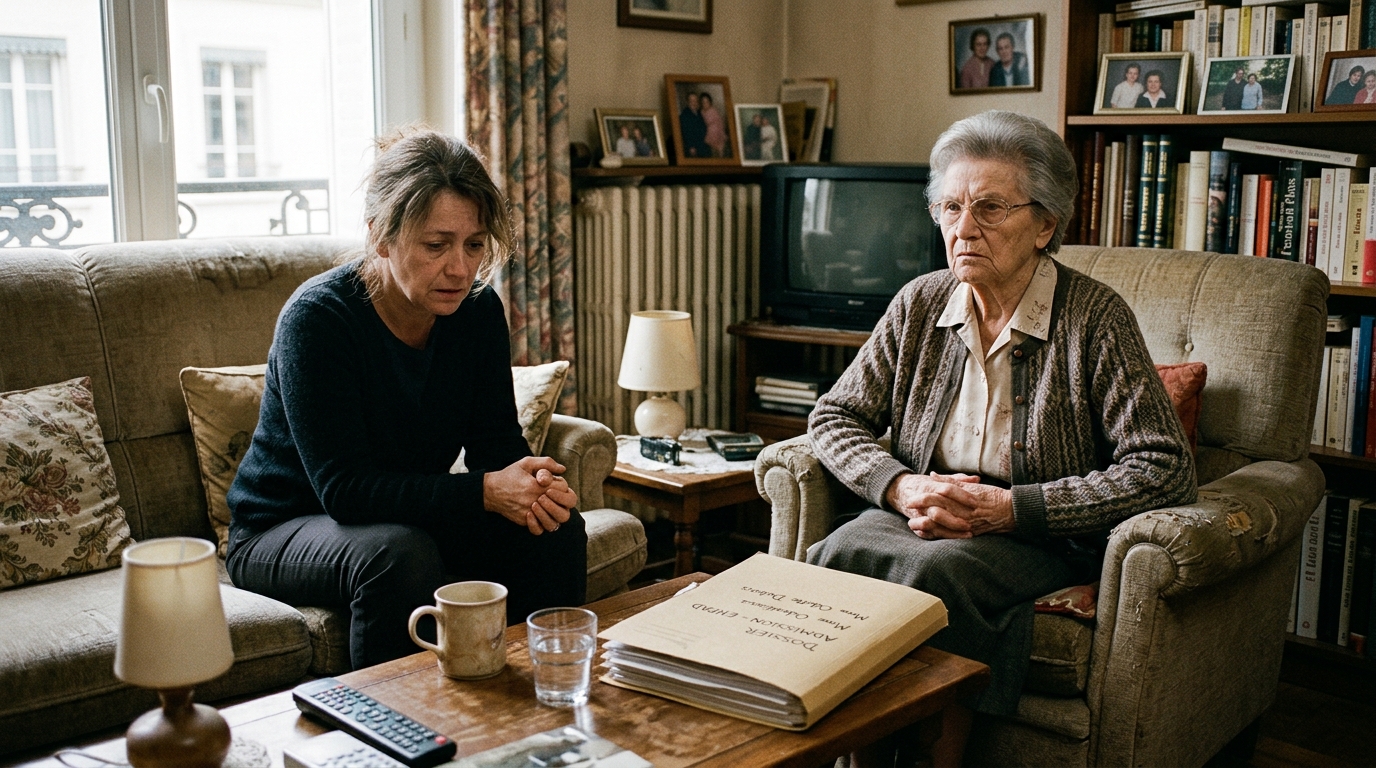
Because a care facility cannot, in principle, admit an elderly person without seeking their consent, even if their children have filled out and signed the admission paperwork on their behalf. This situation, lived by many families facing the gradual isolation of a parent, reveals a reality that is often little known: the decision to enter a care home (Ehpad) does not belong solely to relatives, no matter how well-intentioned they may be. Between the legitimate desire to protect a frail parent and respect for their own will, the boundary is sometimes thin, and the law ensures it is not crossed too quickly. A topic all the more sensitive as the loss of autonomy affects a growing number of French people, raising the question of the right balance between protection and freedom to choose one’s place of life.
- The consent of the elderly person remains essential for admission to a care home, even if their children have signed the admission paperwork
- The Code of Social Action and Families guarantees residents in care facilities the right to retain their fundamental rights, including the right to choose their place of residence
- Assessing the discernment capacity of an elderly person is not dependent on age, since 41.8% of those aged 85 and older are experiencing loss of autonomy versus 13.5% among those aged 75-84, according to INSEE
- Why the elderly person’s consent takes precedence over the family’s decision
- How discernment capacities are assessed before admission to a facility
Why the elderly person’s consent takes precedence over the family’s decision
Signing an admission form is not enough to open the doors of a facility. The Code of Social Action and Families indeed devotes an entire section to the rights of users of social and medico-social establishments, from Article L311-3 to L311-12, reminding that the resident retains their fundamental rights, regardless of age or situation. Concretely, this means that an elderly parent remains, except for legally defined exceptions, the sole decision-maker of their place of residence. The will of the children, however legitimate and well-intentioned it may be, does not automatically replace the parent’s own. A serious establishment is therefore required to verify that the admitted person has understood and accepted, within the limits of their abilities, this major life change, at the moment of signing the residency contract, which perhaps explains why some forms signed in urgency are suddenly called into question.
How discernment capacities are assessed before admission to a facility
Evaluating a senior’s ability to express an informed choice is not automatic. Age alone never determines the degree of discernment, and the statistics on loss of autonomy in France underscore the diversity of individual situations.
- 41.8% of people aged 85 or older are experiencing loss of autonomy, compared with 13.5% among those aged 75-84, according to INSEE.
- 670,000 seniors, or a third of elderly people with loss of autonomy, are in
