
- Ta’amra Bedouins discovered the first scrolls in Cave 1 in 1946–1947.
- Three scrolls were sold for 7 pounds, according to an unconfirmed reconstruction.
- Four scrolls were announced in the Wall Street Journal on June 1, 1954.
- Approximately 950 manuscripts were recorded in the region between 1949 and 1956.
A Tent Stake, 3 Scrolls and 7 Books
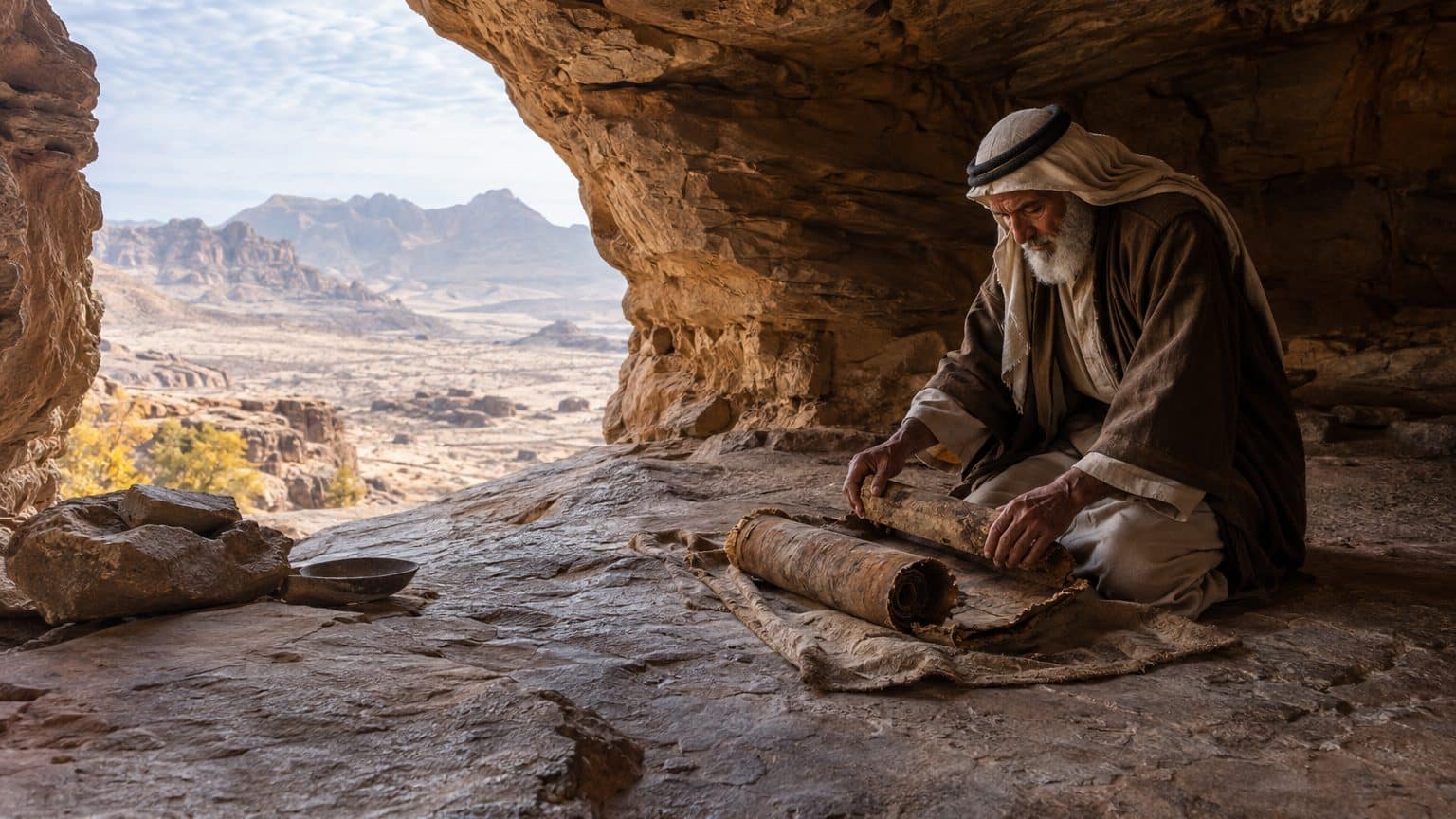
In 1947, by hanging the scrolls hauled from Cave 1 near Khirbet Qumrân on a tent stake, Ta’amra Bedouins literally left under a canvas shelter some of the oldest known copies of biblical texts. The Israel Museum attributes the discovery to this tribe and places it between 1946 and 1947.
A Bethlehem antiquarian judged them worthless.
Scholars call this site Cave 1 and mark its manuscripts with the siglum 1Q, hence references like 1QIsaiah for the Great Isaiah Scroll. The Biblical Archaeology Society dates the discovery from November 1946 to February 1947 and attributes it to Muhammed edh-Dhib Hassan, accompanied by at least two other Bedouins who were guarding sheep or goats near the Dead Sea. Accounts even waver on the animal. In March 1947, the Bedouins were already seeking a buyer.
According to the reconstructed narrative by John Trever, then director of the American Schools of Oriental Research in Jerusalem, and echoed by Wikipedia, 3 scrolls were sold for 7 pounds, about 28 dollars. That would amount to just over 2 pounds per scroll, roughly 9 dollars apiece. The conditional remains apt: this amount comes from a reconstruction, with no independent confirmation in the sources consulted.
Kando held two trades, shoemaker and antiquarian. Faced with a parchment of seemingly little historical value, at least the leather could be used to resole shoes. Yet the letters reminded him of the old Syriac script he had seen at the Orthodox Church of Bethlehem. He therefore sold 4 scrolls to Archbishop Samuel, head of the Syriac Orthodox Saint Mark Monastery in Jerusalem.
Two Lots, Two Destinies
Three more scrolls head toward the Hebrew University of Jerusalem. Eleazar Sukenik, a professor of archaeology, travels to Bethlehem to view them and discovers Hebrew manuscripts that the Israel Antiquities Authority says are more than a thousand years older than any biblical text known at the time. He acquires them in 1948, and they are housed at the university.
The other four cross the Atlantic.
Archbishop Samuel takes his four scrolls to the United States in 1948 according to the account used here, while the Israel Antiquities Authority places the departure in 1949, due to regional unrest, and mentions a Syriac church in New Jersey as the destination. Before this journey, the archbishop had invited Trever to study and photograph the manuscripts. Sukenik had been able to examine them in January 1948, thanks to a friend of Samuel who had brought them to him. The two lots, born from the same cave, thus end up separated by an ocean.
An Advertisement in the Miscellaneous Section
On June 1, 1954, the Wall Street Journal published the archbishop’s advertisement, categorized under the heading “Miscellaneous for Sale.” It offered 4 biblical manuscripts dating to at least 200 BCE, presented as an ideal gift for an educational or religious institution, and pointed readers to box F 206 of the newspaper.
Yigael Yadin, Sukenik’s son, happened to be in the United States for a tour of lectures when the notice appeared. He urgently wrote to Teddy Kollek, the chief of staff to the Israeli prime minister, to inform him that the scrolls were for sale. An intermediary answered the advertisement, because Yadin wanted to keep Israel out of the negotiations, for fear that Samuel would refuse. The purchase was eventually made, via an American intermediary, on behalf of the State of Israel.
The Jewish Link presents the front buyer as a New York businessman named Sydney Estridge. The purchase was arranged in secret on June 11, 1954, ten days after the publication. The return of the scrolls to Israel was announced only on February 13, 1955, more than eight months later.
From a Lot of 7 Scrolls to About 950 Manuscripts
The excavations would extend as far as Cave 11.
In August 1952, Bedouins discovered Cave 4, from which 80% of the manuscripts were said to have emerged, according to the Biblical Archaeology Society. The Palestine Archaeological Museum began purchasing them from Kando.
Between 1949 and 1956, fieldwork in the region yielded about 950 manuscripts, almost all in fragments. That is more than 130 times the original seven scrolls. Most are leather, a few are papyrus, notes the Gospel Coalition.
The superlative claim of the oldest copies rests with the Israel Antiquities Authority, which speaks of the oldest known copies of biblical texts. It describes the current state of the discoveries, not a definitive ranking. The Mar Samuel scrolls included a complete Book of Isaiah, a Habakkuk Commentary, the Community Rule, and an Aramaic text, the Genesis Apocryphon. The Sukenik scrolls contained a second Isaiah, the War Scroll, and the Hymns Scroll.
The amounts vary from account to account: World Archaeology cites 24 Palestinian pounds, about $100 at the time, for the purchase of the four scrolls by the archbishop. The four scrolls from the advertisement are today housed in Jerusalem, at the Israel Museum, whose Digital Dead Sea Scrolls site posts the discovery online.
Sources: world-archaeology.com | biblicalarchaeology.org
